Hermes
For the collector who appreciates timeless craftsmanship and understated luxury.
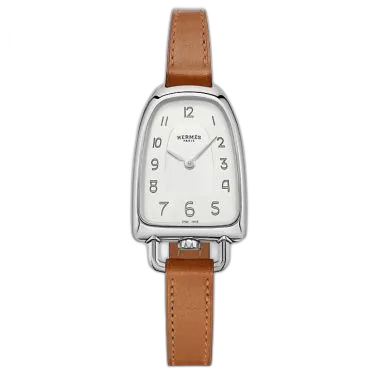
Founded in 1837 in France, Hermès is renowned for its exquisite craftsmanship and luxury accessories, particularly leather goods and fine watches. The brand positions itself within the heritage Swiss maison tier, appealing to those who value tradition and elegance in their timepieces.
Hermès has been a French leather-goods and luxury house since 1837, but its watchmaking only became a dedicated business in 1978 with the founding of La Montre Hermès in Biel, Switzerland. That later start shows in how directly its watch designs borrow from the house's other products: the Kelly takes its case detailing from the Kelly handbag's lock hardware, the Galop d'Hermès borrows from equestrian bit and cuff motifs, and the Faubourg leans into rectangular jewelry-watch proportions. Hermès has long partnered with Vaucher Manufacture for mechanical movements — the two houses share ownership ties — rather than building a large-scale in-house caliber program of its own. More recently, Hermès co-designed the Apple Watch Hermès collaboration, extending its design language into wearable tech. For buyers, Hermès competes with Cartier and Bulgari as a design-led, fashion-rooted luxury watchmaker rather than a horological specialist.
Country
France
Founder
Thierry Hermès
Positioning
luxury, fashion-adjacent
Main collections
Cut
$11,664
A 2023 unisex sport-chic release in a round steel case, a rare departure from Hermès's usual jewelry-watch styling toward everyday wearability.
Galop d'Hermès
$3,834
A cuff-inspired watch borrowing its stirrup and bit motifs from equestrian tack, wrapping the wrist rather than sitting on it like a conventional case.
Faubourg
$24,030
A rectangular jewelry watch in gold, prioritizing precious-metal case work and diamond setting over horological complications.
Kelly
$4,212
A watch that borrows its case-and-strap hardware directly from the Kelly handbag's iconic turn-lock closure.
Prices by collection
As of August 2026 — retail, before any market premium or discount
Unisex steel sport-chic case; sold at list, with no notable secondary-market activity.
Cuff-style bracelet watch; size and gem-setting drive most of the price spread.
A gold jewelry watch rather than a mechanical-complication piece; priced accordingly.
Bag-inspired case; gold and diamond-set versions sit toward the top.
The brand
About Hermès
Hermès had made watches on and off as a sideline since the 1910s and 1920s, but formalized the business in 1978 when Jean-Louis Dumas established La Montre Hermès in Biel, Switzerland. For nearly three decades afterward, its watches relied on outsourced quartz and automatic movements — the appeal was Hermès's design and materials, not manufacture credentials.
That changed from 2003, when Hermès began sourcing calibers from Vaucher Manufacture Fleurier, taking a 25% ownership stake in 2006. By 2012, six years of joint development produced the H1837 and H1912 automatic calibers — Hermès's first genuinely in-house mechanical movements, and proof that the house's watchmaking ambitions had outgrown its early decades as a design-only sideline.
Why Hermès matters
Hermès occupies an unusual seat among luxury watchmakers: almost nobody buys an Hermès watch expecting horological history, and that is precisely the point. The house leans on what it already does better than most watchmakers — leather. Straps are built in-house to the same standard as its handbags, and the Kelly, Galop d'Hermès, and Faubourg lines translate the maison's own leather-goods and equestrian icons directly into case and strap design rather than borrowing conventions from traditional watchmaking.
This design-first approach has made Hermès a genuine competitor to Cartier and Bulgari — fellow houses where design pedigree and materials craft matter as much as movement engineering. The 2015 Apple Watch Hermès collaboration extended that same design language into wearable tech, giving Hermès a foothold in smartwatches that none of its watchmaking-first peers can claim as convincingly.
Style, fit & buyer profile
Hermès's watch catalog splits cleanly by how much it borrows from the house's other product lines. The Kelly carries the turn-lock hardware from the 1935 Kelly handbag straight onto the case and clasp; the Galop d'Hermès wraps the wrist in stirrup and bit motifs from equestrian tack rather than sitting on it like a conventional case; and the Faubourg is a rectangular gold jewelry watch that prioritizes precious-metal case work and diamond setting over complications. The Cut, launched in 2023, is the outlier: a round steel, unisex sport-chic case built for everyday wearability rather than jewelry-watch presentation.
Buyers choosing Kelly or Galop d'Hermès want a watch that reads as fashion-house craft first; buyers choosing Faubourg want a jewelry watch that happens to tell time; and buyers choosing Cut want the Hermès name on something they can wear daily without ceremony. None of the four is competing on case-size range or movement complexity — the decision is almost entirely about which house icon speaks to you.
Price positioning
In the current 10h09 catalogue, Hermès spans a wide range depending on which design language you're buying into: the Galop d'Hermès starts around $2,760, the Kelly spans $2,940–$8,280 depending on case and strap, and the Cut and gold Faubourg sit higher still — the steel Cut at $7,820–$12,880 and the gold Faubourg at $16,560–$29,440 as a jewelry watch rather than a mechanical-complication piece. That spread is wider than most heritage Swiss houses because Hermès is pricing design and materials — leather, gold, diamonds — rather than movement tiers.
Against Cartier and Bulgari, its closest fashion-house competitors, Hermès holds a comparable position: buyers pay a premium for house design language and craftsmanship pedigree, not for in-house caliber complexity, though the Vaucher-built H1837 and H1912 movements mean that premium isn't purely cosmetic.
What sets Hermes apart
Hermès holds a stake in Vaucher Manufacture Fleurier, giving it access to genuine Swiss mechanical movements without operating a full-scale in-house caliber program.
Hermès designs, from the Kelly's turn-lock to the Galop's stirrup motif, translate the house's leather-goods and equestrian icons directly into watch case and strap design.
Since 2015, Hermès has co-designed straps and faces for the Apple Watch Hermès collaboration, extending its design language into smartwatch territory.