Hublot
For the individual who embraces boldness and innovation in luxury.
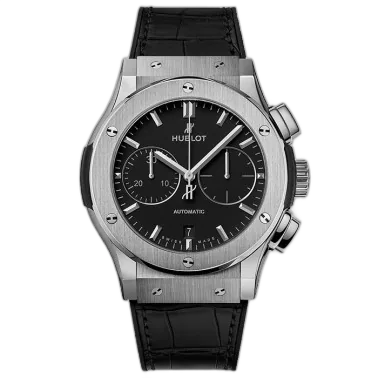
Founded in 1980 in Switzerland, Hublot is recognized for its bold designs and innovative material combinations, such as rubber and precious metals. The brand positions itself as a luxury option with a contemporary twist, appealing to those who value both performance and style in their timepieces.
Hublot, founded in 1980 by Carlo Crocco, built its identity on combining materials that watchmaking had kept separate — most famously gold cases on natural rubber straps, a pairing the brand markets as its "Art of Fusion." That identity stayed niche until the 2005 launch of the Big Bang, which relaunched Hublot as a bold, oversized sport-luxury brand and became one of the most visible sports-sponsorship watches of the following decade. Since being acquired by LVMH in 2008, Hublot has developed the in-house UNICO chronograph movement, used across the Big Bang Unico line, alongside a proprietary King Gold alloy that adds a small amount of platinum to standard 18k gold for a warmer tone. The Classic Fusion line offers a more restrained, dress-adjacent counterpoint to the Big Bang's scale, giving Hublot a genuine range beyond its loudest pieces.
Country
Switzerland
Founder
Carlo Crocco
Positioning
luxury, tool-watch
Main collections
Big Bang
$16,956
The 2005 launch that relaunched Hublot, mixing steel, ceramic, and rubber into an oversized case that became the brand's signature silhouette.
Big Bang Unico
$24,084
A Big Bang built around Hublot's in-house UNICO chronograph movement, with an open dial construction that shows off the caliber.
Classic Fusion
$13,068
A pared-back round case that softens Hublot's bold Big Bang identity into a dress-sport crossover watch.
Prices by collection
As of August 2026 — retail, before any market premium or discount
Mixed-materials case; ceramic references anchor the line, King Gold versions sit at the top.
In-house UNICO chronograph movement; sapphire and gold-cased versions sit well above the base ceramic references.
Hublot's more restrained line; titanium references anchor it, King Gold versions sit at the top.
The brand
About Hublot
Hublot was founded in 1980 in Geneva by Carlo Crocco, an Italian watchmaker who left his family's Binda Group, maker of Breil watches. His debut Classic model paired a gold case with a natural rubber strap — an unusual, initially controversial combination that gave the brand both its founding idea, 'the Art of Fusion', and its name: French for 'porthole', after the case's screwed bezel.
Hublot stayed a niche brand until Jean-Claude Biver, formerly of Blancpain, became CEO in 2004. The 2005 Big Bang combined ceramic, titanium, carbon fibre, and rubber in one oversized case and became an immediate commercial success, setting the template — bold material mixing, wide limited-edition variety, high-profile sports sponsorships — that still defines the brand.
Why Hublot matters
Hublot matters because it made material experimentation itself the marketing story, at a moment when most Swiss luxury brands were still selling restraint and heritage. Where a competitor might treat a sapphire case or a new gold alloy as a footnote, Hublot builds an entire release around it — its proprietary King Gold alloy adds a small amount of platinum to standard 18k gold for a noticeably warmer tone, and its sapphire-cased Big Bangs turn a technically difficult material into the headline feature rather than a limited curiosity.
That willingness to be loud is deliberate positioning against quieter luxury houses: Hublot competes for buyers who want their watch's engineering and boldness to be immediately legible, not discovered on close inspection. Owned by LVMH since 2008, the brand backs that identity with real manufacturing — its own UNICO chronograph movement, built at Hublot's Nyon manufacture, rather than relying purely on outsourced calibers to support the marketing.
Style, fit & buyer profile
The Big Bang is Hublot's signature and its most direct expression of the brand's material-mixing identity: an oversized, multi-material case that reads as unmistakably Hublot from across a room. The Big Bang Unico builds on that same case around the in-house UNICO chronograph movement, with an open dial construction that puts the caliber itself on display rather than hiding it under a solid dial.
The Classic Fusion is the line for buyers who want Hublot's manufacturing pedigree without the Big Bang's scale: a pared-back round case that softens the brand's boldest instincts into a genuine dress-sport crossover. Buyers choosing Big Bang or Big Bang Unico want a watch that announces itself; buyers choosing Classic Fusion want the same movement quality with far less visual noise.
Price positioning
In the current 10h09 catalogue, Hublot's Big Bang runs roughly $9,660 to $25,760 depending on case material, with ceramic references anchoring the line and King Gold versions at the top. The Big Bang Unico, built around the in-house UNICO chronograph movement, runs higher still at $15,640 to $41,400, while the more restrained Classic Fusion spans $5,520 to $23,000, anchored by titanium references with King Gold versions again topping the range.
That pricing places Hublot alongside TAG Heuer and Omega in bold sport-luxury territory, with its King Gold and sapphire-cased versions pushing well past its ceramic and titanium entry references.
What sets Hublot apart
Hublot's founding philosophy of combining materials watchmaking had kept separate — most famously gold cases on natural rubber straps — remains the throughline across its modern catalog.
The UNICO is Hublot's in-house automatic chronograph caliber, built with a modular column-wheel construction and used across the Big Bang Unico line.
Hublot's proprietary King Gold alloy adds a small amount of platinum to standard 18k gold, producing a warmer, more reddish tone than typical rose gold.
Browse all 25 references
- Classic Fusion Chronograph — 521NX1171LR
- Classic Fusion Racing Grey — 521NX7071LR
- Big Bang Steel Ceramic — 301SB131RX
- Classic Fusion Aerofusion — 525NX0170LR
- Big Bang Original Black Magic — 301CM130RX
- Big Bang Unico — 421NX1170RX
- Big Bang Unico — 421NL5170RX
- Big Bang Unico — 421NM1170RX
- Big Bang Meca-10 — 414NI1123RX
- Big Bang Meca-10 — 444NX1170RX
- Big Bang UNICO Mint Green — 441.GS.5221.RX
- Big Bang UNICO Petrol Blue — 441.ES.5121.RX
- Big Bang Unico Dark Green — 441GX5210RX
- Big Bang Meca-10 — 414EX5123RX
- Classic Fusion Racing Grey — 511OX7081LR
- Classic Fusion Blue King Gold — 511OX7180LR
- Big Bang Meca-10 — 444QN1170NR
- Big Bang Unico Yellow Magic — 421CY471YRX
- Big Bang Unico Orange — 441CU5910RX
- Big Bang Unico Golf — 416YS1120VR
- Big Bang Unico Golf — 416YT1120VR
- Classic Fusion Blue Chronograph — 521OX7180LR
- Big Bang Meca-10 — 444OX1180RX
- Big Bang Unico Sapphire — 441JX4802RT
- Big Bang Unico Green SAXEM — 441JG4990RT