Raymond Weil
For those who appreciate style without ostentation.
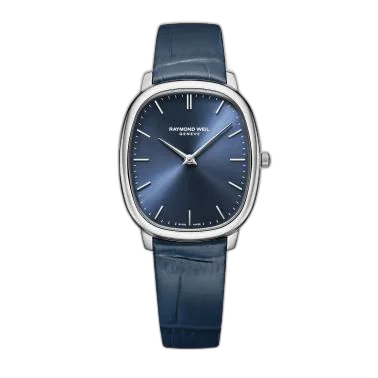
Founded in 1976 in Switzerland, Raymond Weil is known for its elegant Swiss watches that blend tradition with modern design. Operating as an independent watchmaker, it caters to a mid-range market, focusing on accessible luxury for discerning buyers.
Raymond Weil is an independent Geneva watchmaker founded in 1976 by its namesake, Raymond Weil, and remained family-run for decades — a rarity among Swiss brands of its size, most of which belong to large groups. Its watches rely on Swiss-sourced ETA-based movements rather than in-house calibers, which keeps pricing in line with brands like Longines and Tissot rather than higher-tier independents. The Millesime line, the brand's largest, channels Art Deco-influenced dress-watch proportions, while the Toccata line targets an even more accessible entry price for buyers new to Swiss watches. Raymond Weil's positioning is straightforward: dependable Swiss dress watches without the movement-development story that brands like Frédérique Constant or Chopard lean on.
Country
Switzerland
Founder
Raymond Weil
Positioning
premium, dress-watch
Main collections
Millesime
$2,430
Raymond Weil's largest line, built around Art Deco-influenced dress-watch proportions and a fluted bezel detail.
Millesime Chronographe Tri-Compax
$4,563
A tri-compax chronograph variant of the Millesime, adding three sub-dials to the line's Art Deco-influenced case.
Toccata Heritage
$1,782
The brand's most accessible line, offering a simple round dress case aimed at first-time Swiss watch buyers.
Prices by collection
As of August 2026 — retail, before any market premium or discount
Art Deco-styled dress line; typically discounted well below list at retail.
Tri-compax chronograph version of Millesime; sits at the top of the family-owned brand's range.
Raymond Weil's most accessible round dress reference.
The brand
About Raymond Weil
Raymond Weil founded the company in 1976 at age 50, after 27 years as general manager of the Camy Watch Company. He launched it deliberately committed to mechanical Swiss watchmaking at a moment when much of the industry was pivoting hard to quartz during the crisis years.
A devoted classical music fan, Weil named his collections after operas and compositions he loved — Parsifal, Nabucco, Fidelio, Toccata — an unusually personal way for a watch brand to build a naming identity, carried forward in newer lines like Freelancer and Maestro.
Why Raymond Weil matters
Raymond Weil matters because it's one of the few mid-size Swiss watch brands that never sold out to a group — still family-owned since Weil's son-in-law joined in 1982 and helped professionalize the company, in an industry where most brands of similar size and vintage now answer to Swatch Group, Richemont, or LVMH. That independence shows up as consistency rather than innovation: no group-mandated pivots, no shared movement platforms dictated from above.
The brand's positioning is deliberately straightforward: dependable Swiss dress watches built on proven ETA-based movements, without the in-house-manufacture story that brands like Frédérique Constant or Chopard lean on to justify similar or higher pricing. For buyers, that means paying for genuine Swiss assembly and design rather than for a caliber-development narrative.
Style, fit & buyer profile
The Millesime is Raymond Weil's largest line and its clearest style statement: Art Deco-influenced dress-watch proportions with a fluted bezel, aimed at buyers who want a classic round dress case with a bit more visual character than a plain three-hander. The Millesime Chronographe Tri-Compax builds on that same case with three sub-dials, adding chronograph function without abandoning the Art Deco detailing.
The Toccata Heritage strips things back to a simple round dress case at the brand's most accessible price, aimed squarely at buyers taking their first step into Swiss watch ownership. Buyers choosing Millesime want Art Deco character; buyers choosing the Tri-Compax want that same character with a working chronograph; buyers choosing Toccata Heritage want the lowest-friction way into the brand.
Price positioning
In the current 10h09 catalogue, the Toccata Heritage is the entry point at €1,290–€2,120, the Millesime sits in the middle at €1,750–€3,040, and the Millesime Chronographe Tri-Compax tops the range at €3,310–€5,150 as the family-owned brand's most complicated reference.
That range sits close to Longines, the Swiss competitor Raymond Weil is most often measured against — both rely on ETA-based movements rather than in-house calibers, but Longines carries nearly two centuries of heritage and Swatch Group backing, while Raymond Weil offers a narrower, independently run catalogue at a broadly similar price.
What sets Raymond Weil apart
The Millesime line's fluted bezel and elongated dial proportions draw directly on Art Deco design language, giving Raymond Weil a distinct visual identity within accessible Swiss dress watches.
Founded in Geneva in 1976, Raymond Weil remained family-run for decades, a structure that is unusual among Swiss watch brands of its size, most of which belong to larger groups.
By relying on proven Swiss-sourced ETA-based movements rather than developing its own in-house calibers, Raymond Weil keeps pricing competitive with brands like Longines and Tissot.
Browse all 13 references
- Toccata Héritage — 5280-STC-50001
- Toccata Héritage — 2280-STC-50001
- Millesime — 2125-STC-65001
- Millesime — 2925-STC-50001
- Millesime — 2925-ST-60011
- Millesime — 2130-STC-60521
- Millesime Petite Seconde — 2130-STC-65001
- Millesime — 2930-STC-50011
- Millesime Phase de Lune — 2945-STC-65001
- Millesime Phase de Lune — 2145-PC5-05650
- Millesime — 2130-C5S-64001
- Millesime Chronographe Tri-Compax — 7765-STC-60651
- Millesime — 7765-STC-20001