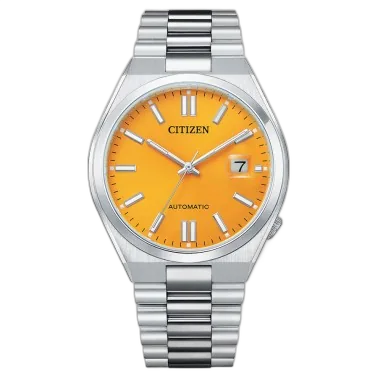
Best Integrated-Bracelet Sports Watches Under €2,000
An integrated-bracelet watch is not simply a watch on a steel bracelet. The bracelet is designed as part of the case, usually with a proprietary attachment, and often with no conventional strap option at all. That architecture is the whole appeal — and the whole fit problem, because the fixed first links extend the watch across your wrist well beyond the case itself. This guide compares current integrated-bracelet sports watches with official EUR pricing under €2,000, judged on construction, bracelet finishing, clasp adjustment and effective length rather than on how closely they resemble a Royal Oak. The Tissot PRX is the benchmark and deserves to be. It is not automatically the winner.
Start with the Tissot PRX Powermatic 80 — €775, 10.93 mm thick, 100 m, an 80-hour Swiss automatic — in 40 mm for most wrists and 35 mm if yours is slim. The best alternative to it is Christopher Ward’s The Twelve: 9.95 mm tall, 43.30 mm lug-to-lug at 38 mm, a bracelet that tapers 23 mm to 17 mm with 3 mm of clasp micro-adjustment, and a quick-release system that actually lets you fit a strap. Buy the Citizen Series 8 if you want the strongest technical case, the Tsuyosa if you want in under €500, and the Zenshin 60 if you want the lightest watch on a larger wrist.
Cyril Favre12 min read
The best integrated-bracelet sports watches under €2,000, compared
Information checked September 2026 on each maker’s own product page for the exact reference named. Citizen publishes no price on its European product pages, so its official US price is shown and labelled as such; each converts to well under €2,000, and European retail differs. Where a maker does not publish a figure, the cell says so — none of these numbers is an estimate.
Watch and reference
Price
Diameter
Thickness
Lug-to-lug
Movement
Water resistance
Best for
Tissot PRX Powermatic 80 40 (T137.407.11.041.00)
€775
40 mm
10.93 mm
Not published
Powermatic 80 automatic
100 m
The benchmark
Tissot PRX Powermatic 80 35 (T137.207.11.041.00)
€775
35 mm
10.93 mm
Not published
Powermatic 80 automatic
100 m
PRX styling on a slim wrist
Tissot PRX Quartz 40 (T137.410.11.031.00)
€395
40 mm
10.40 mm
Not published
Quartz
100 m
Cheapest way into the look
Christopher Ward The Twelve 38 (C12-38ADA1-S00B0-B0)
€1,425
38 mm
9.95 mm
43.30 mm
Sellita SW200-1
100 m
Best overall alternative
Christopher Ward The Twelve 36 (C12-36A3H1-S00B0-B0)
€1,425
36 mm
9.95 mm
40.80 mm
Sellita SW200-1
100 m
Smallest wrists
Citizen Series 8 (NB6080-51W)
$1,095 (US)
39.85 mm
10.4 mm
Not published
Citizen 9051 automatic
100 m
Best technical proposition
Citizen Tsuyosa (NJ0150, dial refs -81Z / -56E)
$495 (US)
40 mm
Not published
Not published
Citizen 8210 automatic
50 m
Best under €500
Citizen Zenshin 60 (NK5020-58L / -58M)
$775 (US, -58M)
40 mm
11 mm
Not published
Citizen 8322 automatic
100 m
Larger wrists, lightest
Christopher Ward is the only brand here that publishes lug-to-lug, which is why The Twelve is the one watch in this guide you can size with confidence before it arrives. That is not a small advantage in a category where the published diameter tells you least.
What an integrated bracelet actually means
The definition is architectural, not decorative. On an integrated-bracelet watch the bracelet is engineered as part of the case: the first links are shaped to the case flanks, the attachment is usually proprietary, and there are often no conventional lugs or spring-bar spacing to work with. Citizen describes the Tsuyosa bracelet as seamlessly integrated and publishes a 9.1 mm lug width — a number that exists to tell you no normal strap will fit there. A sports watch on an ordinary tapered bracelet is not in this category, however closely it hugs the case.
The consequence is effective lug-to-lug. On a conventional watch, the case ends and a flexible strap begins. Here, the first link or two is rigid and case-shaped, so the watch behaves as though it were longer than its published case length — and no maker publishes that effective figure. Christopher Ward publishes 43.30 mm lug-to-lug for The Twelve 38 and 40.80 mm for the 36; Tissot publishes a lug width for the PRX but no length; Citizen publishes neither. Treat the published diameter as a starting point, measure the flat top of your wrist, and where the numbers are close, try the watch on.
Two other things separate a good integrated bracelet from a merely attached one. Taper is the first: a bracelet that narrows sharply toward the clasp drapes and disappears, while a slab of constant width sits on the wrist. Clasp micro-adjustment is the second, and it matters more here than anywhere else, because you cannot simply swap to a strap when the fit lands between links. Finishing is where the money shows — the transition from case flank to first link is the hardest surface in watchmaking to get right, and it is exactly where a cheaper watch gives itself away.
The benchmark: Tissot PRX
Verdict: the watch that made this category accessible, and still the default first purchase in it. Tissot publishes 40 mm diameter and 10.93 mm thickness for the Powermatic 80 reference T137.407.11.041.00 at €775, with a Nivachron balance spring, an 80-hour power reserve, 100 m water resistance, a sapphire crystal with anti-reflective treatment, a display caseback, and a butterfly clasp on a steel bracelet with Tissot’s quick-change interchangeable system. The 35 mm Powermatic 80, reference T137.207.11.041.00, is the same price and the same 10.93 mm thickness. The quartz 40 mm, reference T137.410.11.031.00, is €395 and 10.40 mm. Rubber-strap versions of the Powermatic 80 cost less than the steel-bracelet references quoted here.
35 mm or 40 mm is a fit decision, not a gender one, and it is the only decision worth agonising over here. The 40 mm PRX has broad, flat case flanks and a bracelet that keeps its width a long way out, so it reads larger than 40 mm and needs a reasonably flat wrist to sit properly. The 35 mm keeps the same thickness and the same movement, which means it is proportionally taller for its width but far shorter across the wrist. If your wrist is round rather than flat, or under roughly 16.5 cm, start with the 35 mm and only move up after trying both.
Watch out for: Tissot publishes a lug width but no lug-to-lug for either size, so you are buying the length blind. The Powermatic 80 is accurate enough but not a chronometer, and the butterfly clasp has no micro-adjustment — with half-links your only recourse, fit is coarser than the price suggests. Avoid it if you want a bracelet that feels above its price; the PRX’s value is in the package, not in its finishing, and that is precisely where the alternatives below make their case. If you are weighing the PRX against a conventional field watch rather than against another integrated design, our PRX 35 versus Hamilton Khaki Field 38 comparison is the more useful read.
Featured in this article
Tissot · ~$800
PRX
The benchmark: 40 mm, 10.93 mm thick, 100 m and an 80-hour Swiss automatic for €775 on the steel bracelet.
Featured in this article
Tissot · ~$840
PRX Powermatic 80
Same movement, same 10.93 mm height, far shorter across the wrist — the PRX for a slimmer wrist.
Christopher Ward The Twelve — best overall alternative
Verdict: the alternative that beats the PRX on every measure except price. Best for the buyer who cares about bracelet execution and wants to know what they are buying before it arrives. Christopher Ward publishes 9.95 mm height for both the 38 mm and 36 mm versions, with 43.30 mm and 40.80 mm lug-to-lug respectively, a Sellita SW200-1 with a 38-hour reserve, 100 m water resistance, anti-reflective sapphire, and a marine-grade steel bracelet at €1,425 on the bracelet; rubber-strap configurations cost less. The 38 mm tapers from 23 mm to 17 mm; the 36 mm from 22 mm to 17 mm.
Why it earns its place: the bracelet is the answer to everything the PRX leaves coarse. It uses screw links rather than pins, tapers hard, and its butterfly clasp carries micro-adjustment of up to 1.5 mm per side — 3 mm in total — which is the difference between a bracelet that fits and one that nearly fits. The integrated ends are compatible with Christopher Ward’s quick-release system, so rubber straps are a genuine option rather than a theoretical one. At 9.95 mm it is the thinnest watch in this guide, and the twelve-sided bezel is a real design idea rather than an octagon borrowed from 1972.
Watch out for: the Sellita SW200-1 gives 38 hours of power reserve against the PRX’s 80, which is a real weekend-off-the-wrist difference, and at €1,425 it is nearly twice the PRX’s price. Christopher Ward sells direct, so trying one on before ordering is harder than walking into a Tissot dealer. Fit guidance: the 36 mm at 40.80 mm lug-to-lug is the shortest watch in this guide by a wide margin and the clearest recommendation for a genuinely small wrist; the 38 mm at 43.30 mm suits most wrists from about 16 cm upward. Some configurations ship to pre-order rather than from stock — check the exact reference at checkout.
Featured in this article
Christopher Ward · ~$1,250
The Twelve
9.95 mm tall, 43.30 mm lug-to-lug, a 23-to-17 mm taper and 3 mm of clasp micro-adjustment.
Featured in this article
Christopher Ward · ~$1,550
The Twelve
At 40.80 mm lug-to-lug it is the shortest watch in this guide, and the clearest answer for a small wrist.
Citizen Series 8 — best technical proposition
Verdict: the most substantial watch here for the money, and the one that owes nothing to 1970s Geneva. Best for the buyer who wants a genuinely different design and cares about what the movement does. Citizen’s European page for reference NB6080-51W publishes 39.85 mm diameter and 10.4 mm height, the in-house calibre 9051 with 42 hours of reserve and a rated accuracy of −10/+20 seconds a day, an antimagnetic construction, 100 m water resistance, an anti-reflective sapphire crystal and a solid steel bracelet; its US site adds the integrated H-link construction and a fold-over clasp with hidden push buttons, at $1,095.
What it does better than the PRX: the movement. A 16,000 A/m magnetic rating and a specified daily rate are things Tissot does not claim at this level, and the case and bracelet finishing — sharp brushed flanks, polished chamfers running into the first link — sits closer to The Twelve than to the PRX. The design is its own: an angular case with an asymmetric crown guard and a dial architecture that looks Japanese rather than Genevan. What it does worse: a 42-hour reserve against 80, and no published lug-to-lug at all, which in this category is the specification that matters most.
Watch out for: Citizen does not publish a European price for this reference, so the figure above is its official US price. Avoid it if you need to know the length before ordering, or if an 80-hour reserve is the reason you were looking at the PRX in the first place.
Featured in this article
Citizen · ~$970
Serie 8
In-house calibre 9051, 16,000 A/m magnetic resistance and an integrated H-link bracelet that owes nothing to 1972.
Citizen Tsuyosa and Zenshin 60 — the cheapest and the lightest
The Tsuyosa is the way into this category on the smallest budget. Citizen’s European page for reference NJ0150-81Z publishes 40 mm diameter, the calibre 8210 with a 40-hour reserve and an accuracy of ±20 seconds a day, 50 m water resistance, an anti-reflective sapphire crystal and a steel bracelet; its US page describes the bracelet as seamlessly integrated, publishes a 9.1 mm lug width and lists the watch at $495. Best for the buyer who wants the architecture and a mechanical movement for the price of a quartz watch. What to watch out for: 50 m is the weakest water resistance here, Citizen publishes no case height for it, the finishing is honest rather than refined, and that 9.1 mm attachment means no strap alternative exists at all.
The Zenshin 60 is the pick for a larger wrist and anyone who dislikes weight. Citizen’s European page for reference NK5020-58L publishes 40 mm diameter and 11 mm height, a Super Titanium case and solid Super Titanium bracelet, the calibre 8322 with a 60-hour reserve, 100 m water resistance, a scratch-resistant sapphire crystal, a twelve-sided bezel and a total weight of 100 g; Citizen’s US site lists the matching NK5020-58M at $775 and describes the bracelet as integrated, and it was showing as temporarily out of stock there at the time of checking. Best for the buyer who wants a full-size integrated watch that weighs almost nothing. Avoid it if you need an accurate daily rate — Citizen quotes −20/+40 seconds a day, the loosest specification in this guide.
A mechanical integrated-bracelet watch with a sapphire crystal at the price of a quartz one.
Featured in this article
Citizen · ~$540
Super Zenshin
Super Titanium case and bracelet, calibre 8322 with a 60-hour reserve — the lightest watch in this guide.
What we excluded, and why
This category is smaller than the marketing suggests. Several names that turn up on every list of PRX alternatives did not survive the rules we set for this guide: Frederique Constant’s Highlife Automatic COSC 39 mm is the closest miss on merit but sits well above €2,000 at its official price; Maurice Lacroix’s Aikon Automatic 39 mm could not be verified on a working official product page, and its Swiss-franc price would sit near the cap even if it could; Michel Herbelin’s Cap Camarat is listed by retailers but the brand’s own site is no longer live. We did not fill the gaps with third-party specification pages, and we did not use a discounted street price to bring anything under the cap.
Choose yours
Start with wrist shape, because this category punishes the wrong call harder than any other. A flat, wide wrist carries the PRX 40, the Series 8 or the Zenshin 60 comfortably. A round or narrow wrist needs a short watch, and the only two here with a published length are The Twelve 36 at 40.80 mm and The Twelve 38 at 43.30 mm. If you cannot try before you buy, that published figure is worth paying for.
Then decide what you are paying for. If it is power reserve and dealer access, the PRX is the answer and nothing here displaces it. If it is finishing and a bracelet that adjusts properly, The Twelve is worth the difference. If it is the movement specification, the Series 8. If it is the lowest possible entry price for a mechanical integrated watch, the Tsuyosa, provided you accept 50 m and no strap option. If it is weight, the Zenshin 60. And if the ability to change straps matters to you at all, be honest about it early: only The Twelve and the PRX offer a real quick-release system, and on the Tsuyosa a 9.1 mm attachment closes the question entirely.
Where two of these are close on paper, the bracelet decides it, and the bracelet is the part you cannot judge from a photograph. Take the seven-question quiz to find integrated-bracelet watches matched to your wrist, your budget and the way you actually wear a watch.
“The case size is not the size. The fixed end links are.”
FAQ
What is an integrated-bracelet watch?
One where the bracelet is engineered as part of the case rather than attached to it. The first links are shaped to continue the case lines, the attachment is usually proprietary, and there is often no conventional lug or spring-bar spacing at all — Citizen publishes a 9.1 mm lug width for the Tsuyosa, which is another way of saying no standard strap fits. A sports watch on an ordinary steel bracelet is not in this category, however tightly the bracelet hugs the case.
Is the Tissot PRX still the one to beat?
On value, yes. At €775 for the Powermatic 80 you get an 80-hour Swiss automatic, 100 m, sapphire and a dealer network, and nothing here matches that combination for the money. On execution, no. Christopher Ward’s The Twelve is thinner at 9.95 mm, publishes its lug-to-lug, tapers its bracelet harder and gives you 3 mm of clasp micro-adjustment the PRX simply does not offer. The PRX is the right default; it stops being the right answer the moment bracelet fit or finishing is what you actually care about.
Do integrated bracelets work on small wrists?
They can, but the published diameter will mislead you. Because the first links are rigid and case-shaped, the watch reaches further across the wrist than its case length suggests, and almost no maker publishes that effective length. The practical approach is to prefer watches whose lug-to-lug is published — The Twelve 36 at 40.80 mm and The Twelve 38 at 43.30 mm are the only two here — measure the flat top of your wrist rather than its circumference, and treat anything unpublished as a try-on. The Tissot PRX 35 is the other sound starting point, but you are buying its length blind.
Can you put a strap on an integrated watch?
Sometimes, and it depends entirely on the model. Tissot builds a quick-change interchangeable system into the PRX, and Christopher Ward’s The Twelve has integrated ends compatible with its own quick-release system and optional rubber straps — in both cases the replacement is a proprietary part shaped to the case, not a strap off a shelf. At the other extreme, the Citizen Tsuyosa publishes a 9.1 mm lug width, which rules out every conventional strap. If strap changing matters to you, confirm it for the exact reference before you buy; it is not a category-wide property.
How should an integrated bracelet fit?
Snugger than you would wear a conventional bracelet, and with the case sitting flat rather than rocking. Because the first links do not flex, a loose integrated bracelet lets the whole watch pivot, which is what makes these designs feel top-heavy when they are badly sized. That is why clasp micro-adjustment matters more here than on any other kind of watch: The Twelve offers 3 mm in total, while the PRX gives you half-links and nothing finer. Size it so the case stays put when you turn your wrist over, and expect to spend time getting there.
Tissot PRX Powermatic 80 35 or Hamilton Khaki Field Auto 38: how case size, styling, and everyday practicality decide the better first mechanical watch.
Leather, rubber, or metal — the right watch strap depends on your climate, routine, and formality needs. Here's how each material actually performs day to day.
Five smart first watches under €1,000 — a field watch, an all-rounder, a GMT, a design pick, and a diver. Chosen for fit, versatility, and low ownership regret.
Seven everyday watches under €2,500 that handle daily life without fuss — and still feel right five years from now. From the Tissot Gentleman to the Seiko SPB453.
July 9, 2026
Find yours
Know what kind of buyer you are. We'll find the right watch.
A few questions. A considered shortlist. No algorithm slop.