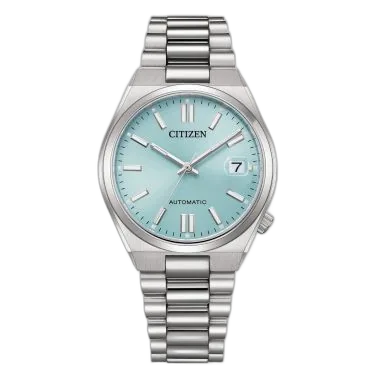
An integrated bracelet makes the case and bracelet look like one continuous shape. That's the attraction, but it's also the sizing complication: a rigid first link can carry the watch farther across your wrist before the bracelet begins to wrap around it. Buy for that shape on your wrist, not for a diameter that sounds safe on paper.
Start with the Tissot PRX 35 quartz if you want a slim, low-commitment integrated-bracelet watch; choose the PRX Powermatic 80 35 if you want the same angular design with a mechanical movement. Choose the Citizen Tsuyosa 37 for an affordable automatic with a softer look, or Christopher Ward's The Twelve 36 if fine bracelet adjustment and a more detailed case matter enough to spend more. The current Tudor Royal 36 is the higher-budget choice for a dressier design and an adjustable clasp. None is a guaranteed fit by diameter alone: the first bracelet links must turn down within the flat width of your wrist.
Two separate measurements decide whether an integrated-bracelet watch works on a small wrist: how far its rigid first links carry the case across your skin, and how well the rest of the bracelet then wraps around it.
Look at your wrist from above and find the relatively flat area where the watch head sits. On a watch with conventional lugs, the strap typically turns downward close to the case. On an integrated-bracelet watch, the first links can continue outward before they start to articulate — and if that rigid section reaches beyond the flat part of your wrist, removing links at the clasp will tighten the watch without fixing the overhang.
Don't treat a published case length or a conventional lug-to-lug figure as the watch's effective span on its bracelet. Time and Tide measured the Tissot PRX 35's fixed first bracelet link at roughly 44.7 mm across, well beyond its 39 mm case-only lug-to-lug. That's a useful warning about how integrated bracelets read on paper, not a universal wrist-size cutoff.
Then check drape and adjustment
Beyond that rigid span, a bracelet should turn down around the sides of your wrist without leaving straight, unsupported sections. Short removable links get you close to the right circumference; clasp adjustment lets you fine-tune it from there. Ask how small the bracelet can actually be sized, whether the clasp stays centered, and whether there's room for normal changes in wrist size through the day — don't assume a watch fits just because a seller can remove another link.
Case shape and height matter too. A broad, flat case can occupy more visible wrist than a rounder one of similar width, and a thicker case can feel less settled even on a bracelet that otherwise fits. If you expect to change the look, or want an escape route from the steel bracelet, check the exact watch's compatible strap system before buying — an integrated connection doesn't imply a standard, easily interchangeable strap.
The watches worth choosing
Five watches are worth comparing on those terms: rigid-link span, bracelet adjustment, and what you get for moving up in price.
Tissot PRX 35 quartz: the simplest starting point
Best for: someone who wants the PRX's crisp, angular design and a slimmer, fuss-free watch rather than a mechanical movement.
The silver-dial PRX 35 quartz, reference T137.210.11.031.00, puts a Swiss quartz movement in the compact PRX case with a quick-release steel bracelet. It's the first model to try if the design is the draw: you can judge whether its continuous case-to-bracelet line suits your wrist without paying for an automatic movement you may not value. Tissot lists a 9.6 mm case thickness and 100 m water resistance for this line.
Watch-outs: its first bracelet link is fixed. A Time and Tide hands-on review measured about 44.7 mm across the case and fixed-link assembly on the PRX 35 quartz — so the ‘35’ in its name isn't the whole fit story. Its butterfly clasp also makes precise sizing more dependent on the removable links than on-the-fly adjustment. Try it fastened and viewed from above, rather than judging an unfastened watch held against your wrist.
Featured in this article
Tissot · ~$430
PRX
The slimmest, simplest way to try the PRX shape — no movement trade-off to think about.
Citizen Tsuyosa 37: the affordable automatic with a softer look
Best for: a buyer who wants a mechanical integrated-bracelet watch but finds the PRX's straight-edged design too severe.
The Ice Blue Tsuyosa 37, reference NJ0200-50L, uses Citizen's automatic calibre 8210 and pairs a rounded steel case with a matching bracelet, a date, and a sapphire crystal. It's the budget-conscious mechanical choice here when its shape appeals to you more than the PRX's flat planes. Fratello's hands-on coverage of this generation describes a push-button folding clasp adjustable across three tool-set positions — a genuine fine-tuning option, distinct from a clasp with no adjustment at all.
Watch-outs: a smaller case doesn't establish how the first links sit on your wrist — check this exact reference on the bracelet you intend to buy rather than assuming another Tsuyosa colorway measures the same. Its 50 m water resistance is also lower than the 100 m rating on the PRX and Twelve covered here.
Featured in this article
Citizen · ~$320
Tsuyosa
A rounder, more affordable automatic with genuine clasp fine-tuning.
Tissot PRX Powermatic 80 35: the angular mechanical choice
Best for: someone already sure they want the PRX shape, but who wants an automatic movement and a longer power reserve than the Tsuyosa provides.
The blue-dial reference T137.207.11.041.00 keeps the PRX's 35 mm architecture and adds the Powermatic 80 automatic movement, a textured dial and an exhibition back. Tissot specifies up to 80 hours of power reserve, a 10.93 mm case thickness and 100 m water resistance.
Watch-outs: paying for the movement doesn't make the bracelet more adaptable. Hodinkee's hands-on review of this size describes roughly the same short-link construction as the quartz PRX — a case-only lug-to-lug well under its effective wearing length, and no clasp micro-adjustment. If the quartz PRX's rigid span misses your wrist, this isn't a fit upgrade just because it's mechanical.
Featured in this article
Tissot · ~$840
PRX Powermatic 80 35mm
Same fixed-link case as the quartz PRX, with an 80-hour automatic movement.
Christopher Ward The Twelve 36: for a more tunable bracelet
Best for: a buyer willing to spend more for a sharply finished, date-free automatic whose bracelet offers small fit adjustments.
The white-dial steel Twelve 36 has a 36 mm case and 100 m water resistance. Christopher Ward's current product page — listed under reference C12-36A3H1-S00W1-B0 — specifies a Sellita SW200-2 Power+ automatic movement with a minimum 60-hour reserve (typically 65), screwed bracelet links, a butterfly clasp adjustable by up to 1.5 mm on each side (3 mm total), and a quick-release connection for compatible straps. Those details make it the most promising option here when you're close to a comfortable bracelet fit but need a little refinement.
Watch-outs: its published 40.8 mm lug-to-lug figure is a case measurement, not a verified span across the rigid first links — confirm the bracelet's actual turn-down on your wrist before treating that number as proof of fit. Christopher Ward has sold more than one movement/clasp generation under the Twelve name, so confirm the current specification at checkout rather than assuming it matches what's written here.
The bracelet with the most room to fine-tune, at a real step up in price.
Tudor Royal 36: the dressier, higher-budget alternative
Best for: someone who wants the strongest jewelry-like presence of this shortlist, a mechanical movement and clasp adjustment, and is comfortable with a substantially higher spend.
The current blue-dial steel Royal 36 is reference M2836C1A0-0102. Tudor specifies its manufacture MT5412 automatic movement, approximately 70 hours of power reserve, 100 m water resistance and a five-link integrated steel bracelet with a T-fit clasp. The 36 mm case is 9.7 mm thick. Its notched bezel and polished bracelet details give it a more formal character than the PRX or Tsuyosa.
Watch-outs: this is the current Royal 36, not the older Royal 34 — don't transfer movement, size or clasp details from one generation to the other. Its redesigned end links and adjustable clasp are encouraging fit features, but Tudor's published specification doesn't establish the bracelet's effective rigid span or its minimum wearable circumference. Try this exact generation on your wrist before buying.
How to choose decisively
First, eliminate any watch whose case and rigid first links overhang the flat top of your wrist once the bracelet is fastened. Then ask the seller to size it as close as possible to your actual wrist measurement, and reject it if the clasp can't stay comfortably centered or the remaining adjustment leaves it persistently tight or loose.
Among what's left, pick the PRX quartz for the angular look and the simplest ownership; the Tsuyosa 37 for an affordable automatic and a softer design; the PRX Powermatic 80 35 only when you specifically want both the PRX shape and an automatic movement; The Twelve 36 when its more adjustable bracelet and date-free dial justify the extra spend; or the Royal 36 when you want its dressier finish and are ready to pay well beyond the rest of this list. If two watches survive the fit test, choose the one whose bracelet settles around your wrist without a fight — no movement spec rescues a case that sits badly.
Take the seven-question quiz to find watches that are genuinely built for your wrist.
“The watch ends where its bracelet starts to bend—not where the case specification says it ends.”
FAQ
Is 35 or 36 mm automatically small enough for a small wrist?
No. Diameter measures across the case, not the distance across the rigid first links or the point where the bracelet starts to curve. The PRX 35, for example, has been measured at roughly 44.7 mm across its fixed-link assembly. Check the fastened watch from above for overhang and from the side for bracelet drape.
Is a case-only lug-to-lug figure useful?
Yes, but only if you know what it measures. It describes the case and supports comparisons between similar constructions, but it can't replace a measurement across the non-articulating first links on an integrated bracelet. Ask for a straight-on photo of the fastened watch on a wrist or sizing form if you can't try it on.
Which is the better small-wrist buy: PRX quartz or PRX automatic?
Buy the quartz model unless owning a mechanical movement is part of the pleasure you want from the watch. Both share the same fixed-link fit constraint — the automatic's movement and power reserve don't change it.
Will removing enough bracelet links fix an overhanging watch?
No. Removing links changes circumference, not the rigid section beside the case, and it can pull the clasp away from the center of your wrist. If the first links extend too far while the watch head is centered, look for a different case-and-bracelet shape instead.
Should I buy an integrated-bracelet watch on a strap instead?
Only if you prefer that configuration in its own right, or you've verified the exact model's compatible strap system. A more flexible strap can improve how a watch wraps around your wrist, but it changes the continuous look you came to an integrated-bracelet watch for — don't assume a standard strap will attach to a proprietary integrated case.
Tissot PRX Powermatic 80 35 or Hamilton Khaki Field Auto 38: how case size, styling, and everyday practicality decide the better first mechanical watch.
The Twelve and the PRX Powermatic 80 both nail the integrated-bracelet brief. We compare case, movement, finishing and price to settle which is worth it.
August 30, 2026
Find yours
Know what kind of buyer you are. We'll find the right watch.
A few questions. A considered shortlist. No algorithm slop.