Laco watches
One of the five original B-Uhr makers, still building to the brief.
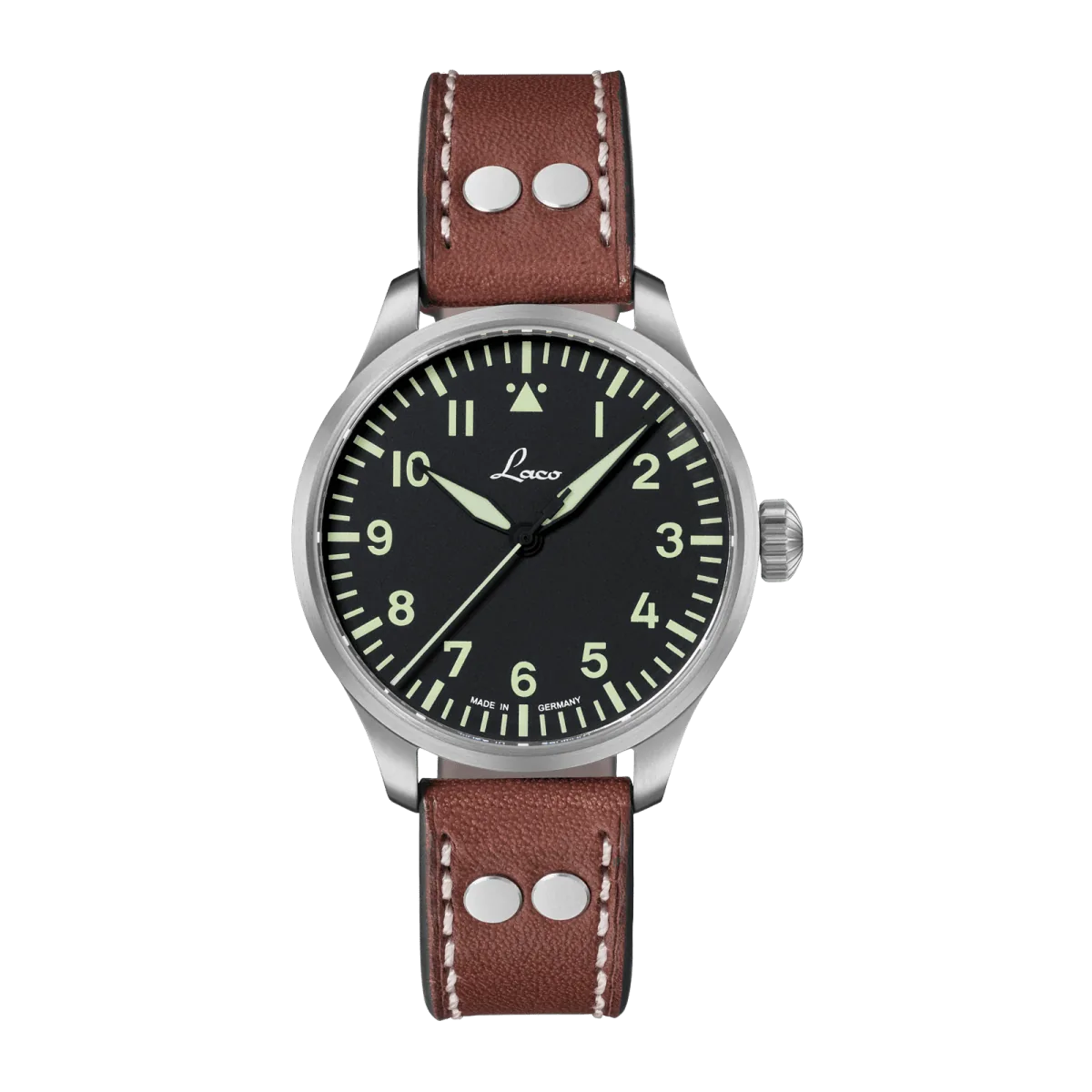
Founded in 1925 in Pforzheim by Frieda Lacher and Ludwig Hummel, Laco became one of only five manufacturers commissioned in the late 1930s to build the B-Uhr, the standardised German navigation watch. That specification — oversized case, high-contrast dial, railway-track minute scale — still shapes almost everything the brand makes.
Laco is a German manufacturer built around a single historically significant design: the B-Uhr observation watch, which it produced in the 1940s as one of five approved suppliers alongside IWC, A. Lange & Söhne, Wempe and Stowa. That gives its modern pilot watches an unusually direct claim on the category — they continue an original specification rather than reinterpret someone else's. The current range runs from affordable Miyota-powered Basic models through Sellita-powered Original pilot watches to the Squad tool-watch line, the Navy observation watches, and the aged-finish Erbstück references at the top. Against IWC, the reference point for luxury pilot watches, Laco offers comparable design lineage at roughly a tenth of the price; against Stowa, its closest peer, the two split the same heritage almost evenly.
Country
Germany
Founder
Frieda Lacher and Ludwig Hummel
Positioning
affordable, tool-watch, pilot-watch
Main collections
Pilot Watch Basic
$421
The entry tier: the full flieger layout in 39mm and 42mm on a Japanese Miyota automatic, and the cheapest honest way to own a watch from an original B-Uhr maker.
Pilot Watch Original
$1,004
The core line, named after German cities and built on Swiss Sellita calibers, with 100m water resistance and cases stepping from 39mm to the historically scaled 45mm.
Squad
$1,069
Laco's modern tool-watch line — Amazonas, Atlantik, Himalaya and Mojave — trading historical fidelity for 300m water resistance and a harder-wearing everyday brief.
Navy
$1,393
Marine observation watches with enamel-look dials: a 39mm automatic on a Sellita 261, or a 42.5mm hand-wound version running the classic ETA 6498 pocket-watch caliber.
Erbstück
$2,041
The top of the regular range: Baumuster A and Baumuster B dials given an artificially aged, heirloom finish, so a new watch reads like a surviving one.
Prices by collection
As of September 2026 — retail, before any market premium or discount
The whole spread is dial variant and strap: the mesh-bracelet references sit at the top.
Priced strictly by case size — €930 at 39mm, €980 at 42mm, €1,130 at the historically scaled 45mm.
The narrowest range in the catalogue: the only variable is whether you take a strap or a bracelet.
Two tiers rather than a gradient: 39mm automatic at the bottom, 42.5mm hand-wound ETA 6498 at the top.
Laco's dearest regular line; the aged finishing, not the movement, is what you're paying for.
The brand
About Laco
Laco was founded in 1925 in Pforzheim as Lacher & Company, in a city that was then the centre of the German jewellery and watch trade. Co-founder Ludwig Hummel later established Durowe — Deutsche Uhren-Rohwerke — which supplied the company with its own movements, an unusual degree of vertical integration for a firm of that size and the reason Laco could take on large military contracts at all.
In the late 1930s the German Air Ministry standardised a navigation watch for aircrew — the Beobachtungsuhr, or B-Uhr — and commissioned five manufacturers to build it: Laco, IWC, A. Lange & Söhne, Wempe and Stowa. The specification was severe and left almost nothing to the maker: a 55mm case, a soft-iron core against magnetism, a long strap to fit over a flight jacket, and a dial designed to be read instantly. Laco still builds to that layout today, scaled down to wearable sizes.
Why Laco matters
The flieger dial is one of the most copied designs in watchmaking, and almost every version on the market is a homage to a specification its maker had no part in writing. Laco is one of the five companies that actually built to it. For a buyer who cares about provenance, that is the difference between owning a continuation and owning an imitation — and it costs a fraction of what the same lineage costs from IWC.
The second thing Laco gets right is legibility as an engineering goal rather than a style. Dials are matte, numerals are large, hands are filled with luminous material along their full length, and the triangle at twelve gives orientation without reading anything. It is the reason these watches work as everyday tool watches for people who have never been near a cockpit.
Style, fit & buyer profile
The original B-Uhr was 55mm, which nobody wears. Laco's modern range concentrates on 39mm and 42mm, with 45mm versions for buyers who want something closer to the historical presence and a handful of smaller cases below 36mm. The 39mm is the safe recommendation for most wrists; the 42mm reads as a proper flieger without becoming a costume piece.
There are two dial layouts to choose between, and the choice matters more than the case. Type A puts a conventional hour ring on the dial with the triangle at twelve. Type B moves the hours to a small inner ring and gives the outer track to minutes, which is what a navigator actually needed to read. Type B looks more unusual and is the more historically specific of the two; Type A is easier to live with as a daily watch.
Price positioning
Laco spans roughly €390 to €2,490. The Basic pilot watches sit at the bottom on Japanese Miyota automatics, the Original line occupies the middle on Swiss Sellita calibers, and the top of the range is reached by larger hand-wound models, sport and navy references, and limited editions. Almost nothing here competes on movement exotica; the money buys the design, the case finishing and the name on the dial.
For context, an IWC Big Pilot costs more than the entire Laco catalogue put together at retail. That is the trade Laco offers: the same historical claim, none of the luxury positioning, and a movement you can have serviced by any competent watchmaker.
Alternatives & comparisons
Stowa is the direct comparison — the other surviving small manufacturer from the original five, at similar money and with a similar argument. IWC sits far above on price and finishing while making the same heritage claim. Hamilton's Khaki field watches cover the adjacent territory of military legibility without the aviation specificity, and Sinn takes the German tool-watch idea in a more technical direction, with case treatments and dehumidifying technology rather than historical fidelity.
Within Germany, Junghans is the opposite pole: the same country and a comparable price band, but a Bauhaus design language built on removing information rather than maximising it. Buyers often shortlist a Laco and a Junghans Max Bill together and are really choosing between legibility and restraint.
What sets Laco apart
The late-1930s German navigation-watch standard fixed the case at 55mm, required a soft-iron core against magnetic fields, mandated a long strap to be worn over flight clothing, and specified the dial down to the triangle at twelve. Laco was one of five manufacturers commissioned to build it, and its modern pilot watches follow the same layout at wearable diameters.
The Type A dial carries a single hour ring with the orientation triangle at twelve. The later Type B inverts the hierarchy, shrinking the hours onto an inner ring so the full outer scale can be given to minutes — the reading a navigator actually needed. Laco builds both, and the choice changes the character of the watch more than the case size does.
Co-founder Ludwig Hummel established Durowe (Deutsche Uhren-Rohwerke), which supplied Laco with its own movements and made the company unusually self-sufficient for its size. Today's watches use supplied Swiss and Japanese calibers assembled in Pforzheim, but the Durowe archive remains the basis of the brand's claim to genuine movement heritage.
Browse all 94 references
- Augsburg 39 — 861988
- Augsburg 42 — 861688.2
- Augsburg Blaue Stunde — 862100.2
- Augsburg Blaue Stunde — 862102.2
- Aachen Blaue Stunde — 862101.2
- Aachen Blaue Stunde — 862103.2
- Aachen 39 — 861990
- Aachen 42 — 861690.2
- Augsburg Grau — 862158
- Augsburg Grau 39 — 862161
- Aachen Grau — 862159
- Aachen Grau 39 — 862162
- Augsburg 42 MB — 861895.2
- Augsburg 39 MB — 862140
- Augsburg Blaue Stunde 39 MB — 862102.2.MB
- Augsburg Blaue Stunde 42 MB — 862100.2.MB
- Aachen Blaue Stunde 39 MB — 862103.2.MB
- Aachen Blaue Stunde — 862101.2.MB
- Aachen 42 MB — 861891.2
- Aachen 39 MB — 862139
- Altenburg 42 — 861759.2
- Altenburg 39 — 861991
- Bielefeld 42 — 861760.2
- Bielefeld 39 — 861992
- Augsburg Grau 42 MB — 862158.MB
- Augsburg Grau 39 MB — 862161.MB
- Aachen Grau 42 MB — 862159.MB
- Aachen Grau 39 MB — 862162.MB
- Kempten — 862093
- Speyer — 862095
- Heidelberg — 862094
- Mülheim an der Ruhr — 862092
- Leipzig — 861747
- Paderborn — 861749
- Münster — 861748
- Memmingen — 861746
- Stuttgart PRO — 862141
- Karlsruhe PRO — 862142
- Amazonas 42 — 862107
- Amazonas 39 — 862134
- Amazonas 42 RB — 862107.RB
- Amazonas 39 RB — 862134.RB
- Himalaya 39 — 862131
- Himalaya 42 — 862106
- Himalaya 42 RB — 862106.RB
- Himalaya 39 RB — 862131.RB
- Atlantik 42 — 862108
- Mojave 42 — 862109
- Atlantik 42 RB — 862108.RB
- Mojave 39 — 862132
- Mojave 39 RB — 862132.RB
- Atlantik 39 — 862133
- Atlantik 39 RB — 862133.RB
- Mojave 42 RB — 862109.RB
- Amazonas 42 MB — 862107.MB
- Amazonas 39 MB — 862134.MB
- Himalaya 42 MB — 862106.MB
- Himalaya 39 MB — 862131.MB
- Mojave 39 MB — 862132.MB
- Atlantik 39 MB — 862133.MB
- Atlantik 42 MB — 862108.MB
- Mojave 42 MB — 862109.MB
- Westerland — 861750
- Friedrichshafen — 861753
- Saarbrücken — 861752
- Dortmund — 861751
- Köln — 862191
- Köln MB — 862191.MB
- Köln Grau — 862192
- Cuxhaven 39 — 862168
- Bremerhaven 39 — 862169
- Stuttgart Pro WatchTime Edition — 852141_1
- Cuxhaven 42,5 — 862104.2
- Bremerhaven 42,5 — 862105.2
- FRANKFURT 43 GMT — 862121.2
- FRANKFURT 43 GMT — 862120.2
- FRANKFURT 40 GMT SCHWARZ — 862187
- Speyer Erbstück — 862099
- Kempten Erbstück — 862097
- Heidelberg Erbstück — 862098
- Mülheim an der Ruhr Erbstück — 862096
- Paderborn Erbstück — 861932
- Münster Erbstück — 861931
- Wien Erbstück — 861944
- Graz Erbstück — 861946
- Florenz Erbstück — 861945
- Leipzig Erbstück — 861936
- Memmingen Erbstück — 861935
- Venedig Erbstück — 861943
- Saarbrücken Erbstück — 861933
- Friedrichshafen Erbstück — 861934
- Dortmund Erbstück — 861938
- Westerland Erbstück — 861937
- Hamburg GMT DIN 8330 — 862165