Junghans watches
Bauhaus design with a genuine German industrial past.
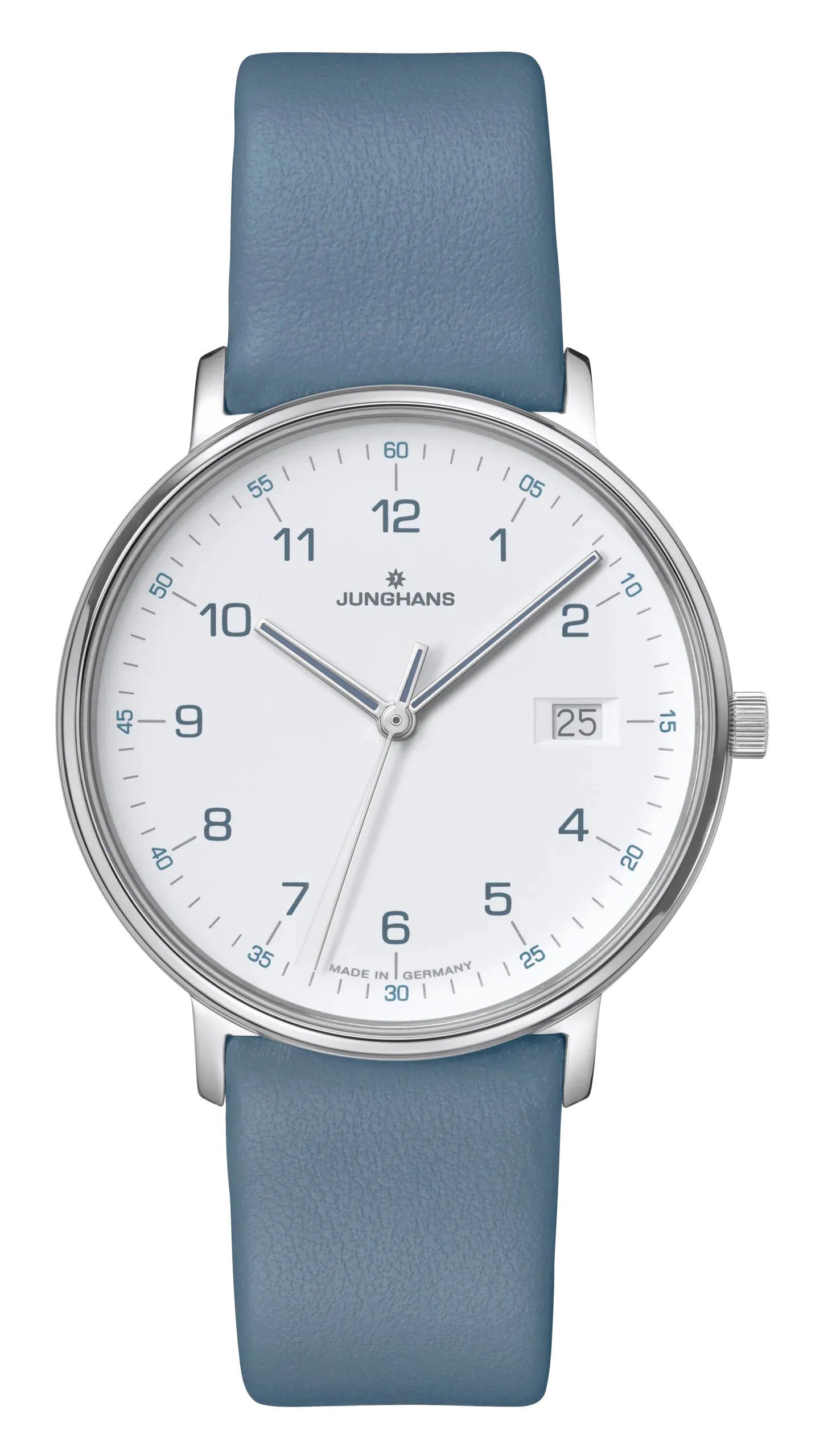
Founded in 1861 in Schramberg, in Germany's Black Forest, Junghans grew into the largest clock and watch manufacturer in the world by 1903 before finding its lasting identity in the early 1960s through its collaboration with Bauhaus designer Max Bill. That pairing of industrial depth and functionalist design still defines the brand today.
Junghans is a German manufacturer whose identity rests on two distinct legacies: nineteenth-century industrial scale as one of the world's largest clockmakers, and a defining mid-century collaboration with Bauhaus designer Max Bill. The Max Bill collection remains the clearest expression of that design philosophy, favouring uncluttered dials, restrained typography and calm proportion over ornamentation. The vintage-leaning Meister line and the everyday Form collection extend the same sensibility, while the radio-controlled, solar-powered Mega watches give the brand a technical dimension few design-led competitors can match. Compared with NOMOS Glashütte, its closest rival in German minimalism, Junghans leans more historical and typographic where NOMOS leans architectural.
Country
Germany
Founder
Erhard Junghans and Jakob Zeller-Tobler
Positioning
premium, dress-watch, minimalist
Main collections
Max Bill
$1,604
The brand's defining line, built close to Max Bill's original 1960s drawings: a domed crystal, hairline hands and a dial reduced to numerals and nothing more.
Meister
$1,717
The vintage-leaning collection, referencing Junghans's mid-century watches with warmer dial finishes, applied indices and more traditional case profiles.
Form
$1,177
The everyday line, carrying the same restraint into slightly larger, more contemporary cases — and the most affordable way into the brand's design language.
Mega
$1,393
The technical side of Junghans: solar-charged movements with radio time reception across Europe, the UK, the US and Japan, in ceramic and titanium cases.
Prices by collection
As of September 2026 — retail, before any market premium or discount
Runs from quartz and smaller women's references up to the Chronoscope; the 38mm automatic sits near the middle.
The brand's dressiest tier; three-hand models sit low in the range, chronoscopes at the top.
The widest spread in the catalogue, from quartz Form C references to the automatic Form A Chronoscope.
Solar and radio-controlled models across the Max Bill, Meister, Force and Spektrum lines; ceramic cases sit at the top.
The brand
About Junghans
Junghans was founded in 1861 in Schramberg by Erhard Junghans and his brother-in-law Jakob Zeller-Tobler, initially making components for the Black Forest clock trade rather than finished watches. Vertical integration followed quickly, and by 1903 the company was the largest clock and watch manufacturer in the world — an industrial scale that gave it engineering capability long before it had a design reputation.
That reputation arrived in the early 1960s, when Junghans asked Bauhaus-trained designer and artist Max Bill — who had already designed a kitchen clock for the company — to shape a wristwatch. The result stripped the dial back to numerals, thin hands and nothing else, and the Max Bill line is still built close to those original proportions. Everything else in the catalogue, from the Meister family to the Form series, is measured against it.
Why Junghans matters
Bauhaus-inspired watches are everywhere; watches designed by an actual Bauhaus figure are not. Max Bill studied at the Bauhaus in Dessau and later led the Ulm School of Design, which makes the Max Bill collection a primary source rather than a homage. For buyers who care where a design language comes from, that distinction is the whole argument for the brand.
The second argument is technical. Junghans built Germany's first quartz wristwatch movement in the early 1970s and, in 1990, the first radio-controlled wristwatch. That line continues in today's Mega models, which combine solar charging with radio time reception across Europe, the UK, the US and Japan — an unusually practical proposition inside a design-led catalogue.
Style, fit & buyer profile
Junghans cases run small to moderate by modern standards: the hand-wound Max Bill sits at 34mm, the automatic version at 38mm, and the Meister Hand-Winding at 37.7mm. Domed crystals and slim bezels keep dial area generous relative to case width, so a 38mm Junghans wears calmly under a shirt cuff and reads clearly at a glance. Anyone shopping with a smaller wrist in mind will find the range unusually well-suited.
The typical buyer is a design-minded generalist rather than a specification collector: someone choosing a watch the way they would choose a chair or a lamp. Junghans suits office wear, weddings and daily wear far better than sport, with the exception of the Aquaris diver and the sportier Mega models. If you want a rugged German tool watch instead, Sinn is the more natural stop.
Price positioning
Junghans sits in the accessible-premium band. Quartz Form and Max Bill references start under €1,000, mechanical Max Bill and Meister models cluster between €1,100 and €1,700, and chronographs reach the mid-€2,000s. That places the brand alongside Longines and below NOMOS Glashütte, whose in-house calibres carry a clear premium for comparable design.
Because most Junghans movements are supplied rather than made in-house, the money goes into design, dial execution and finishing rather than calibre development. That is the trade-off to weigh: a Junghans buys you more design provenance per euro, a NOMOS buys you more movement.
Alternatives & comparisons
The obvious comparison is NOMOS Glashütte: same country, same Bauhaus vocabulary, different emphasis. NOMOS designs and finishes its own calibres in Glashütte and prices accordingly; Junghans answers with a longer history and a direct link to the Bauhaus itself. For a Swiss alternative at similar money, Longines offers heritage-driven dress watches with broader service coverage, while Hamilton covers the more casual, field-watch end of the same budget.
Within Germany, Sinn is the counterweight rather than the rival: technical, tool-focused and built around water resistance and case technology instead of dial restraint. Buyers who like the Max Bill silhouette but want a smaller budget usually end up comparing it to a quartz Form or a vintage-inspired Tissot before deciding.
What sets Junghans apart
Max Bill studied at the Bauhaus in Dessau and later directed the Ulm School of Design. His work for Junghans, beginning with a kitchen clock and extending to the wristwatch in the early 1960s, makes the collection a primary Bauhaus object rather than a stylistic tribute.
By 1903 Junghans was the largest clock and watch manufacturer in the world, producing movements and components at a volume no boutique manufacture could match. That industrial base is why the brand could later absorb quartz and radio technology instead of being displaced by it.
Junghans introduced the first radio-controlled wristwatch in 1990. Current Mega calibers such as the J101 combine a solar dial with radio time reception in Europe, the UK, the US and Japan, plus a perpetual calendar and a multi-year power reserve in the dark.
Browse all 35 references
- FORM Damen — 47/4456.00
- FORM Damen — 47/4055.00
- FORM C — 41/4771.00
- max bill Damen — 47/4554.02
- max bill Quarz — 41/4562.02
- 1972 Chronoscope Sports Edition 2026 — 41/4557.00
- max bill MEGA — 58/4821.46
- Meister Driver — 27/7710.00
- Meister S Quarz — 47/4531.44
- FORM A Automatic — 27/4731.00
- max bill Handaufzug — 27/3701.02
- max bill Kleine Automatic — 27/4006.02
- max bill MEGA Solar — 59/4325.02
- max bill MEGA Kleine Sekunde Edition 60 — 58/4100.02
- Meister MEGA Solar — 59/4603.02
- Meister MEGA — 58/7500.02
- FORM A Titan — 27/2002.00
- Spektrum Mega Solar — 18/1527.00
- FORM A Bauhaus Edition — 27/4533.44
- Force Mega Solar — 18/1001.00
- max bill Automatic — 27/3500.02
- Meister Handaufzug — 27/3504.02
- Meister S Automatic 36 — 27/4582.44
- Meister S Automatic — 27/4614.44
- FORM A Chronoscope — 27/4371.00
- FORM A Chronoscope — 27/4372.03
- Pilot Automatic Navy Blue — 27/4495.00
- Pilot Automatic — 27/4490.00
- max bill Chronoscope — 27/4502.02
- Meister Chronoscope — 27/4223.02
- Meister Chronoscope — 27/4222.03
- max bill Chronoscope Bauhaus — 27/4303.02
- 1972 Competition — 27/4203.00
- 1972 Competition FIS Edition Trondheim — 27/4507.00
- Aquaris Diver — 27/4668.44