10h09.com
The verdict, first

Buy the Max Bill unless you want a bigger, day-date Junghans automatic built for 20 bar and a steel bracelet from the start.

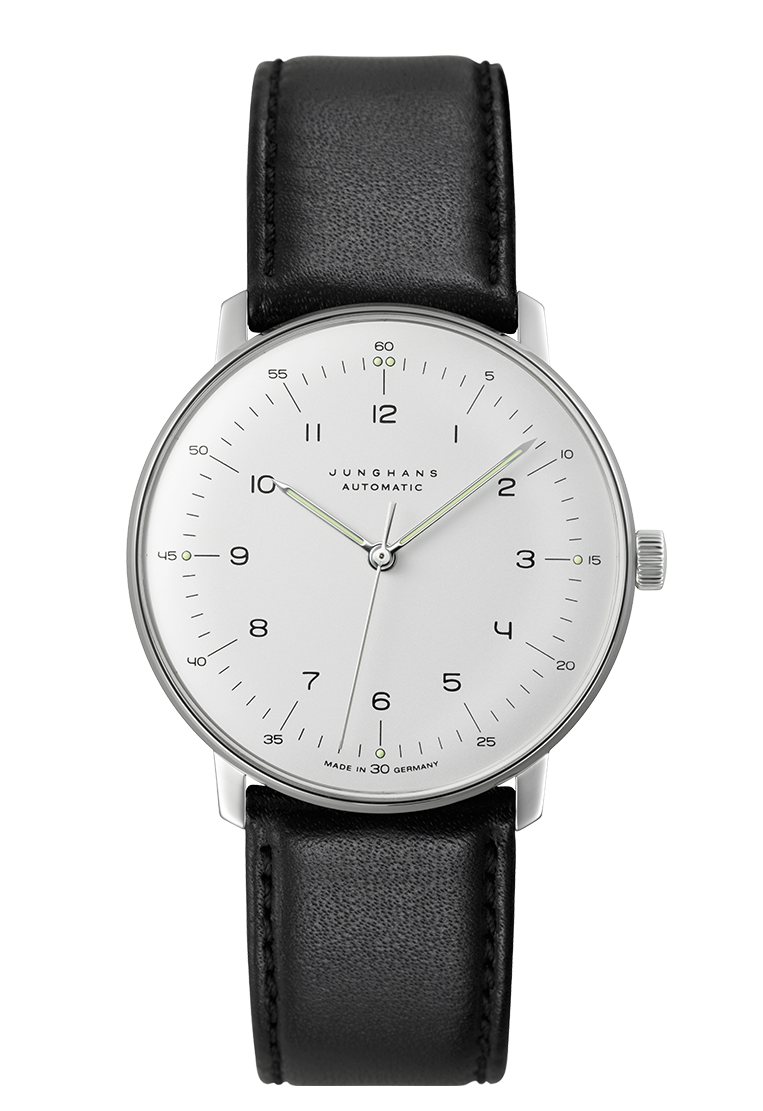
Both watches share Junghans' self-winding J800 movement family, up to 38 hours of reserve and an anti-reflective sapphire crystal. That's where the resemblance stops: the Max Bill Automatic (27/3500.02) is a 38.0 mm, 10.0 mm-thick, time-only watch on black leather; the Meister S Automatic (27/4614.44) is a 40.5 mm, 13 mm-thick, day-and-date watch on a steel bracelet, rated to 20 bar rather than 5.

This isn't a same-watch-different-finish choice. It's a choice between a compact, purist, graphic Max Bill and a larger, more functional, more classically finished Meister S — and the price gap reflects a genuinely different watch, not just a bracelet.

Junghans max bill Automatic, 38.0mmJunghans · ~$1,550max bill AutomaticJunghans Meister S Automatic, 40.5mmJunghans · ~$2,150Meister S Automatic
The other case

The Meister S isn't simply a bigger, pricier Max Bill. Its domed, sunray-brushed dial and partially skeletonised hands sit in a more traditional watchmaking register than Max Bill's flat graphic design, and its day-date display, 20 bar rating and steel bracelet make it the more complete watch for someone who wants one automatic to handle the office, the weekend and the odd splash of water without a second thought.

Where it is decided
4 arguments
01

Dial design and visual identity

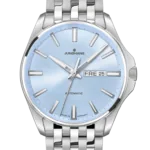
The Max Bill's flat matt silver dial carries Max Bill's own square-edged Arabic numerals — Junghans' description even notes the upside-down-chair '4' — with a fine minute track and slim luminous hands. The Meister S runs a domed, sunray-brushed light blue dial with partially skeletonised hands carrying luminous material on their counterweights, a more classical, reflective register than Max Bill's graphic flatness. Neither is more elegant in any objective sense: one is restraint by design, the other is depth by finish.

Goes to
Draw
Flat dial, Arabic numerals
Domed sunray dial, skeletonised hands
02

Case size, water resistance and everyday robustness

This is not a negligible gap. The Max Bill is 38.0 mm and 10.0 mm thick, rated to 5 bar. The Meister S is 40.5 mm and 13 mm thick — noticeably more case on the wrist — with a screwed crown and a genuine 20 bar (200 m) rating, four times the Max Bill's depth rating. Neither is marketed as a dive watch, but the Meister S tolerates far more incidental water exposure — swimming or light water sports — without a second thought, where the Max Bill is a hand-washing-and-rain watch at best.

Goes to
Junghans Meister S Automatic
38.0 mm, 10.0 mm, 5 bar
40.5 mm, 13 mm, 20 bar
03

Movement, complication and caseback

Both run self-winding Junghans J800-family movements with up to 38 hours of reserve and an anti-reflective sapphire crystal — but the Max Bill 27/3500.02 has no date at all, while the Meister S runs the J800.4 with day and date (German or English weekday setting). Junghans doesn't publish a jewel count or frequency for the J800.4 separately; sibling J800-family calibres run 25 jewels at 28,800 vph, but that figure isn't confirmed for this exact reference. The Meister S's caseback is confirmed solid: stainless steel, held by 7 screws with a Junghans star insignia — not a display back. The Max Bill's caseback construction isn't stated in official copy either way.

Goes to
Junghans Meister S Automatic
J800.1, time-only, caseback unconfirmed
J800.4, day-date, solid 7-screw caseback
04

Price, bracelet and ownership role

The Max Bill lists at €1,445 on black leather; the Meister S lists at €1,990 on a matt/polished steel bracelet with a safety folding clasp — a €545, roughly 38%, gap. That premium is not just a bracelet: the Meister S is also bigger, thicker, rated to four times the depth, and adds a day-date complication, so the price reflects a genuinely different, more capable watch, not a strap swap. If you'd only ever wear the Max Bill on leather anyway, the Meister S's extra capability may not be worth the difference; if you want the bracelet, the water resistance and the day-date as a package, the premium buys real function, not just finish.

Goes to
Junghans max bill Automatic
€1,445, leather, time-only
€1,990, steel bracelet, day-date, 20 bar
Who should buy which
Junghans max bill Automatic
  • Max Bill's flat, graphic design language is the reason you're here.
  • You value clean numeral typography and negative space over sunray finishing.
  • You wear leather straps and see no reason to pay for a steel bracelet.
  • A pure time-only dial suits you better than a day-date complication you won't use.
  • You want the lower entry price into a Junghans automatic dress watch.
See the max bill Automatic
Junghans Meister S Automatic
  • You want classical dress-watch cues: a domed sunray dial, partially skeletonised hands and a polished case.
  • The steel bracelet and folding clasp are part of the purchase, not an accessory to add later.
  • You actually want a day display alongside the date, not just the date alone.
  • 20 bar water resistance matters to you even in a dress watch you'll wear daily.
  • The premium over the Max Bill is justified to you by size, capability and finishing, not by branding.
See the Meister S Automatic
Your personal verdict

The movement family is the same; the answer depends on whether you prefer Max Bill's restraint or the Meister S's bigger, more classically finished, more capable case.

Find which one fits you
Explore Junghans dress watches

Junghans splits its dress-watch line into the graphic Max Bill collection and the more classical Meister collection, each spanning several movements and complications.

Frequently asked

What is the difference between the Junghans Meister S and Max Bill?

Both use Junghans' self-winding J800-family movement with an anti-reflective sapphire crystal, but they're different watches beyond that: the Max Bill Automatic (27/3500.02) is 38.0 mm, 10.0 mm thick, time-only, on leather, rated to 5 bar; the Meister S Automatic (27/4614.44) is 40.5 mm, 13 mm thick, with day and date, on a steel bracelet, rated to 20 bar. Design-wise, Max Bill is flat and graphic with Arabic numerals; the Meister S has a domed sunray dial with partially skeletonised hands.

Does the Junghans Meister S use the same movement as the Max Bill?

They share the same self-winding J800 movement family and up to 38 hours of reserve, but not the identical calibre: the Max Bill 27/3500.02 runs the J800.1 with no date function, while the Meister S runs the J800.4 with day and date. Junghans doesn't publish a separate jewel count or frequency for the J800.4.

Is the Junghans Meister S more elegant than the Max Bill?

There's no objective winner — they represent different registers of elegance. The Max Bill's flat, graphic dial is restraint by design; the Meister S's domed sunray dial and partially skeletonised hands are refinement by finish. Which reads as more elegant to you depends on whether you prefer minimalist typography or classical dial depth.

Which Junghans is better for everyday wear: Meister S or Max Bill?

It depends on strap preference and visual taste as much as capability. The Meister S's steel bracelet, day-date and 20 bar rating make it the more functionally complete everyday watch; the Max Bill is lighter, more compact and better suited to someone who exclusively wears leather and wants a purely graphic, time-only dial.

Is the Meister S worth more than the Max Bill?

The €545 premium buys a genuinely bigger, more water-resistant watch with a day-date complication and a steel bracelet included — not just a bracelet swap on the same watch. Whether that's worth it to you is a personal call about size, complication and strap preference, not a resale or investment question.