10h09.com
The verdict, first

Buy the 34 mm unless you want the Max Bill to read as a modern everyday watch before it reads as an original design.

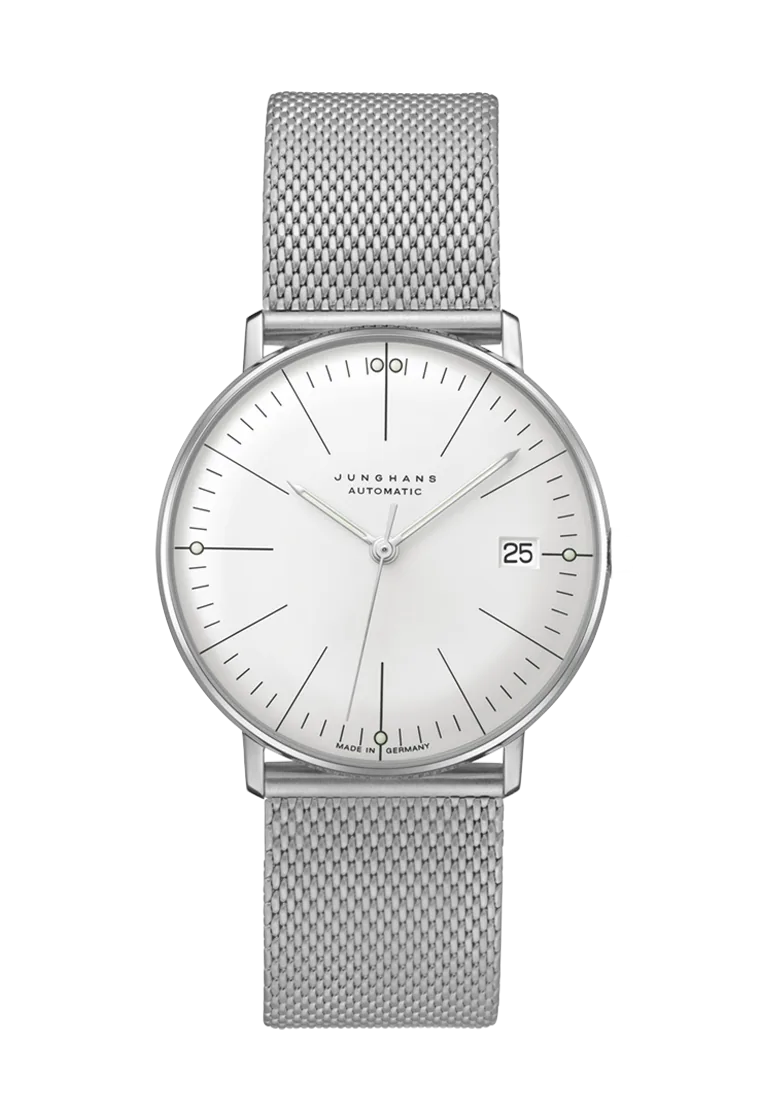
The movement may be the same, but the character is not. The 34 mm Max Bill Kleine Automatic returns to the scale of the original 1961 design: compact, calm and deliberately mid-century.

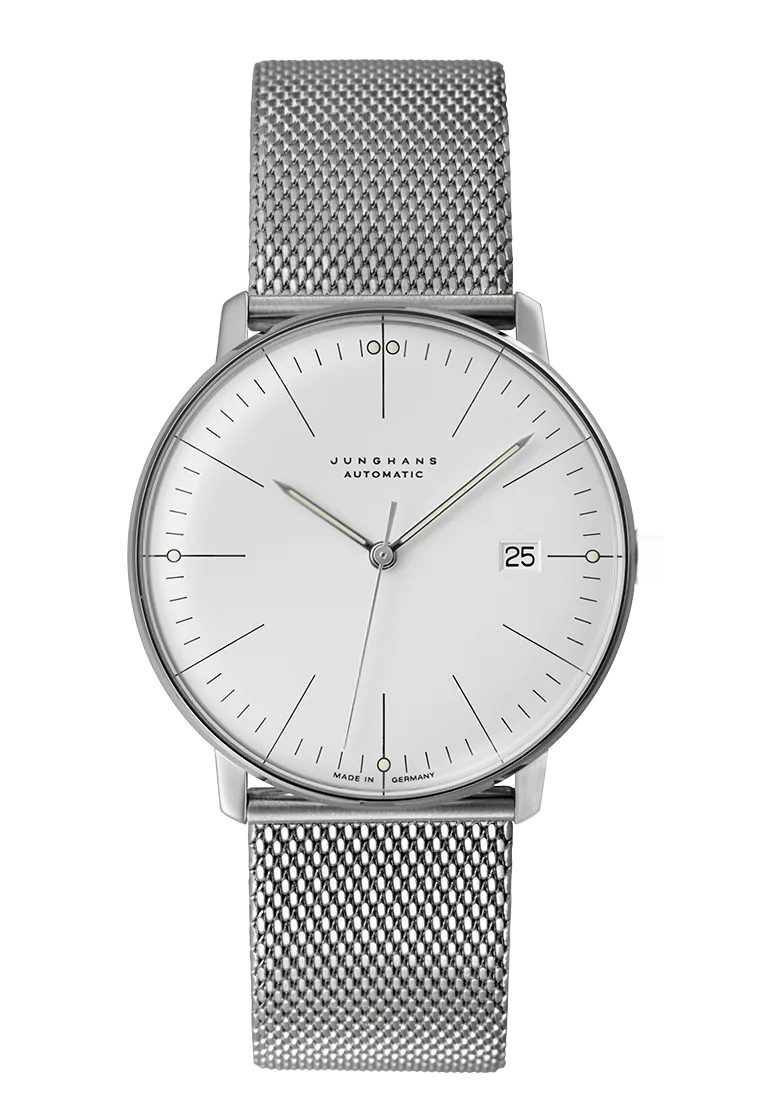
The 38 mm Automatic gives the same index markers, minute track and date more room, so the same Bauhaus language reads more easily across a desk and carries more presence in a casual wardrobe. Neither is the universal size; the right choice is whether you want historical proportion or contemporary visibility.

Junghans max bill Kleine Automatic, 34.0mmJunghans · ~$1,600max bill Kleine AutomaticJunghans max bill Automatic, 38.0mmJunghans · ~$1,700max bill Automatic
The other case

The 38 mm is not simply a scaled-up version for larger wrists. Max Bill's work depends on balance and empty space, and the larger dial gives the same index-and-minute-track layout a different clarity without abandoning the original logic. If the 34 mm feels like a period object, the 38 mm proves why the Max Bill still works as a current everyday design.

Where it is decided
4 arguments
01

Historical proportion and wrist presence

The Kleine Automatic's 34.0 mm case is the closer match to Max Bill's original 1961 proportions; Junghans has presented the Kleine Automatic line as a return to that period's scale. Both resolved references stand 10.0 mm tall, so the size difference reads entirely in diameter and dial area, not case height. Going from 34 mm to 38 mm is an 11.8% increase in diameter — a large proportional shift for a minimalist dial with little else to absorb it. Neither size is wrong: the 38 mm isn't a compromise, just a visibly more contemporary reading of the same design. Junghans doesn't publish a lug-to-lug figure for either reference, so this comparison rests on diameter and case height, not a full silhouette.

Goes to
Junghans max bill Kleine Automatic
34.0 mm, 10.0 mm height
38.0 mm, 10.0 mm height
02

Dial legibility and visual character

Both references share the same dial architecture: a clean index-and-baton track, three luminous dots near 12 o'clock, slim dauphine-style hands and a date window at 3. On the 34 mm, that layout sits inside a noticeably smaller opening, giving the dial a condensed, close-read character. The 38 mm spreads the same markers and minute track across more surface, so the whole face reads faster at a glance and carries more presence next to a cuff or across a desk. Neither dial is objectively more legible — the 34 mm rewards a closer look, the 38 mm is easier to read in a hurry — and nothing in the resolved records suggests the two use different luminous material.

Goes to
Junghans max bill Automatic
Condensed dial, closer-read scale
Larger dial opening, faster at-a-glance read
03

Movement, construction and practical capability

Both resolved references run the same Junghans J800.1 self-winding calibre — 25 jewels, 28,800 vibrations per hour, up to 38 hours of reserve, DIN 8309 antimagnetic protection — with date, a domed anti-reflective sapphire crystal and 5 bar water resistance. Size buys nothing here: choosing 38 mm over 34 mm doesn't upgrade the movement, the crystal or the water resistance, because this pair is genuinely matched on all three. Junghans lists a four-times-screwed caseback for the 34 mm; its 38 mm page doesn't repeat that detail, though nothing indicates a different construction. Both are everyday dress watches rated to 5 bar — fine for washing hands or rain, not something to wear swimming or diving.

Goes to
Draw
J800.1, sapphire, 5 bar
04

Price, collection role and what size changes

In the same Milanaise-bracelet configuration, the 34 mm lists at €1,475 and the 38 mm at €1,585 — a €110, roughly 7.5%, difference that is genuinely attributable to size here, since crystal, movement and strap are identical on both. That's a real but modest premium, not a reason to choose one over the other on value alone. The 34 mm tends to work as a distinctive, historically faithful counterpoint in a collection that already has larger sports or tool watches; the 38 mm tends to work better as a single everyday Max Bill for office, weekend and casual wear alike. Both are tendencies, not rules — actual wrist and wardrobe should decide.

Goes to
Draw
€1,475 (Milanaise, matched)
€1,585 (Milanaise, matched)
Who should buy which
Junghans max bill Kleine Automatic
  • You want the original 1961 proportion and the most historically faithful automatic Max Bill available.
  • You prefer a discreet watch that stays quiet under a cuff rather than reading as a contemporary sports watch.
  • You value compact mid-century scale and have already checked that 34 mm looks intentional — not merely small — on your wrist.
  • You own larger watches and want a distinctive, more formal counterpoint in the collection.
  • The Milanaise bracelet, sapphire crystal and 5 bar rating of this exact reference are what you want.
See the max bill Kleine Automatic
Junghans max bill Automatic
  • You want the same design language with more dial presence and a faster at-a-glance read.
  • You prefer a contemporary everyday scale without leaving a restrained, 38 mm dress-watch format.
  • You expect to wear it with knitwear, denim and casual tailoring as often as with a dress shirt.
  • You've tried the 34 mm and found it too delicate for the presence you want on your wrist.
  • The €110 step up for the same Milanaise bracelet, sapphire crystal and 5 bar rating doesn't change your decision.
See the max bill Automatic
Your personal verdict

The mechanics may be the same; wrist width, desired presence and how you dress determine the better Max Bill.

Find which size fits you
Explore Max Bill sizes

Junghans catalogues Max Bill automatics at 34 mm and 38 mm, hand-wound versions at 34 mm, a quartz line at 38 mm and the Chronoscope at 40 mm — a different size often means a different movement or complication, not just a bigger dial.

34 mm — Automatic
34 mm — Hand-Winding
38 mm — Automatic
38 mm — Quartz
40 mm — Chronoscope
Frequently asked

Is the 34 mm or 38 mm Junghans Max Bill better?

Neither is strictly better — they're different readings of the same design. The 34 mm is closer to the original 1961 proportions and stays quieter on the wrist; the 38 mm gives the same dial more presence and reads faster at a glance. Choose 34 mm for historical proportion and discretion, 38 mm for dial presence and a more contemporary everyday scale.

Is the Junghans Max Bill 34 mm too small?

Not inherently — 34 mm is a deliberate mid-century scale, not a compromise or a rule about who should wear it. Whether it reads as intentional or simply small depends on your wrist width and what you're used to wearing, so trying it on or checking a calibrated fit guide is more useful than any fixed cutoff.

Does the 34 mm Max Bill use the same movement as the 38 mm?

Yes — both the Kleine Automatic 34 mm (27/4106.46) and the Automatic 38 mm (27/4002.46) run the Junghans J800.1 self-winding calibre with up to 38 hours of power reserve. Size doesn't buy a different movement here.

Which Junghans Max Bill size is closest to the original?

The 34 mm. Junghans has presented the Kleine Automatic as a return to the size of the original 1961 Max Bill watches, while the 38 mm is a later, larger reading of the same design.

Is the Junghans Max Bill 38 mm too large for a dress watch?

No — 38 mm remains restrained by contemporary dress-watch standards. It's simply visibly larger and less period-faithful than the 34 mm, not oversized in absolute terms.