10h09.com
The verdict, first

Buy the Max Bill unless the Tangente's 6.8 mm case, hand-wound manufacture movement and sapphire display back are the reason you are buying a mechanical watch.

Both watches reduce a dress watch to its essentials: steel, a pale dial, Arabic numerals, thin hands and a leather strap. The Max Bill gives that Bauhaus clarity a warmer, more practical interpretation — a 38 mm automatic with a 38-hour reserve, an anti-reflective sapphire crystal and 5 bar water resistance.

The Tangente is the more deliberate object: only 6.8 mm thick, manually wound and driven by NOMOS's DUW 4001 calibre — the movement formerly called Alpha — visible through a sapphire back. Neither is a lesser version of the other. The max bill line descends from watches Max Bill designed for Junghans; the Tangente is NOMOS's own 1992 design, drawn in the Bauhaus tradition rather than reproducing a historical one.

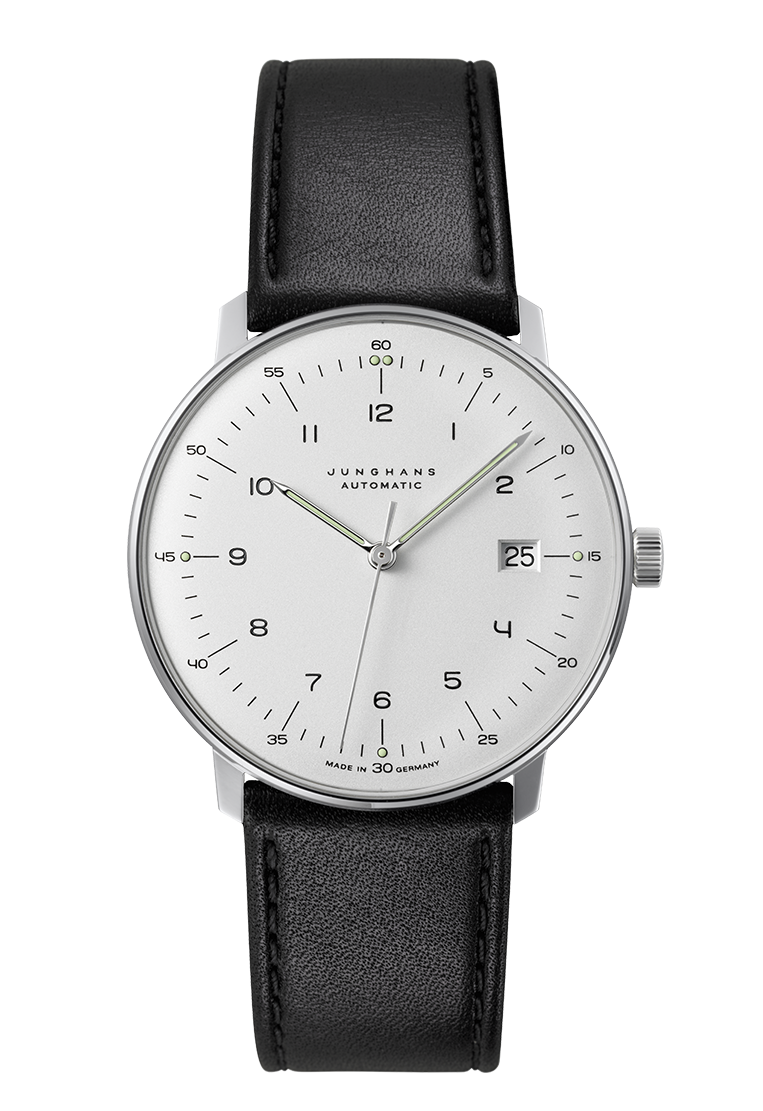
Junghans max bill Automatic, 38.0mmJunghans · ~$1,600max bill AutomaticNOMOS Glashütte Tangente, 37mmNOMOS Glashütte · ~$2,400Tangente
The other case

It is tempting to read the in-house calibre and the display back as the serious choice, and the Junghans as the affordable one. The Max Bill is not the lesser watch. It carries a direct link to Max Bill, who studied at the Bauhaus, and it is the more relaxed everyday proposition: automatic winding, a compact lug profile and higher water resistance on the current sapphire-crystal 38 mm automatic references. If the design's historical authorship and an easy daily-wear mechanism matter more to you than seeing an in-house movement, the Junghans is the more coherent choice.

Where it is decided
4 arguments
01

Design lineage and visual identity

The max bill line is rooted in watches Max Bill designed for Junghans, and Max Bill himself studied at the Bauhaus — this is the rare case where a Bauhaus watch has an actual Bauhaus author. The resolved reference, 27/4700.02, is a 38 mm round steel case with closely set lugs, a matt silver-plated dial, simplified numerals, a slim minute track and a date window at three. The Tangente takes the other road: it is a NOMOS original introduced in 1992, drawing on Bauhaus principles rather than reproducing a historical design. Ref. 164 pairs a galvanised, white silver-plated dial with elongated Arabic numerals, a railway minute track, small seconds at six and tempered-blue steel hands, behind sapphire front and back. Choose the Junghans if the historical connection to Max Bill's own work is what makes Bauhaus compelling to you; choose the NOMOS if you want the more graphic, more geometric modern German reading. Neither is objectively more Bauhaus than the other.

Goes to
Draw
38 mm, date at three, Max Bill authorship
37.5 mm, small seconds, no date, NOMOS 1992
02

Proportion and wearability

This is the argument most buyers get backwards. The Tangente is the smaller watch by diameter — 37.5 mm against the Junghans's 38.0 mm — and it is dramatically thinner, at 6.8 mm against roughly 10 mm. But its lugs are long and straight: 47.7 mm from tip to tip on a 19 mm lug width. The Max Bill's rounded case flows into closely set lugs, so it reads as the more compact object on the wrist despite the larger nominal diameter and the extra three millimetres of height. Water resistance also splits the pair: the current sapphire-crystal Max Bill Automatic 38 references are rated 5 bar (50 m), while ref. 164 is 3 ATM (30 m), described by NOMOS as splash-proof. Neither is a swimming watch, but the Junghans is the more relaxed one around rain, hand washing and incidental water. If your wrist is narrow, do not assume the smaller diameter wins — measure the lug span, or try both.

Goes to
Draw
38.0 mm, ~10 mm high, sapphire, 5 bar
37.5 × 6.8 mm, 47.7 mm lug-to-lug, 3 ATM
03

Movement and daily ritual

The Junghans runs Calibre J800.1, a self-winding movement with up to 38 hours of reserve, and the resolved reference adds a date. The NOMOS runs the DUW 4001 — the current name for the calibre long sold as Alpha — an in-house-built NOMOS hand-wind with 17 jewels, a movement height of 2.6 mm and up to 53 hours of reserve, with small seconds and no date, visible through the sapphire back. That single difference sets the whole ownership rhythm. The Tangente asks you to wind it, rewards you with a Glashütte manufacture movement you can actually look at, and it is that hand-wound architecture which makes the 6.8 mm case possible at all. The Max Bill winds itself while you wear it and makes more sense if you want Bauhaus design without adding another daily task. Someone who rotates several watches often prefers the manual; someone who wants one grab-and-go watch usually prefers the automatic. Neither movement is objectively more accurate or easier to service than the other on current published evidence, and the J800.1's external base is no reason to dismiss it.

Goes to
Draw
J800.1 automatic, 38 h, date
DUW 4001 hand-wound, 53 h, 17 jewels
04

Ownership proposition and price

This is the one section with a clear winner, and it is a trade-off rather than a hierarchy. Junghans delivers the design heritage, an automatic movement, anti-reflective sapphire and 5 bar water resistance at a materially lower entry price than the Tangente; the cards above carry the current catalogue figures for both. NOMOS charges more for the in-house DUW 4001, the sapphire display back, the extreme thinness, the Glashütte manufacture identity and an original NOMOS design language. Both are honest positions. The question is whether the extra outlay closes a gap you actually feel: if automatic winding, 5 bar and direct Max Bill lineage leave no important desire unmet, the Junghans is the more complete ownership proposition and leaves budget for a second strap or a second watch. If a manufacture calibre, manual interaction, a display back and a 6.8 mm case are precisely what you are paying for, the Tangente is not expensive — it is specific. Confirm current regional pricing and warranty terms with Junghans and NOMOS before you buy; both change by market.

Goes to
Junghans
Automatic, 5 bar, lower entry price
In-house DUW 4001, sapphire display back
Who should buy which
Junghans max bill Automatic
  • You value a collection connected directly to Max Bill's own designs for Junghans, not to a design tradition in general.
  • You prefer automatic winding and have no wish to wind a watch every day or two.
  • You want a compact-looking, rounded 38 mm dress-everyday watch rather than long straight lugs.
  • You want 5 bar water resistance and a sapphire crystal in a low-stress daily wearer.
  • The lower price leaves room for another watch, a better strap, or simply less financial pressure.
See the max bill Automatic
NOMOS Glashütte Tangente
  • You buy mechanical watches partly to see and interact with their movements.
  • You want the 6.8 mm thinness and accept the unusually long 47.7 mm lug-to-lug span that comes with it.
  • A hand-wound, in-house Glashütte calibre with a 53-hour reserve means more to you than automatic convenience.
  • You prefer small seconds and a dial uninterrupted by a date window.
  • You want an original contemporary NOMOS design rather than a historic design lineage.
See the Tangente
Your personal verdict

Your wrist width, winding preference, date requirement and appetite for a thin manufacture movement can change the answer.

Find which one fits you
Explore both collections

Neither watch stands alone. Both the max bill line and the Tangente run across sizes, movements and complications — if the two references compared above are close but not quite right, the answer is usually a sibling rather than a different brand.

Frequently asked

Is the NOMOS Tangente worth more than the Junghans Max Bill?

That depends entirely on what you personally value, not on any market forecast. The Tangente premium buys four specific things: the in-house DUW 4001 hand-wind calibre, a 6.8 mm case, a sapphire display back that lets you see the movement, and NOMOS's Glashütte manufacture identity. If those four matter to you, the price gap is what they cost. If they do not, the Max Bill delivers the same Bauhaus clarity, an automatic movement and higher water resistance for less, and nothing about that makes it the inferior watch.

Which wears smaller: the Max Bill Automatic 38 or the Tangente 38?

Counterintuitively, usually the Junghans. The Tangente is smaller in diameter — 37.5 mm against 38.0 mm — and far thinner at 6.8 mm, but it spans 47.7 mm from lug tip to lug tip on long, straight lugs. The Max Bill is larger in diameter and roughly three millimetres thicker, yet its rounded case and closely set lugs make it visually more compact and easier to fit on a narrow wrist. Measure your wrist across the flat top rather than trusting diameter alone, and if you can, try both.

Is the NOMOS Tangente movement in-house?

Yes. Ref. 164 uses the NOMOS DUW 4001, the current name for the calibre formerly called Alpha. It is an in-house-built NOMOS hand-wind movement with 17 jewels and a movement height of 2.6 mm, offering up to 53 hours of power reserve, and it is visible through the watch's sapphire crystal back. Older listings and reviews still describe it as "Alpha" with a 43-hour reserve; that is the previous specification for the same movement family, not a different watch.

Should I buy an automatic Max Bill or a hand-wound Tangente?

Let winding habit and date requirement decide it, not a ranking of movement quality. If the watch will be your one daily wearer and you want it running when you pick it up, the automatic Max Bill fits your life better — and the resolved reference gives you a date, which the Tangente 38 ref. 164 does not offer at all. If you rotate several watches, enjoy the ritual of winding, and want a dial with small seconds and no date window, the Tangente is built for exactly that. Both are properly made; they simply ask different things of you.

Can the Junghans Max Bill and NOMOS Tangente get wet?

Only within limits, and the limits differ. The current Max Bill Automatic 38 references with a sapphire crystal are rated 5 bar (50 m), which covers rain, hand washing and incidental splashes without concern. NOMOS rates Tangente ref. 164 at 3 ATM (30 m) and describes it as splash-proof — the same everyday spills, but with less margin. Neither watch should be treated as a swimming, showering or water-sports watch, and neither has a screw-down crown. Follow the manufacturer's own guidance for your exact reference, and have the gaskets checked at service.