


Best Watches for Small Wrists: What Actually Wears Well Under 38mm
Lug-to-lug length, case thickness, bezel width, and dial layout — not diameter alone — determine fit under 38mm. Five real picks, no marketing.
July 1, 2026If you want one answer: the Christopher Ward C63 Valour is the chronograph most small wrists should buy. At 39 mm wide, 11.55 mm tall and 45.8 mm lug-to-lug, it clears the two things that sink chronographs on a smaller wrist — height and lug reach — without shrinking the dial into illegibility. Diameter is only the filter. What decides fit is lug-to-lug measured against the flat top of your wrist, case thickness, how far the pushers and crown project, and whether the bezel scale crowds the dial opening. Below are five chronographs, from €369 to €6,400 and from quartz to Swiss automatic, chosen on published geometry rather than reputation — plus the traps that catch buyers who shop by diameter alone.
Buy the Christopher Ward C63 Valour: 39 mm, 11.55 mm tall, 45.8 mm lug-to-lug and 150 m water resistance. Spend less and the Seiko SSB477P1 or Yema Rallygraf Meca-Quartz do the job; insist on a Swiss automatic and the Omega Speedmaster 38 is the only one whose geometry still works.
Every figure below comes from the maker’s own product page for the exact reference named. Prices and availability were checked in September 2026 on the brand’s European store where one exists. Where a maker does not publish lug-to-lug, the cell says so rather than carrying an estimate.
| Model and reference | Price | Diameter | Thickness | Lug-to-lug | Movement | Water resistance | Best for |
|---|---|---|---|---|---|---|---|
| Christopher Ward C63 Valour (C63-39QCC3-S00K0-B1) | €1,040 | 39 mm | 11.55 mm | 45.8 mm | ETA G10.202 quartz, COSC | 150 m | Best overall |
| Seiko SSB477P1 | €490 | 38.7 mm | 12.6 mm | 45.1 mm | Seiko 8T63 quartz | 5 bar | Best accessible |
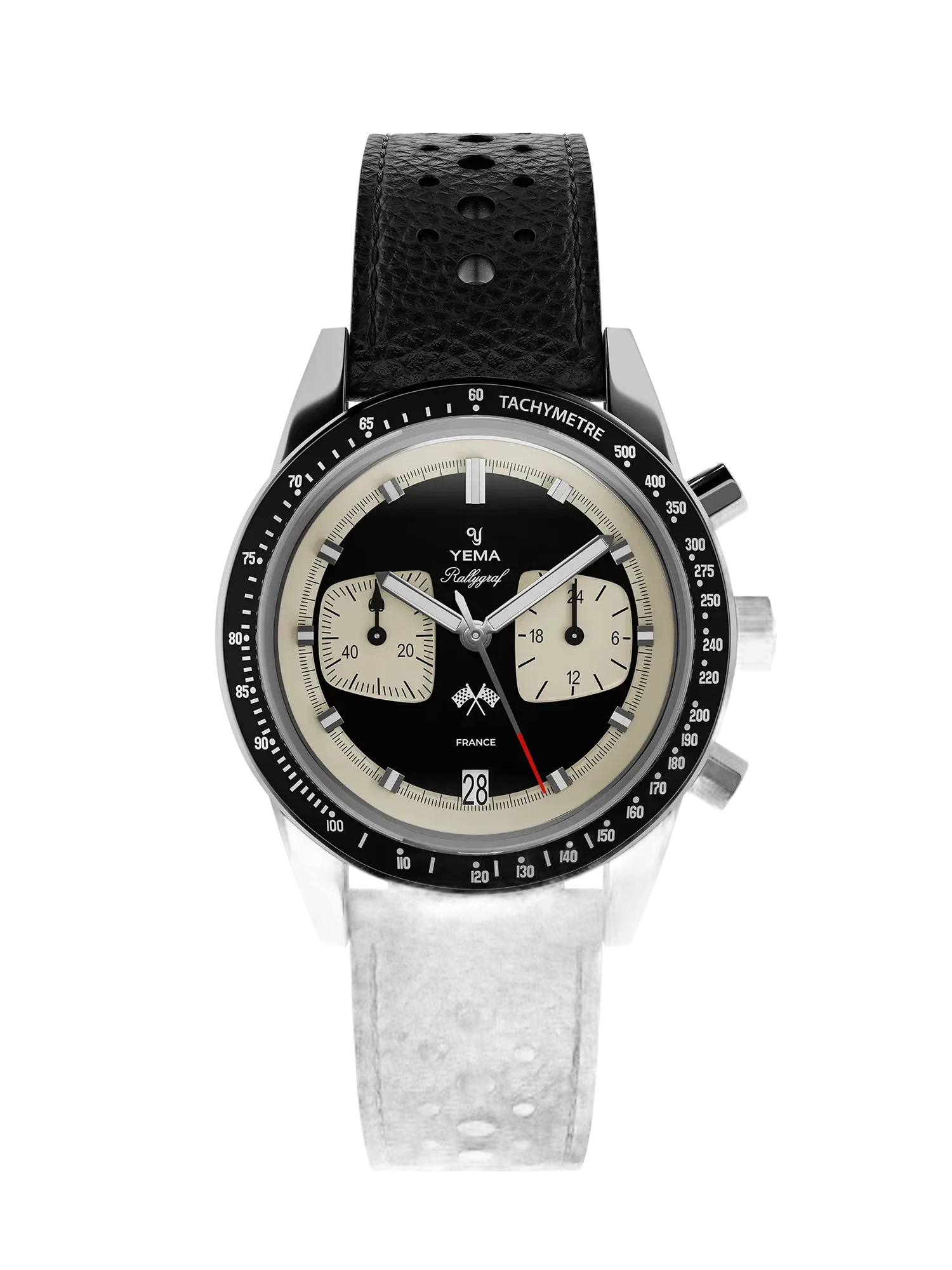
| Yema Rallygraf Meca-Quartz (YMHF1580-AA) | €369 | 39 mm | 11 mm | Not published | Seiko VK64 meca-quartz | 100 m | Best value meca-quartz |
| Omega Speedmaster 38 (324.30.38.50.01.002) | €6,400 | 38 mm | 14.75 mm | 44.96 mm | Omega 3332, chronometer | 100 m | Best premium |
| Baltic Bicompax 002 (pre-owned only) | Secondary market | 38 mm | 13 mm | 47 mm | Seagull ST1901 hand-wound | Not published | Vintage-inspired wildcard |
Four of the five are current production. The Baltic is the one deliberate exception, and it is flagged as such throughout: Baltic sold the Bicompax 002 until April 2025, so it is a secondary-market purchase only.
Related guideChronograph watches →
A chronograph has to find room for a mechanism that a three-hand watch does not carry. In an automatic, the chronograph works sits on top of the base movement or beside it, and the rotor adds another layer — which is why a 38 mm automatic chronograph routinely measures 14 to 15 mm tall while a 38 mm automatic three-hander sits nearer 11. Height is what makes a watch catch on a cuff, tip on a narrow wrist, and feel heavier than its diameter suggests.
Then there is visual bulk, which is a separate problem. Pushers and a screw-down crown widen the effective silhouette by several millimetres on the right-hand side. A tachymeter scale printed on a wide bezel eats into the dial opening, so a 39 mm chronograph can show less dial than a 37 mm three-hander. Three registers, a date window and a running-seconds sub-dial fill what is left. A watch that is physically small can still read as busy and large, and a watch that reads clean can survive an extra millimetre of diameter.
So the useful shortlist criteria are these, in order: lug-to-lug against the flat top of your wrist, case thickness, the shape of the mid-case and the curve of the lugs, how far the pushers and crown project, how much dial the bezel leaves open, and whether the bracelet or strap articulates close to the case. Diameter comes seventh.
Related guideWatches for small wrists →
Verdict: the most complete fit-led chronograph on this list, and the one we would buy without a try-on. Best for the reader who wants a proper 150 m chronograph that disappears under a shirt cuff. Christopher Ward publishes 39 mm diameter, 11.55 mm height and 45.8 mm lug-to-lug for reference C63-39QCC3-S00K0-B1, at €1,040 on the Consort bracelet, with a 20 mm lug width and an ETA G10.202 AD COSC quartz chronograph rated to ±10 seconds per year.
Why it earns its place: 11.55 mm is thin for any chronograph and unheard of at 150 m, and the 45.8 mm lug-to-lug is shorter than several 36 mm watches with straight lugs. The quartz movement is what buys that height — there is no rotor and no stacked chronograph module — and COSC certification means the compromise is precision rather than cheapness. The reverse-panda dial is a three-register layout, but the sub-dials are recessed and colour-coded rather than outlined in heavy rings, so the dial reads in one glance.
Watch out for: it is a quartz watch at four figures, which some buyers will not accept on principle, and the 20 mm lugs give the case a broad, squared-off stance that suits flat wrists better than narrow round ones. Fit analysis: with the shortest height-to-diameter ratio here, this is the pick that tolerates a 15 cm wrist as readily as a 17 cm one. The bracelet is the variable — check that the first link articulates close to the case rather than running straight out before it bends.
Verdict: the cheapest way to get genuinely small-wrist chronograph geometry from a maker that publishes its numbers. Best for a first chronograph, or a second watch that has to survive being worn badly. Seiko publishes 38.7 mm diameter, 12.6 mm thickness, 45.1 mm lug-to-lug and a 20 mm lug width for SSB477P1, with the 8T63 quartz calibre, a box-shaped Hardlex crystal, 5 bar water resistance and a steel bracelet with a three-fold clasp, at €490.
Why it earns its place: 45.1 mm lug-to-lug is the shortest reach in this group, and 12.6 mm is modest for a watch with a box crystal, which adds height for the sake of the domed profile rather than the movement. The proportions are conventional in the best sense — nothing about the case is doing anything clever, so nothing about it overhangs.
Watch out for: 5 bar is splash resistance, not swimming resistance, and Hardlex is a mineral crystal that will mark where sapphire would not. Avoid it if you want a lifetime watch — this is a well-judged tool, not an heirloom. Fit analysis: the short lug-to-lug and flat caseback make it the safest blind buy here for a wrist under 16 cm; the bracelet is the weakest part, and a 20 mm strap changes the watch more than the price suggests.
Verdict: the thinnest watch here, and the one that gives you a snapping chronograph reset for under €400. Best for the reader who wants the feel of a mechanical chronograph without its height. Yema publishes 39 mm diameter, 11 mm thickness and a 20 mm lug width for reference YMHF1580-AA, with the Seiko VK64 meca-quartz calibre, a 2 mm double-domed K1 mineral crystal, 100 m water resistance and a choice of Milanese mesh or French-made rally leather, at €369.
Why it earns its place: meca-quartz gives you a mechanical chronograph module driven by a quartz train, so the central seconds hand snaps back instantly and the pushers have real resistance — the part of a chronograph you actually interact with — while the watch stays 11 mm tall. The bi-compax dial is the cleanest layout in this guide: two registers, no 12-hour counter, and a tachymeter on a narrow bezel that leaves the dial opening generous for a 39 mm case.
Watch out for: Yema does not publish a lug-to-lug figure, and at 39 mm with a flat-ish case that is the number you would most want. Independent hands-on coverage by Fratello reports roughly 48 mm, which would make this the longest case in the guide despite being the thinnest — so treat it as a try-on if your wrist is at or below 15.5 cm. The K1 mineral crystal is also a downgrade from sapphire, and the push-pull crown is why 100 m should not be read as an invitation to dive.
Verdict: the one automatic chronograph here whose geometry genuinely works on a small wrist, and it does so by being short rather than thin. Best for the reader who wants a Swiss automatic chronograph with real provenance and will accept the height that comes with it. Omega publishes 38 mm diameter, 14.75 mm thickness, 44.96 mm lug-to-lug and an 18 mm lug width for reference 324.30.38.50.01.002, with the co-axial calibre 3332, a 52-hour power reserve, chronometer certification, 100 m water resistance, double-sided anti-reflective sapphire and a steel bracelet with a comfort-adjustment clasp, at €6,400.
Why it earns its place: 44.96 mm lug-to-lug is the shortest figure in this guide, and the 18 mm lug width narrows the silhouette exactly where a wide bracelet would otherwise spread over the edge of the wrist. The lyre lugs curve down hard, which is the single most useful case feature a small wrist can be given. Omega redesigned the collection in 2026 around recessed circular sub-dials and a pared-back dial text, so the three registers sit more calmly than they did on the previous generation.
Watch out for: 14.75 mm is tall, and no amount of short lug-to-lug hides that under a cuff. Avoid it if you wear buttoned shirts daily and resent a watch that catches. Note also that the previous Speedmaster 38 references, including 324.30.38.50.01.001, are no longer listed by Omega — if you are shopping a discount, check which generation you are being offered. Fit analysis: this is a watch that sits on the wrist rather than wrapping it, and the verdict genuinely depends on whether you mind height. Try it on before spending €6,400.
Verdict: the best hand-wound option for a small wrist, and the only discontinued watch in this guide. Baltic publishes 38 mm diameter, 13 mm thickness including the crystal — 10 mm without it — and 47 mm lug-to-lug, with the hand-wound Seagull ST1901 chronograph calibre, a 42-hour power reserve and an acrylic crystal. Baltic sold the Bicompax 002 until 1 April 2025, so this is a secondary-market purchase; prices vary by condition and market and we quote none.
Why it still deserves a mention: a hand-wound chronograph has no rotor, which is why a mechanical watch with a genuine column-wheel-era feel can measure 13 mm and drop to 10 mm at the case band. The step case and bi-compax dial keep the visual weight low, and the acrylic crystal accounts for a meaningful share of the height while adding almost none of the perceived bulk — domed acrylic reads as warmth, not thickness.
Watch out for: no warranty from the maker, no current spare-parts promise, an acrylic crystal that will scratch and need polishing, and a 47 mm lug-to-lug that is the longest reach in this guide. Baltic does not publish a water-resistance figure on the archived page, so assume none until the seller proves otherwise. Avoid it if this is your only watch or your first mechanical purchase.
Related guideVintage-inspired watches →
Shopping by diameter. A 38 mm chronograph with 49 mm of lug reach overhangs a 16 cm wrist while a 40 mm one with 45 mm of reach does not. Measure the flat top of your wrist, not its circumference, and compare that to lug-to-lug. Circumference tells you bracelet length; flat width tells you whether the case fits.
Assuming a mid-range automatic chronograph will be fine. This is the single most common disappointment, and it is not about the brands. Hamilton’s American Classic Intra-Matic Auto Chrono, reference H38416111, is a well-made, current, very likeable watch — and Hamilton publishes 40 mm diameter with a 14.45 mm case. That is the normal shape of an automatic chronograph at this price, not an outlier. If you want a mechanical chronograph under roughly €3,000, accept the height or buy hand-wound.
Ignoring the bracelet and the lugs. Straight lugs that run flat before they bend put the whole lug length on your wrist; downturned lugs shorten the effective reach. A stiff bracelet with a long first link does the same thing at the other end — it holds the case away from the wrist and makes a well-proportioned watch teeter. And a dense panda dial with a tachymeter bezel adds perceived size even when the case does not: if you want a chronograph to wear small, a bi-compax layout on a narrow bezel will do more for you than one millimetre of diameter.
Start with the movement, because it sets the height before anything else does. If thickness is your binding constraint, buy quartz or meca-quartz and stop arguing with physics: the Yema at 11 mm and the Christopher Ward at 11.55 mm are simply shapes that an automatic chronograph cannot reach at these prices. If mechanical is non-negotiable, either go hand-wound and accept the secondary market, or go premium and accept 14.75 mm.
Then let budget and daily use decide the rest. Under €500, the Seiko for a bracelet and short lugs, the Yema for a cleaner dial and a proper pusher feel. Around €1,000, the Christopher Ward is the answer for almost everyone, and its 150 m rating makes it the only one here you can stop thinking about. At €6,400, the Omega buys provenance, a chronometer-certified co-axial movement and the shortest case in the guide — at the cost of the tallest. If you wear cuffs daily, weight that cost heavily; if you live in short sleeves, it barely registers.
If your wrist is at or below 15.5 cm, or if you are choosing between two watches whose published numbers are close, a try-on settles it faster than any spec sheet. Take the seven-question quiz to find chronographs matched to your wrist, your budget and the way you actually dress.
“Diameter is the filter. Lug-to-lug and height are the verdict.”
Not by itself — 39 mm says almost nothing on its own. What matters is lug-to-lug against the flat top of your wrist, which on a 16 cm wrist is usually somewhere around 45 to 50 mm depending on how round or flat that wrist is. The Christopher Ward C63 Valour is 39 mm with 45.8 mm of lug reach and 11.55 mm of height, and that combination generally works; a different 39 mm chronograph with 49 mm lugs and straight-running lug tips generally does not. Measure the flat width, compare it to the published lug-to-lug, and check the thickness. Where those numbers are close, try the watch on.
They are thicker, and below roughly €3,000 that is close to unavoidable. Two of the current automatic chronographs cited in this guide measure 14.45 mm and 14.75 mm, and those are normal figures rather than bad ones: the chronograph works and the winding rotor each add a layer the movement would not otherwise need. Thickness is not automatically disqualifying — a short lug-to-lug and downturned lugs can make a 14.75 mm watch sit securely. It is disqualifying if you wear shirt cuffs every day, because height is exactly what catches.
For fit, hand-wound wins: removing the rotor removes a layer, which is how the Baltic Bicompax 002 gets to 13 mm including its acrylic crystal and 10 mm at the case band. The cost is a daily winding habit and, in this specific case, a discontinued watch bought without factory warranty. Automatic wins on convenience and on resale, and at the premium end — the Speedmaster 38 — it also buys chronometer certification and a service network. Choose hand-wound if thinness and character matter more than convenience; choose automatic if the watch has to be ready when you pick it up.
It is a different trade, not a lesser one. Quartz is what lets the Christopher Ward C63 Valour be 11.55 mm tall and still rated to 150 m, and its ETA G10.202 movement is COSC-certified to ±10 seconds per year — an accuracy no mechanical chronograph at any price will match. Meca-quartz, as in the Yema, keeps a mechanical chronograph module so the reset snaps and the pushers resist. What you give up is the mechanism itself: no rotor to watch, no long service life, and lower resale. On a small wrist, the height you gain is usually worth more than the mechanics you lose.
High-contrast sub-dials do increase perceived size, because they draw the eye outward to the edges of the dial and emphasise how much surface the registers occupy. A three-register panda with a printed tachymeter on a wide bezel is the busiest combination available. A bi-compax layout on a narrow bezel — the Yema, or the Baltic — reads calmer and therefore smaller at the same diameter. This is a matter of taste rather than error: if you want the panda look, take it, but expect the watch to announce itself more than its measurements suggest.
Lug-to-lug length, case thickness, bezel width, and dial layout — not diameter alone — determine fit under 38mm. Five real picks, no marketing.
July 1, 2026The Seiko Prospex Speedtimer and Tissot PRX Chronograph, compared on pusher feel, dial legibility, movement type, and real value under a €2,000 budget.
July 27, 2026The best GMT watches for small wrists: verified diameters, lug-to-lug, and flyer-vs-caller GMT type, from Longines and Tudor to Timex and Seiko.
September 13, 2026The best dress watches for small wrists balance dial-to-case ratio, lug length, and thickness, not diameter alone. Six verified picks from €315 to premium.
September 13, 2026