



Best First Dress Watch Under $1,500 You Can Wear Casually — 10h09 Journal
How to choose a first dress watch under $1,500 that works with tailoring at the office and still feels right with denim and knitwear at the weekend.
July 19, 2026The easiest way to shop for a dress watch on a small wrist is also the least reliable: pick the smallest diameter on the spec sheet. A 33mm case can still look clumsy if the dial floats inside a wide bezel, the lugs overhang the wrist's edge, or the case sits thick enough to catch a cuff. A 37mm or 38mm case, meanwhile, can wear closer to 34mm if the dial fills the bezel, the lugs curve in tight, and the whole watch is thin enough to slide under a sleeve without a fight. For wrists around or under 16cm, the variables that actually matter are dial-to-case ratio, lug length and curvature, thickness, and strap width — which is how we chose the best dress watches for small wrists below.
For a wrist around 16cm or smaller, the safest dress-watch zone is 33–37mm with a case under 8mm thick and lugs that curve close to the wrist. A well-shaped 38mm watch can still work — a badly shaped 34mm one won't.
| Watch | Price | Diameter | Thickness | Lug-to-lug | Movement | Water resistance | Best for |
|---|---|---|---|---|---|---|---|
| Tissot Everytime | €315 | 34mm | 6.92mm | Not published | Quartz | 50m (5 bar) | First dress watch |
| Longines La Grande Classique | €1,500 | 36mm | Not published | Not published | Quartz | 30m (3 bar) | Tailoring-first choice |
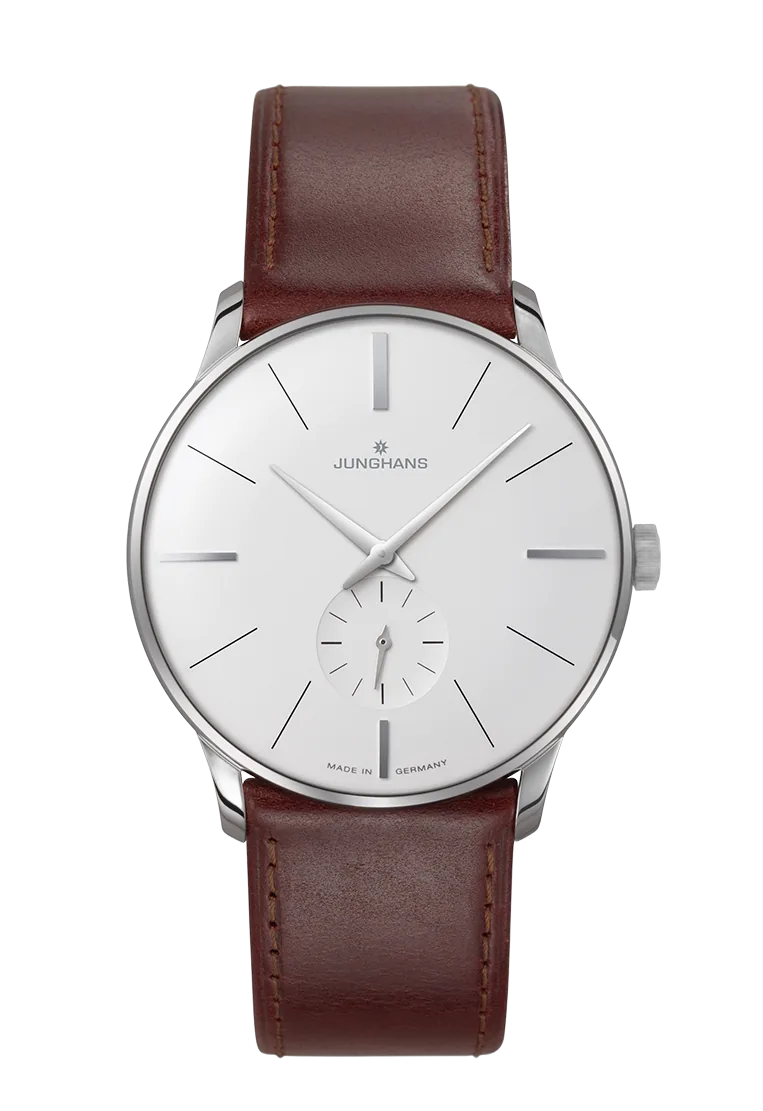
| Junghans Meister Handaufzug | €1,590 | 37.7mm | 7.3mm | Not published | Hand-wound | 50m (5 bar) | Vintage-inspired pick |
| NOMOS Glashütte Tangente | €1,720 | 32.8mm | 6.45mm | 42.2mm | Hand-wound | Splash-resistant (5 ATM) | Understated daily |
| GRAND SEIKO Heritage Snowflake | €3,300 | 33mm | 9.1mm | 39.7mm | Quartz (9F51) | 100m (10 bar) | Premium pick |
| Cartier Tank Must | $4,055 (USD) | 29.5 × 22.0mm | 6.6mm | Not published | Quartz | 30m (3 bar) | Shaped/rectangular pick |
Diameter alone tells you almost nothing about how a dress watch will actually sit. What matters more is dial-to-case ratio — how much of the case is glass and printed dial versus bare metal bezel. A 36mm watch with a slim bezel and a dial that runs nearly to the case edge reads larger and more confident than a 38mm watch with a wide, empty rim around a small printed face. On a wrist at or below 16cm, a generous dial-to-case ratio is usually more flattering than shaving another millimetre off the total diameter.
Lug length and curvature decide whether a watch actually respects the edges of a small wrist, not the diameter printed on the box. Straight, flat lugs push the case's true footprint well past its stated size and can leave a visible gap or overhang at the wrist's natural break. Lugs that curve down sharply — commonly seen on Bauhaus-influenced dress designs — pull the strap in tight to the wrist almost immediately, which is why two watches with an identical diameter can wear completely differently. Lug-to-lug (the case length from tip to tip) is the number that actually predicts this, but plenty of brands don't publish it — treat its absence as a gap to ask about, not a green light to assume the worst.
Thickness is the dimension that decides whether a dress watch disappears under a shirt cuff or catches on it every time you reach for a door handle. Most of the picks below sit between roughly 6.5mm and 9mm; anything creeping past 10mm on a dress watch usually comes from a boxed or domed crystal rather than the movement itself, which is a legitimate design choice but worth knowing before you buy.
Strap width scales with case diameter more than people expect, and a strap that's too wide for a slim wrist will make even a well-proportioned case look bolted on rather than worn. As a rough guide, look for a strap in the 16–19mm range on anything under 37mm; anything wider starts to fight the case rather than complement it. Cuff clearance is really the sum of all of this — thickness, lug curvature and strap taper together, not any single spec on its own.
The six watches below cover roughly $315 to $4,000+, are drawn from brands across Switzerland, Germany, and Japan, and are all currently in production and checked against official specifications. Each earns its place in a different way — read the fit rationale, not just the verdict, before deciding which one matches your wrist and your wardrobe.
The Tissot Everytime at 34mm is the watch to start with if you've never owned a dedicated dress watch and don't want to spend dress-watch money to find out whether you'll wear one. At €315, it clears the bar on the basics that matter most on a small wrist: a 34mm steel case that's just 6.92mm thick, a sapphire crystal instead of the mineral glass this price usually gets, and a blue dial with a clean, uncluttered layout that doesn't fight the case for attention. Best for: a first dress watch, or a no-drama option you're not afraid to wear daily.
Watch-out: Tissot doesn't publish a lug-to-lug figure for this reference, and the quartz movement means you're trading the small mechanical pleasures of the Tangente or the Meister Handaufzug below for a battery you'll swap every few years — a fair trade at this price, but worth naming. The fit case is straightforward: at 34mm with a slim bezel and a thin case, it sits close and low on a wrist at or under 16cm without any of the calculation a larger watch demands. If you want the same accessible price bracket but with a bit more presence on the dial, the Longines Grande Classique two sections down is the natural step up.
Related guideWatches Under $1,000 →
If your dress watch mainly needs to disappear under a cuff at the office and reappear looking sharp at dinner, La Grande Classique de Longines is built for exactly that brief. At 36mm on a black leather strap with a white dial and Roman numerals (ref. L4.755.2.11.2, €1,500), it's one of the longest-running proof points that a slim quartz dress watch can look more expensive than it costs. Best for: readers who want one watch that works with a suit five days a week and doesn't ask to be noticed.
Watch-out: Longines doesn't publish a thickness or lug-to-lug figure for this reference, which is a real gap for a wrist-fit guide — what we can confirm directly from Longines is the 36mm case, the quartz movement, and the sapphire crystal. This collection has kept close to the same slim proportions for decades, which is reassuring but not the same as a verified number, so treat the fit as very likely favourable rather than confirmed to the millimetre. If Roman numerals and leather aren't your style, the Tissot above covers similar accessible ground with a plainer three-hand layout.
The Meister Handaufzug is Junghans's hand-wound take on its own 1930s Bauhaus watchmaking, and at 37.7mm it's the watch in this guide that does the most to prove the point: a well-shaped case a couple of millimetres over 36mm can still wear small. At €1,590 (ref. 27/3200.02), you get a matte silver dial, an offset small-seconds sub-dial, and a hand-wound caliber (J815.1). Best for: a first genuinely vintage-feeling mechanical dress watch, especially for readers who want winding their watch to be a small daily ritual.
Watch-out: at 7.3mm thick, this is one of the slimmer watches here, but Junghans doesn't publish a lug-to-lug figure, and the small-seconds sub-dial position isn't specified either — both are gaps in Junghans's own spec sheet, not omissions on our part. The 37.7mm diameter is the one figure in this guide that's genuinely borderline for a wrist at or under 16cm; it earns its place because the round Bauhaus case has short, closely-set lugs by design, not because the number itself is small. If 37.7mm still feels like too much watch, the NOMOS Tangente 33 below is the more conservative version of the same design language.
The Tangente 33 is the watch that best makes this guide's central argument: at 32.8mm, it's smaller on paper than everything else here, but the combination of a wide, uninterrupted dial, a 6.45mm-thin case, and a 42.2mm lug-to-lug — NOMOS is one of the only brands on this list that publishes that figure — means it reads as fully grown-up rather than small. At €1,720 (ref. 122), it's hand-wound (NOMOS's in-house DUW 4001 caliber), which shows in the tempered blue hands and the offset small-seconds dial that's become the house signature. Best for: readers who've decided that thinness and proportion matter more than diameter, full stop.
Watch-out: NOMOS rates this reference 5 ATM, splash-resistant rather than swim-rated, and the beige leather strap is not a bracelet — factor in a strap swap or two over the watch's life. Because both the diameter and the lug-to-lug are genuinely small, this is the safest fit call in the entire guide for a wrist at or under 16cm; there's very little judgment required here compared with the borderline calls elsewhere in this list. If you'd rather have the same proportions with a small window onto the movement, the sapphire-back version (ref. 123) is €220 more.
The SBGX359 — nicknamed "Snowflake" for its textured white dial — is Grand Seiko's case for what a slim quartz dress watch looks like when cost isn't the constraint. At 33mm and a genuinely thin 9.1mm, with a 39.7mm lug-to-lug confirmed directly by Grand Seiko, it undercuts several cheaper watches in this guide on every fit dimension that matters. At €3,300, the 9F51 quartz caliber is accurate to about 10 seconds a year, and the dual-curved sapphire crystal and Zaratsu-polished case are the reasons the price sits where it does rather than in mechanical-movement territory. Best for: readers who want the smallest, thinnest watch in this guide and are willing to pay for it.
Watch-out: Grand Seiko doesn't state the bracelet material on its own spec sheet for this reference, only band width and clasp type — expect steel, in keeping with the rest of the Heritage line, but confirm before ordering if it matters to you. There's very little to relitigate on fit here — this is the most conservatively proportioned watch in the entire list — so the real decision is budget, not sizing. If €3,300 is more than you want to spend but you like the idea of a compact quartz Grand Seiko, the brand's Heritage line runs other similarly compact references worth researching on the same terms.
A rectangular case changes the fit math completely, and the Tank Must in its Small size (29.5 x 22.0mm, ref. WSTA0107) is the version actually proportioned for a wrist at or under 16cm — Cartier's Large Tank Must, at 33.7 x 25.5mm, runs a real risk of overhanging a wrist this size. At 6.6mm thick, with a silvered dial and blued-steel sword hands on a steel bracelet, it's the one non-round case in this guide that still respects the brief. Best for: readers who want a genuinely shaped dress watch rather than a round case that merely reads as "dressy."
Watch-out: this exact reference was showing as boutique-only rather than orderable online at the time of writing, and Cartier didn't display a Euro price as a result — budget in the neighbourhood of $4,055 and confirm current pricing and availability with a Cartier boutique before you commit. Cartier also doesn't publish a lug-to-lug figure for the Tank Must, and describes the crystal only as "square-shaped glass" rather than confirming sapphire, so treat that detail as unconfirmed rather than assumed. This is also the one role in this guide without a cheaper verified alternative on the same fit logic — treat it as optional rather than essential if budget or availability is a blocker.
Thirty-six millimetres has become the internet's default answer for 'small-wrist dress watch,' and it's a reasonable one — every watch in this guide sits at or under 36mm except the Junghans. But 36mm is a convenient starting point, not a hard ceiling. The Junghans Meister Handaufzug above is 37.7mm, and it wears closer to 36mm than the number suggests because the round Bauhaus case keeps its lugs short and the whole watch thin at 7.3mm.
The honest rule is this: a 38mm watch has to earn its place with a slim case, tight lugs, and a bezel that doesn't eat into the dial — it doesn't get a pass just because 38mm is technically still 'not huge.' If a 38mm watch is thick, long-lugged, or has a chunky bezel around a small printed dial, it will wear larger than a well-shaped 36 or even 37mm case. Use diameter to narrow the search, then use dial-to-case ratio, lug-to-lug, and thickness to actually decide.
Start with how formal your actual wardrobe gets. If you're in a suit most weekdays, lean toward the more restrained dials here — the Longines or the Tissot's plain layout — over the shaped Cartier, which reads more distinctly as jewellery than as office wear. Movement is mostly a matter of ritual versus convenience: quartz (Tissot, Longines, Grand Seiko, Cartier) means no winding and excellent accuracy for the money; hand-wound (NOMOS, Junghans) means a daily wind and a level of mechanical engagement some readers actively want from a dress watch and others find pointless.
Budget maps roughly to how often you'll actually wear the watch. If it's an occasional-wear piece for meetings and events, the Tissot or Longines make more financial sense than the Grand Seiko or Cartier, which reward daily use. Strap and dial choice is genuinely personal, but on a small wrist, a strap width in the 16–19mm range and a dial that isn't crowded by a wide printed chapter ring will do more for the fit than any brand name.
Related guideDress Watches →
If you only remember one thing from this guide, make it this: on a wrist around or under 16cm, diameter is the least useful number on the spec sheet. Check dial-to-case ratio, lug-to-lug where it's published, thickness, and strap width before you check the millimetre count — and when a brand doesn't publish one of those figures, treat that as a reason to ask before you buy, not a reason to guess. Take the seven-question quiz to find watches that are genuinely built for your fit.
No — 36mm is one of the safest diameters for a small wrist on either a men's or women's dress watch, provided the case is reasonably thin and the lugs are short. The risk at 36mm comes from a thick case or long, flat lugs, not the diameter itself.
Yes, but only if the case earns it: a slim profile (under about 8–9mm), lugs that curve down close to the wrist, and a dial that fills most of the bezel. A 38mm dress watch built this way, like the Junghans in this guide at 37.7mm, can wear closer to 36mm than the number implies.
Most of the watches in this guide sit between roughly 6.5mm and 9mm. Anything meaningfully thicker than that on a dress watch usually comes from a domed or boxed crystal rather than the movement, which is a fair trade for some people but worth knowing before you buy.
Yes — several picks here, like the Tissot Everytime and the NOMOS Tangente 33, are built specifically for daily wear rather than occasional use. The main daily-wear trade-off is water resistance: most dress watches in this range are rated for splashes, not swimming, so treat them accordingly.
How to choose a first dress watch under $1,500 that works with tailoring at the office and still feels right with denim and knitwear at the weekend.
July 19, 2026Lug-to-lug length, case thickness, bezel width, and dial layout — not diameter alone — determine fit under 38mm. Five real picks, no marketing.
July 1, 2026Dress watch vs tool watch: how to choose the right category when you can only own one. A practical decision guide based on how you actually live.
July 6, 2026The best GMT watches for small wrists: verified diameters, lug-to-lug, and flyer-vs-caller GMT type, from Longines and Tudor to Timex and Seiko.
September 13, 2026Chronographs are hard to shrink. Five that genuinely suit smaller wrists, judged on lug-to-lug, thickness and pusher bulk rather than diameter alone.
September 13, 2026