Best Watches for Small Wrists: What Actually Wears Well Under 38mm
Lug-to-lug length, case thickness, bezel width, and dial layout — not diameter alone — determine fit under 38mm. Five real picks, no marketing.
July 1, 2026A small-wrist G-SHOCK shortlist should start with the references Casio has actually downsized — not with the standard GA-2100 and an assurance that it wears smaller than its numbers suggest. Downsizing the case only solves half the problem. The band still has to close at a comfortable setting, sit flat against your wrist, and hold the watch steady without digging in. A compact case on the wrong band is still the wrong watch. This guide compares published dimensions and Casio's own band-compatibility ranges, then walks through the checks you need to make yourself once a reference arrives. The shortlist below is built from manufacturer specifications, not hands-on testing.
Start with the GMA-P2100-7A for the narrowest, lightest case in this shortlist, or the GMD-S5610BB-1 for a compact digital square with the same 145–190 mm band range. If your wrist falls below that 145 mm minimum, the wider GMA-S2100-1A is compatible from 140 mm instead. Add the GW-M5610U-1ER only if solar charging and radio time sync are worth its extra size. None of these fits every wrist without trying it on first.
Measure your wrist where you'll actually wear the watch, using a flexible tape or a strip of paper and a ruler. Record the circumference without pulling tight enough to compress your skin.
Casio's "compatible band size" is an adjustment range, not a comfort guarantee. Passing the lower bound means the band can close around your wrist — it doesn't mean the case, strap curvature or buckle position will feel right once it does.
The GMA-P2100-7A makes that point directly. It's narrower than the GMA-S2100-1A, yet its published band range starts at 145 mm against the S2100's 140 mm. A smaller case doesn't automatically mean a lower band minimum, so check both numbers separately before you shortlist anything.
| Reference | Case L × W × H | Weight | Band-compatible range |
|---|---|---|---|
| GMA-P2100-7A | 46 × 40.2 × 11.2 mm | 40 g | 145–190 mm |
| GMD-S5610BB-1 | 45.7 × 40.5 × 11.9 mm | 42 g | 145–190 mm |
| GMA-S2100-1A | 46.2 × 42.9 × 11.2 mm | 41 g | 140–205 mm |
| GW-M5610U-1ER | 46.7 × 43.2 × 12.7 mm | 52 g | 145–205 mm |
These are Casio's case length, width and thickness figures — not lug-to-lug, and not the width across a strap's rigid or outward-flaring sections. Confirm those on the finished watch, not from the case alone. All four references share mineral glass and a 200-metre water-resistance rating, so compactness doesn't come at the cost of that spec here.
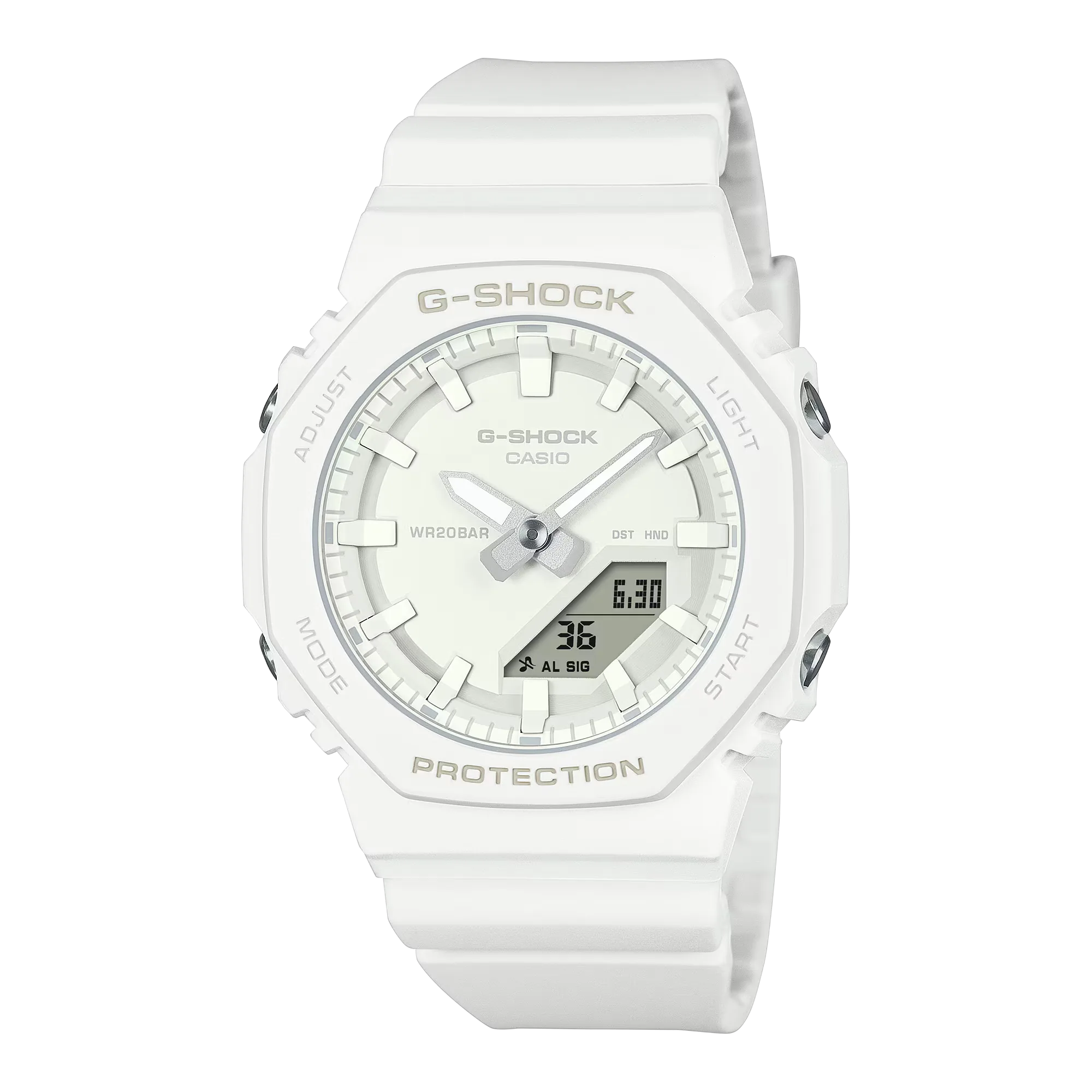
Best for: someone who wants hands and an octagonal case in the narrowest, lightest reference of the four, provided the band range suits their wrist.
Why it works: at 40.2 mm wide and 11.2 mm thick, the white GMA-P2100-7A is a real reduction from the standard GA-2100-1A's 45.4 mm width — 5.2 mm narrower and 11 g lighter. Casio drops the GMA-S2100's separate inset dial and fits a shorter band, giving it a different layout rather than just a smaller GA-2100. It keeps world time, five daily alarms, a 24-hour countdown timer and double LED illumination.
Watch-outs: the 145 mm lower band limit is the constraint that matters most for a very small wrist. It runs on a CR1025 battery with an estimated three-year life — this isn't the solar version.
Best for: someone who wants digital-only timekeeping rather than analog-digital hands, in a smaller case than the standard squares.
Why it works: at 45.7 mm long, it's the shortest case in this shortlist, with a 40.5 mm width close to the P2100's and the same 145–190 mm band range. It adds a 24-hour countdown with auto-repeat and a multi-function alarm, and uses an inverted, all-black display rather than the standard-square layout — worth checking in person, since an inverted LCD reads differently under some lighting.
Watch-outs: don't confuse it with the older GMD-S5600-1, which Casio lists at 41 g with a 145–200 mm range rather than this watch's 42 g and 145–190 mm. It runs on a CR1616 battery with an estimated three-year life and isn't solar-powered.
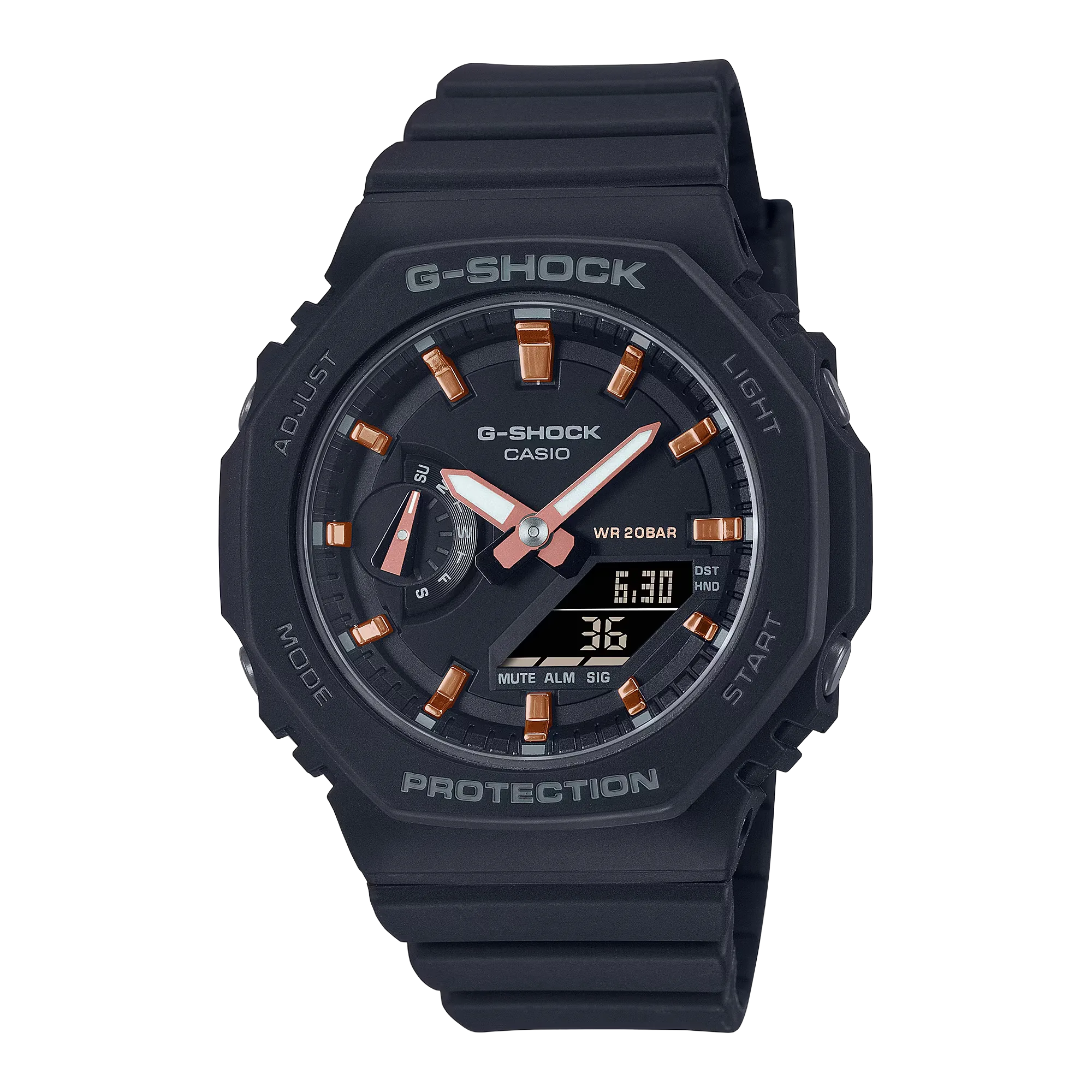
Best for: someone who likes the CasiOak case shape and needs a lower band minimum than the GMA-P2100 provides.
Why it works: Casio's listing gives the GMA-S2100-1A a 140–205 mm compatible band range — 5 mm lower than the P2100's — in a Carbon Core Guard case that keeps the separate day-of-week inset dial the P2100 drops. It shares the P2100's 11.2 mm thickness despite being 2.7 mm wider, and runs on two SR726W batteries rated for about three years.
Watch-outs: that extra 2.7 mm of width still matters on a genuinely small wrist. A lower band minimum doesn't cancel out a case that sits awkwardly once it's on.
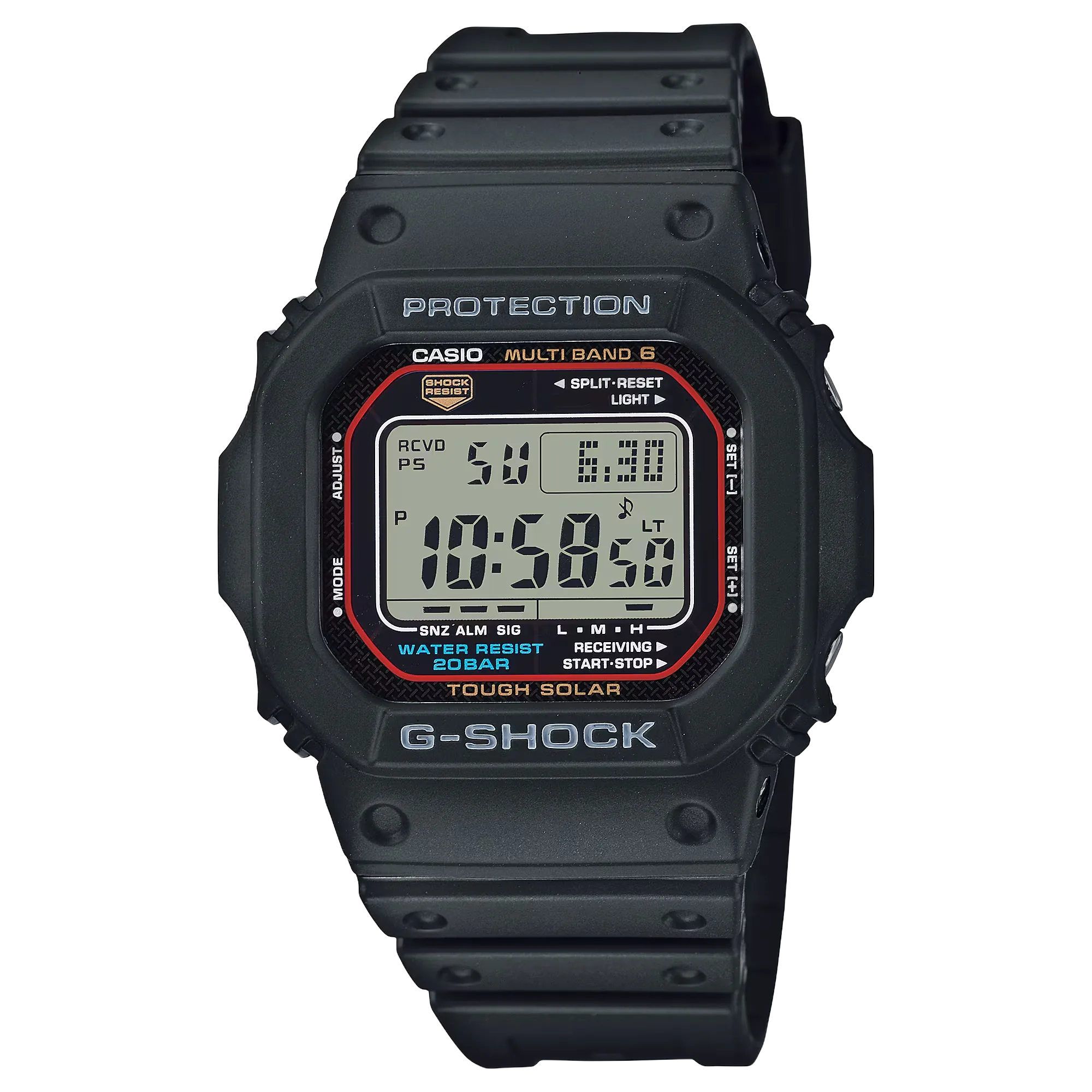
Best for: someone who wants Tough Solar charging and Multi Band 6 radio time sync, and has room for a larger case.
Why it works: the GW-M5610U-1ER pairs solar charging and radio-controlled time adjustment with a 145–205 mm band range. It's the functional alternative to a battery-only square, not an equally compact one.
Watch-outs: at 46.7 × 43.2 × 12.7 mm and 52 g, it's longer, wider, thicker and heavier than the GMD-S5610BB-1. That's the size cost of its feature set — try the complete watch before deciding it's worth it.
Related guideSolar watches →
Use the manufacturer range as a first filter, then put the actual reference on your wrist. Find an adjustment hole that holds the watch securely without squeezing — don't assume the smallest hole will feel right just because your measurement falls inside the stated range.
Look at the strap immediately beside the case to see whether it wraps around your wrist or presses against the sides while the watch perches above it, then bend your wrist forward and back to check for pressure against your hand rather than judging a still photograph.
Check the buckle position and the remaining strap tail, make sure it stays controlled in the keeper, and operate the functions you actually use. A smaller case isn't a benefit if the interface no longer suits you.
If you replace the band, verify compatibility with the full reference and attachment geometry, not just a generic "2100" label, and check the fitted result — a replacement band doesn't inherit the original's compatibility range automatically.
Casio lists several of these compact references in its women's range. That's a catalogue category, not a wrist measurement — choose on dimensions, display and colourway rather than ruling a watch out because of the label.
Reject anything whose band doesn't support your measured wrist, try the cases that remain, then decide between hands and a digital display, and finally whether solar charging or radio sync justifies the extra size of the GW-M5610U-1ER. Start with the GMA-P2100-7A for the narrowest case, the GMD-S5610BB-1 for a compact digital square, or the GMA-S2100-1A if its lower band minimum matters more than its 2.7 mm of extra width.
Take the seven-question quiz to find G-SHOCKs — and other watches — that are genuinely sized for your wrist.
Related guideWatches for small wrists →
“The smallest case isn't always the watch that fits best on the smallest wrist.”
No. The GMA-P2100-7A measures 46 × 40.2 × 11.2 mm against the GMA-S2100-1A's 46.2 × 42.9 × 11.2 mm — the P2100 is narrower and very slightly shorter, but not thinner, and it drops the S2100's separate inset dial.
Its published 145–190 mm band range sits above a 140 mm wrist, so check the GMA-S2100-1A instead — Casio lists that one from 140 mm. Neither published range guarantees comfort; try the actual watch before buying.
No. It runs on a CR1616 battery rather than Tough Solar. The GW-M5610U-1ER adds solar charging and radio time sync, but it's longer, wider, thicker and heavier — treat it as a fit-versus-feature choice, not a smaller equivalent.
No. The comparison table uses Casio's length × width × thickness convention, not an independently measured lug-to-lug span or strap width. Confirm those on the finished watch if they matter to you.
Not automatically. Confirm the exact attachment compatibility, and try the finished configuration — a different band can change the fit, but it won't shrink an oversized case or guarantee a comfortable adjustment.
Lug-to-lug length, case thickness, bezel width, and dial layout — not diameter alone — determine fit under 38mm. Five real picks, no marketing.
July 1, 2026Explore Casio G-SHOCK through its squares, 2100 designs and metal models. Understand the features, wrist fit and trade-offs before choosing yours.
October 2, 2026Chronographs are hard to shrink. Five that genuinely suit smaller wrists, judged on lug-to-lug, thickness and pusher bulk rather than diameter alone.
September 13, 2026Choose a G-Shock square by power, time adjustment, display and construction. Compare battery, solar, Bluetooth, metal-covered and full-metal options.
October 2, 2026