Casio G-SHOCK Decoded: Styles, Features and Wrist Fit
Explore Casio G-SHOCK through its squares, 2100 designs and metal models. Understand the features, wrist fit and trade-offs before choosing yours.
October 2, 2026
G-SHOCK is part of Casio, so this isn't a contest between two manufacturers. It's a choice between different priorities: a watch built around shock resistance, and a simpler watch that may be easier to wear. The useful question isn't whether G-SHOCK has a reputation for toughness — it's whether that toughness improves your actual week enough to justify the size, controls and cost. Three models make the decision concrete: the DW-5600UE-1 for straightforward protection, the GW-M5610U-1 for solar and radio convenience, and the GA-2100-1A1 for an analog-digital design. The basic F-91W-1 makes the counterargument.
G-SHOCK watches are worth buying when shock protection, swimming-ready water resistance and useful timing functions matter more than a slim case. A basic Casio is the better buy when you mainly want a light, unobtrusive watch for everyday timekeeping — and a solar G-SHOCK earns its place for charging and time-setting convenience, not because every G-SHOCK needs the expensive upgrade.
A G-SHOCK's premium over a basic Casio comes down to three things: how much abuse the case and crystal are built to take, how useful the timing functions actually are, and how much convenience a specific reference adds on top. None of it is automatic — it depends on the exact watch.
The DW-5600UE-1, GW-M5610U-1 and GA-2100-1A1 all carry Casio's shock-resistant construction and a 200-meter water-resistance rating. The F-91W-1 is specified simply as "Water Resistant" — its product page does not give it the same shock-resistant rating.
That distinction matters if your watch regularly takes knocks, vibration or swims. Casio's own operating guidance separates shock-resistant watches from ordinary daily-use watches for activities involving strong vibration and strenuous sport — it is not a promise that a G-SHOCK cannot break.
For water use, follow the manual rather than treating "200 meters" as permission for any underwater activity. Casio's guidance for the GW-M5610U's module allows swimming at the 20-bar rating but prohibits scuba diving with air tanks, and tells owners not to operate the buttons while the watch is wet or submerged.
The F-91W-1 is not an equivalent swimming watch. Its simpler water-resistance designation sits in a different category, even though it remains a perfectly sensible everyday watch.
The DW-5600UE-1 adds a countdown timer and a full auto-calendar on top of its stopwatch and alarm. The F-91W-1 already has a stopwatch, daily alarm and LED light, so those alone aren't a reason to upgrade — but its calendar assumes February always has 28 days, rather than handling leap years automatically.
A countdown timer is the more meaningful difference if you time workouts, cooking or short tasks. If you mostly just check the time and the odd alarm, the simpler Casio may already cover what you need.
The GW-M5610U-1 adds Tough Solar charging and Multi-Band 6 radio time sync. Both make sense if you want less routine upkeep — provided the watch gets enough light and can pick up the relevant time signal.
The DW-5600UE-1 and GA-2100-1A1 are conventional battery-powered watches. Buying a G-SHOCK doesn't automatically buy solar charging or radio sync — compare the exact reference, not the badge.
The specifications below come from Casio's international product pages, except the GW-M5610U-1, which uses Casio's European page — they describe the exact references, not whatever generation an older retailer listing might actually ship. Dimensions follow Casio's length × width × height convention; length is not a measured lug-to-lug span.
| Exact reference | Case size (L × W × H) | Weight | Water resistance | Power source | Best for |
|---|---|---|---|---|---|
| Casio F-91W-1, black resin | 38.2 × 35.2 × 8.5 mm | 21 g | "Water Resistant" | CR2016, ~7 years | Low-profile daily timekeeping |
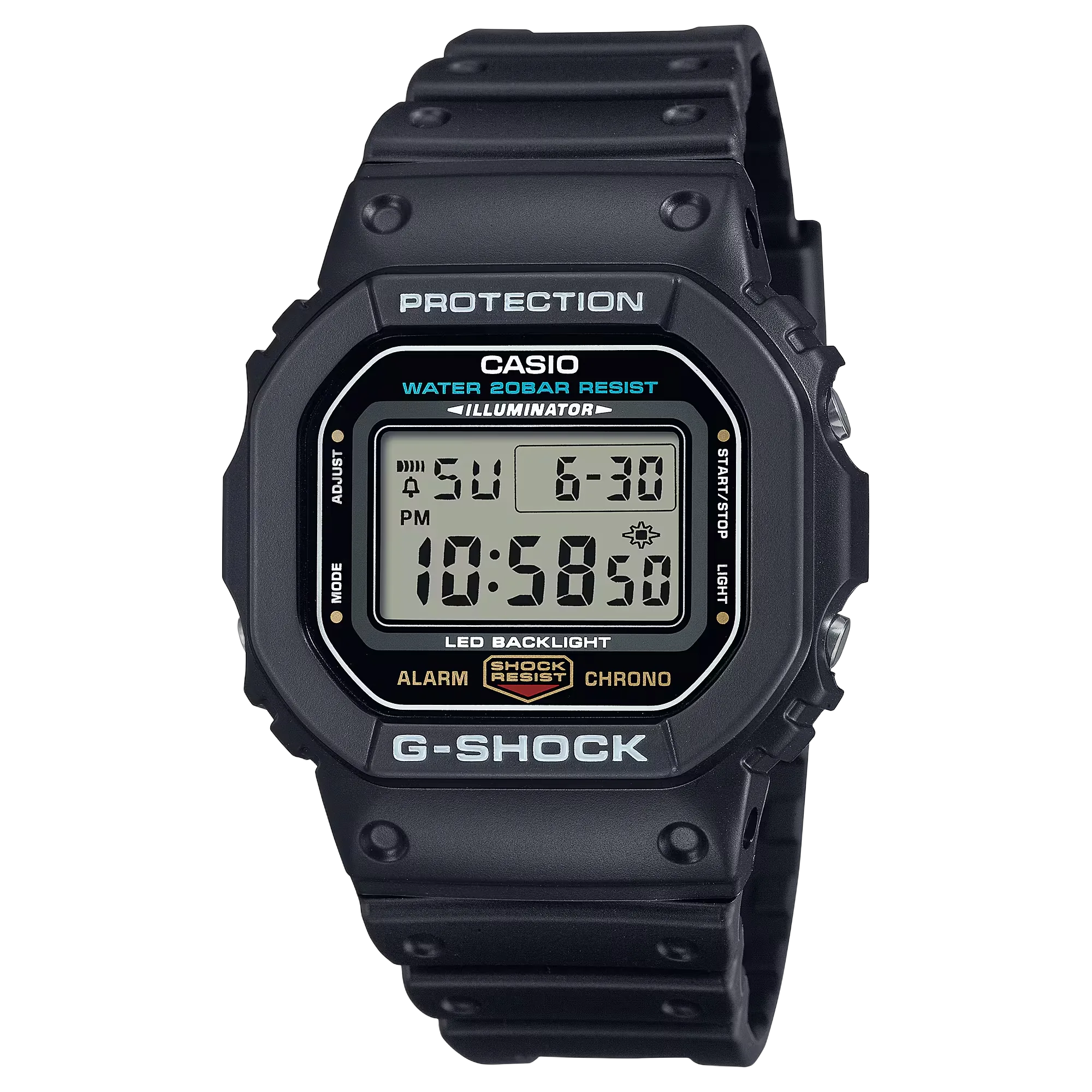
| G-SHOCK DW-5600UE-1, black resin | 48.9 × 42.8 × 13.4 mm | 52 g | 200 m | CR2016, ~5 years | Straightforward protection, countdown timer |
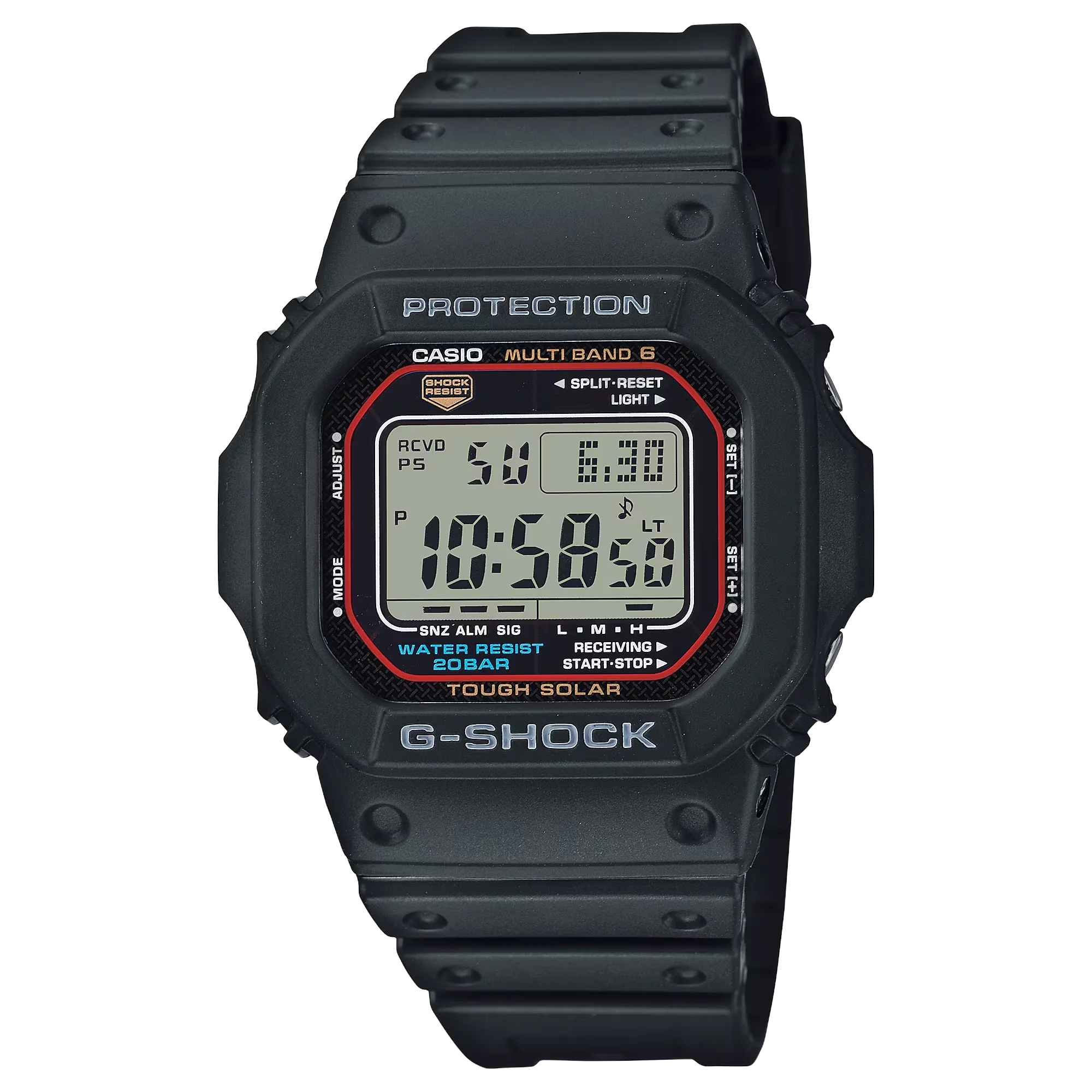
| G-SHOCK GW-M5610U-1, black resin | 46.7 × 43.2 × 12.7 mm | 52 g | 200 m | Tough Solar, rechargeable | Solar charging, radio time sync |
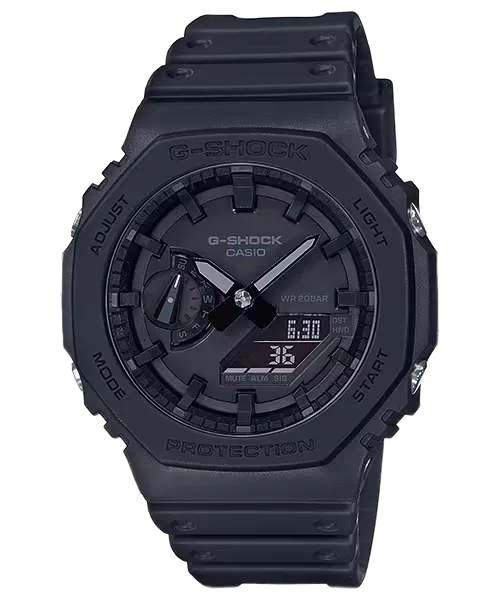
| G-SHOCK GA-2100-1A1, blackout resin | 48.5 × 45.4 × 11.8 mm | 51 g | 200 m | Two SR726W cells, ~3 years | Analog-digital display, octagonal styling |
Battery estimates are Casio's own figures, not guaranteed ownership lifespans — and a solar watch's rechargeable reserve is a different measurement from years-to-replacement, so don't compare them as if they were the same thing.
One result stands out: the basic F-91W-1 has a longer stated primary-battery life than either battery-powered G-SHOCK here. G-SHOCK's case for itself is protection and specific functions, not automatic superiority on every spec. Accuracy runs the other way, though — Casio rates all three G-SHOCKs at ±15 seconds a month, against ±30 seconds a month for the F-91W-1.
Each reference below earns its place for a different reason. Match the one that fits how you'll actually use it, not the one with the longest spec sheet.
Best for: someone who wants a digital watch for knocks, swimming and everyday timing, without solar or radio features.
Why it works: the square layout packs a stopwatch, countdown timer, multi-function alarm and LED backlight into a shock-resistant, 200-meter case. It's the sensible starting point when protection is the actual reason you're buying a G-SHOCK.
Watch-outs: at 13.4 mm thick, it's substantially chunkier than the F-91W-1's 8.5 mm — don't assume it'll disappear under a close-fitting cuff, and check you can comfortably work its buttons before buying.
US naming needs care here. Specialist reporting documents the updated DW-5600UE-1 being sold under the older DW5600E-1V listing name — if you specifically want the updated version, ask the seller to confirm the actual reference and module (3525) rather than trusting the product title.
Best for: someone who wants the square digital format but would value solar charging and automatic time correction where reception works.
Why it works: Tough Solar and Multi-Band 6 cover two practical jobs — powering the watch and keeping its time correct. It also adds world time, a countdown timer and five daily alarms, including a snooze alarm.
Watch-outs: solar isn't permission to leave the watch in a drawer indefinitely — the rechargeable cell still depends on light exposure and can lose capacity over time. Radio reception depends on location, interference and settings; it isn't a synchronize-anywhere system.
US listings can call this watch GWM5610-1. Independent reporting documents the updated GW-M5610U-1 being supplied under that name, but a retailer's legacy title isn't a guarantee — confirm the U reference or module 3495 if the updated LED and functions matter to you. Buy it over the base square when you'll genuinely use the solar and radio convenience, not because it promises a higher water rating: both squares here are rated to the same 200 meters.
Related guideSolar watches: a buyer's guide →
Best for: someone who prefers hands and an octagonal case over a full digital square, and specifically wants the blackout colorway.
Why it works: analog time display combines with digital timing functions, world time, five daily alarms and a double LED light. Its Carbon Core Guard construction keeps the shock resistance, in a case that's a thinner 11.8 mm.
Watch-outs: it's still 45.4 mm wide, and being thinner than the two squares doesn't make it narrower or a better fit for your wrist. The deliberately monochrome treatment also makes contrast worth checking — make sure you can read the hands and digital display in the lighting you actually use.
This exact GA-2100-1A1 runs on replaceable batteries — it isn't a solar upgrade just because it belongs to the 2100 family. Buy it for the design, not as a feature-for-feature substitute for the solar square.
Best for: someone who wants time, date, a daily alarm and a stopwatch in a thin, light package, without the G-SHOCK protection spec.
Why it works: at 21 g and 8.5 mm thick, it prioritizes low bulk over a protective case. That makes it the stronger pick when weight and cuff clearance matter more than a countdown timer or heavier water resistance.
Watch-outs: it has no countdown timer, and its "Water Resistant" rating shouldn't be read as equivalent to a 200-meter swimming-ready watch. Choose it because the simpler brief actually fits your life — not as an interchangeable rugged alternative.
Related guideHow to choose an everyday watch →
A spec sheet can't settle fit, legibility or long-term upkeep on its own — four things worth checking before you commit to any of these.
A G-SHOCK's spec sheet can't tell you exactly how its case and strap will sit on your wrist. Don't substitute case length for a measured lug-to-lug, or for the rigid span created once the strap makes its first bend.
Try the exact model with the strap adjusted. Check whether it sits securely, whether the case interferes with wrist movement, and whether it clears the sleeves you actually wear. A thinner GA-2100 and a shorter solar square each solve a different part of the fit problem — neither is automatically the better choice for a smaller wrist.
A durable watch is still the wrong daily tool if you can't read it quickly or use its timer comfortably. Test the normal viewing angle, the display under indoor lighting, and the light button. For the blackout GA-2100-1A1, treat legibility as a purchase condition, not an acceptable surprise after delivery.
The GW-M5610U's manual shows setup requires button sequences and mode navigation. Radio sync cuts down on routine time adjustment once it's set up correctly — it doesn't remove the need to learn the controls.
Casio warns that daily use and long-term storage can cause resin parts to deteriorate, bend or break. Keep the case and band clean, rinse off seawater with fresh water, and stop wearing a band that's cracked or lost its flexibility.
Solar power cuts down on routine battery swaps, not all maintenance — Casio also warns that a rechargeable cell's capacity or charging efficiency can decline over time. Don't buy a solar watch expecting it to need zero attention.
Water resistance needs upkeep too. Casio recommends periodic gasket checks and a trained technician for battery changes and water-resistance testing. A high rating isn't permission for hot baths, sauna use, or operating submerged buttons.
Across these three G-SHOCKs, the useful distinctions are clear: the DW-5600UE-1 supplies the protective digital basics, the GW-M5610U-1 adds solar and radio convenience, and the GA-2100-1A1 changes the display and styling. All three share the same 200-meter water-resistance rating.
That doesn't rank every G-SHOCK reference, or deny that other models use different materials or features. It gives you a simple discipline: identify the feature you actually want, confirm the exact reference has it, and decide whether it earns its place on your wrist. A spec you'll never use isn't a personal upgrade.
Buy the DW-5600UE-1 when protection and a countdown timer are the point. Buy the GW-M5610U-1 when solar charging and radio time adjustment are worth adding. Choose the GA-2100-1A1 when the analog-digital blackout design is what you actually want, and you've checked its readability.
Keep the F-91W-1 on your shortlist when the main requirement is a thin, light timekeeper. You don't need to invent a rugged-use case to justify spending more — and you don't need to pretend a basic Casio offers the same protection to justify spending less.
Before paying, confirm the supplied reference and generation, compare the actual price from a seller you trust, and try the exact configuration for fit and legibility. The right G-SHOCK earns its purchase through use, not reputation alone.
Take the 10h09 quiz to find watches that match your budget, wrist fit, style and everyday priorities.
“Buy a G-SHOCK for the protection and features you'll actually use, not for the assumption that a bigger watch is automatically a better one.”
No — G-SHOCK is Casio's shock-resistant watch range. "G-SHOCK versus Casio" is shorthand for comparing a G-SHOCK with another Casio watch, not two unrelated manufacturers. The F-91W-1 is a useful basic-Casio example, but its specifications don't describe every non-G-SHOCK Casio.
It can be, particularly if you also want the same watch for swimming or activities where it'll get knocked around. If your routine is mostly desk work and you want low weight and easy cuff clearance, the F-91W-1's smaller, thinner case may be the better fit. Check the G-SHOCK's exact dimensions rather than assuming every model is equally bulky.
The three G-SHOCK references here have manufacturer-specified 200-meter water resistance. Casio's 20-bar guidance allows swimming, but the module 3495 manual prohibits scuba diving with air tanks and says not to operate the buttons while the watch is wet or submerged. Follow the exact watch's manual and keep its seals maintained — the rating isn't a guarantee against every kind of water exposure.
The GW-M5610U-1 is worth considering if you want solar charging and radio-controlled time adjustment in the square format. It still needs adequate light, and radio reception is conditional on location. The DW-5600UE-1 remains the sensible choice if you'd rather have straightforward battery-powered operation and don't need those extras.
No. The GW-M5610U-1 has Tough Solar, but the DW-5600UE-1 and GA-2100-1A1 covered here use replaceable primary batteries. Confirm the power source on the exact reference — a family name, similar-looking case or retailer's shortened title isn't enough.
Explore Casio G-SHOCK through its squares, 2100 designs and metal models. Understand the features, wrist fit and trade-offs before choosing yours.
October 2, 2026Choose a G-Shock square by power, time adjustment, display and construction. Compare battery, solar, Bluetooth, metal-covered and full-metal options.
October 2, 2026Understand the G-Shock 2100 families: resin, solar Bluetooth, metal-covered, steel bracelet and full metal, plus compact CasiOak alternatives.
October 2, 2026Choose the right G-SHOCK for everyday wear, work, travel or outdoor activities. Compare four exact models, useful features and fit trade-offs.
October 6, 2026