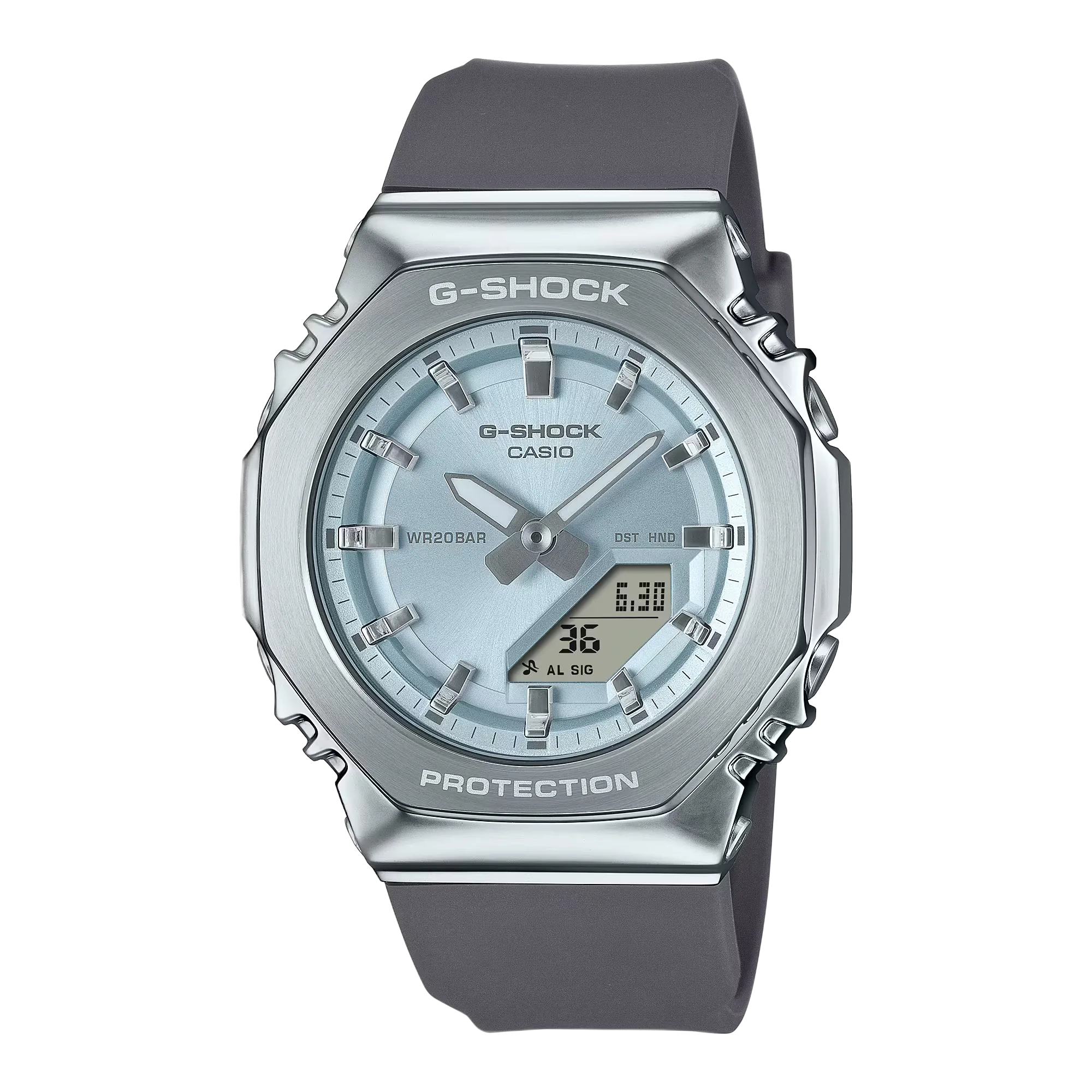
Casio G-SHOCK Decoded: Styles, Features and Wrist Fit
Explore Casio G-SHOCK through its squares, 2100 designs and metal models. Understand the features, wrist fit and trade-offs before choosing yours.
October 2, 2026“CasiOak” is the nickname associated with G-Shock's octagonal 2100 design. It describes a recognisable look, not one fixed set of specifications. Casio itself separates the range into resin, connected resin, metal-covered, connected metal-covered, full-metal and compact branches. That is the useful way to shop it: choose the case size, then the power and adjustment system, then the exterior you actually want. This guide stays inside that family decision. It does not compare squares with CasiOaks or provide a history of every colourway — if you are still deciding what kind of watch to buy at all, our first-watch decision guide is the broader starting point.
Choose GA-2100 for a lightweight, battery-powered resin CasiOak, or GA-B2100 for solar charging and Bluetooth in a similar footprint. Choose GM-2100 for a steel bezel with a resin body and band, or GBM-2100 for that metal-covered format with solar and Bluetooth. A GM-2110D adds a steel bracelet but remains battery-powered and resin-bodied; GM-B2100 is the full-steel case-and-bracelet route. For a smaller case, investigate GMA-S2100, GMA-P2100 and GM-S2110 before buying a standard-size model. Exact references, not just family names, decide the final specifications.
| Watch | Case & band | Power & link | Best for |
|---|---|---|---|
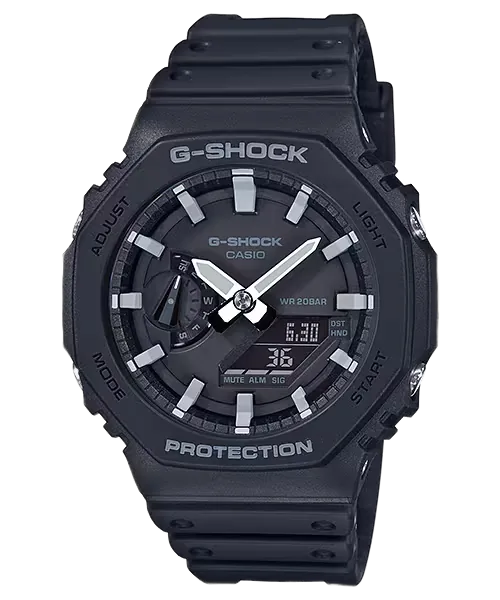
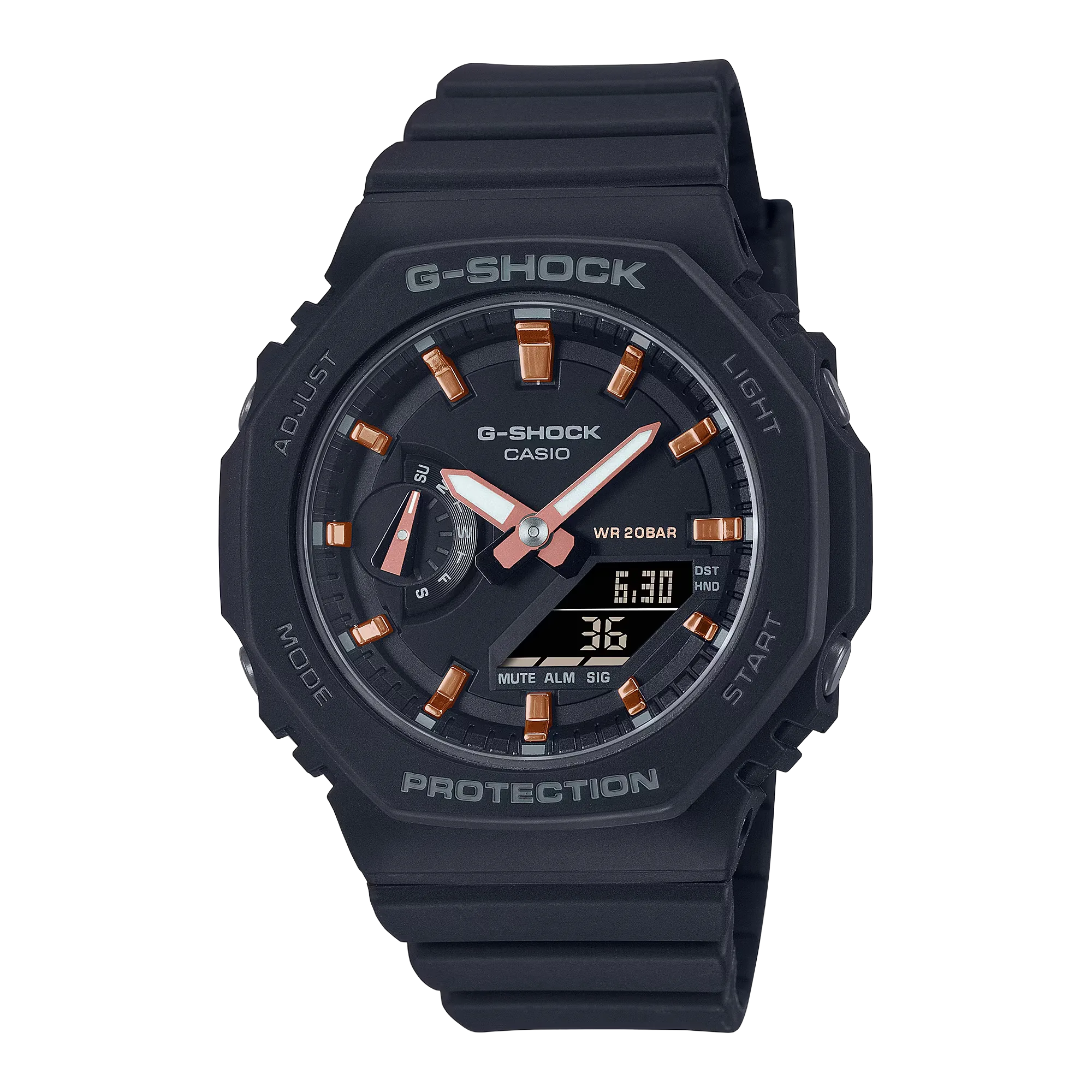
| Casio G-SHOCK GA-2100 | Carbon/resin case, resin band | Battery | Lightweight standard CasiOak |
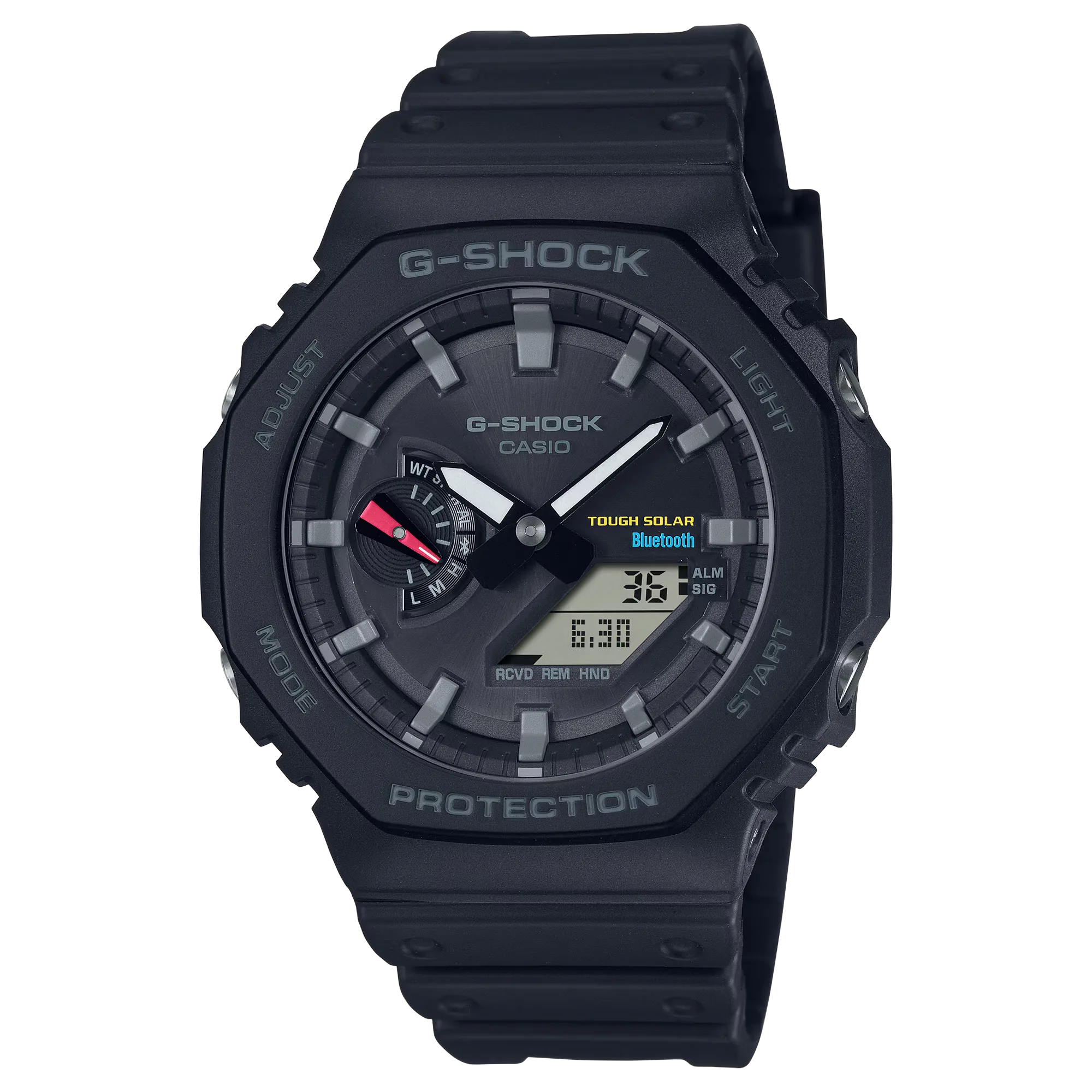
| Casio G-SHOCK GA-B2100 | Carbon/resin case, resin band | Tough Solar + Bluetooth | Connected CasiOak, same footprint |
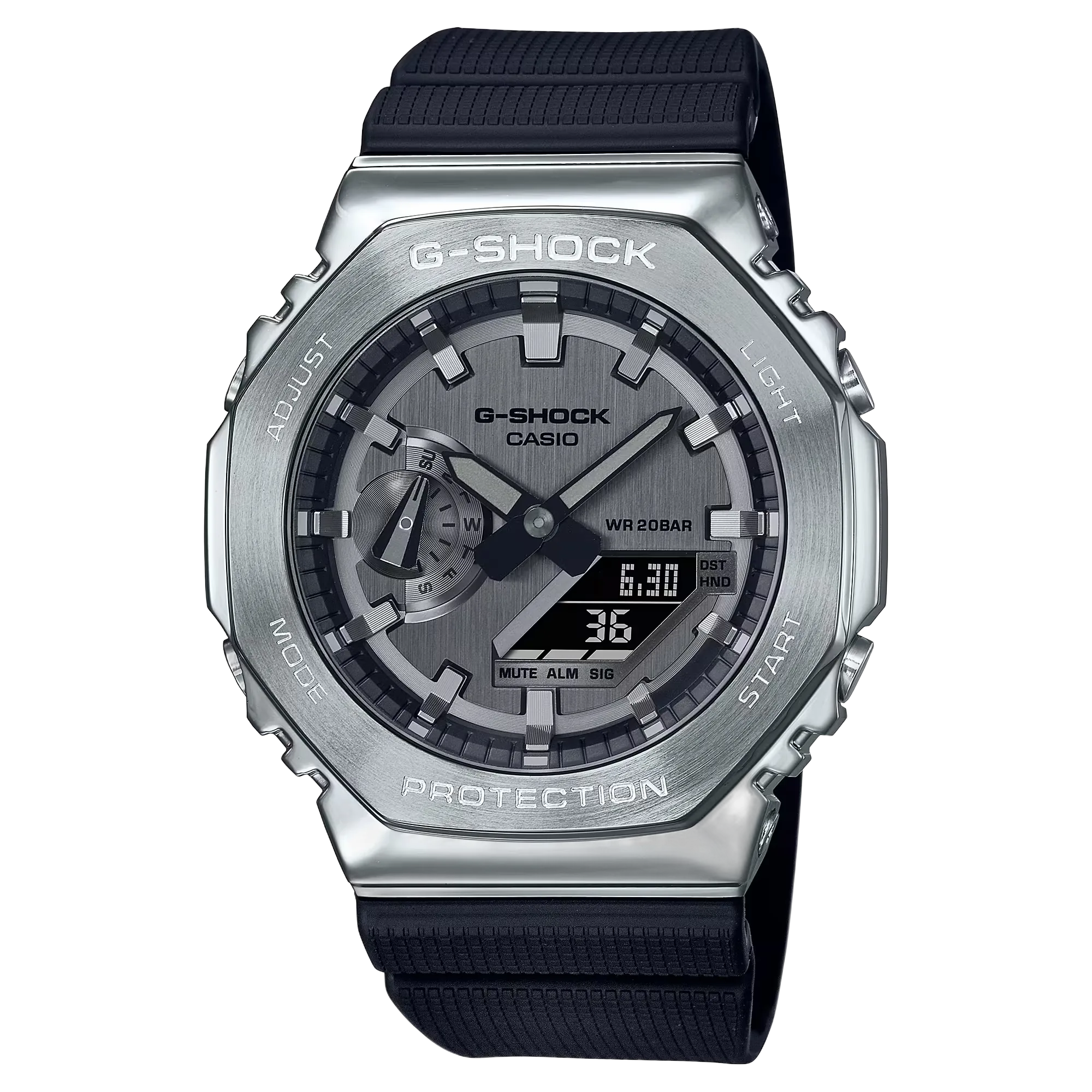
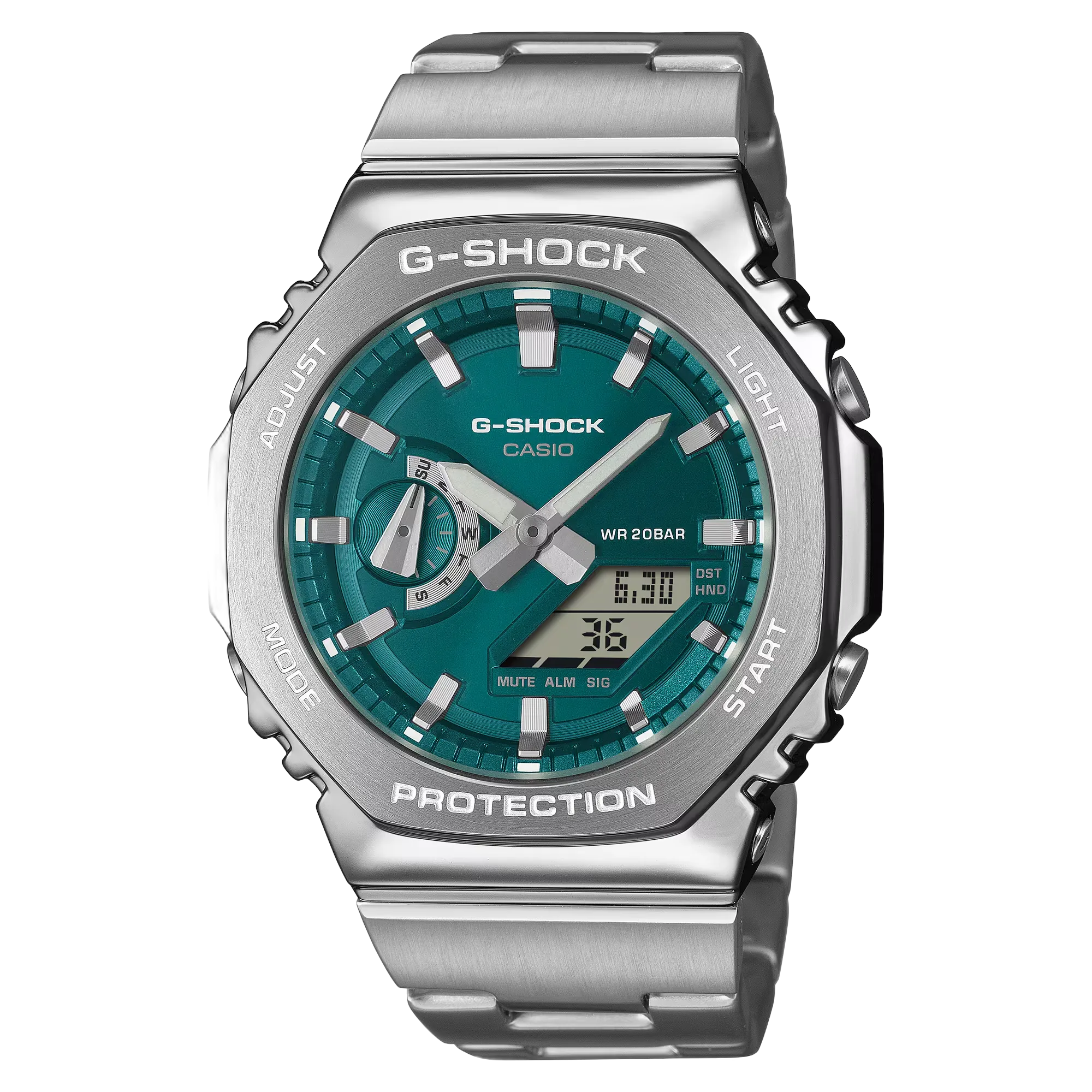
| Casio G-SHOCK GM-2100 | Resin body, steel bezel | Battery | Steel-bezel look, no electronics upgrade |
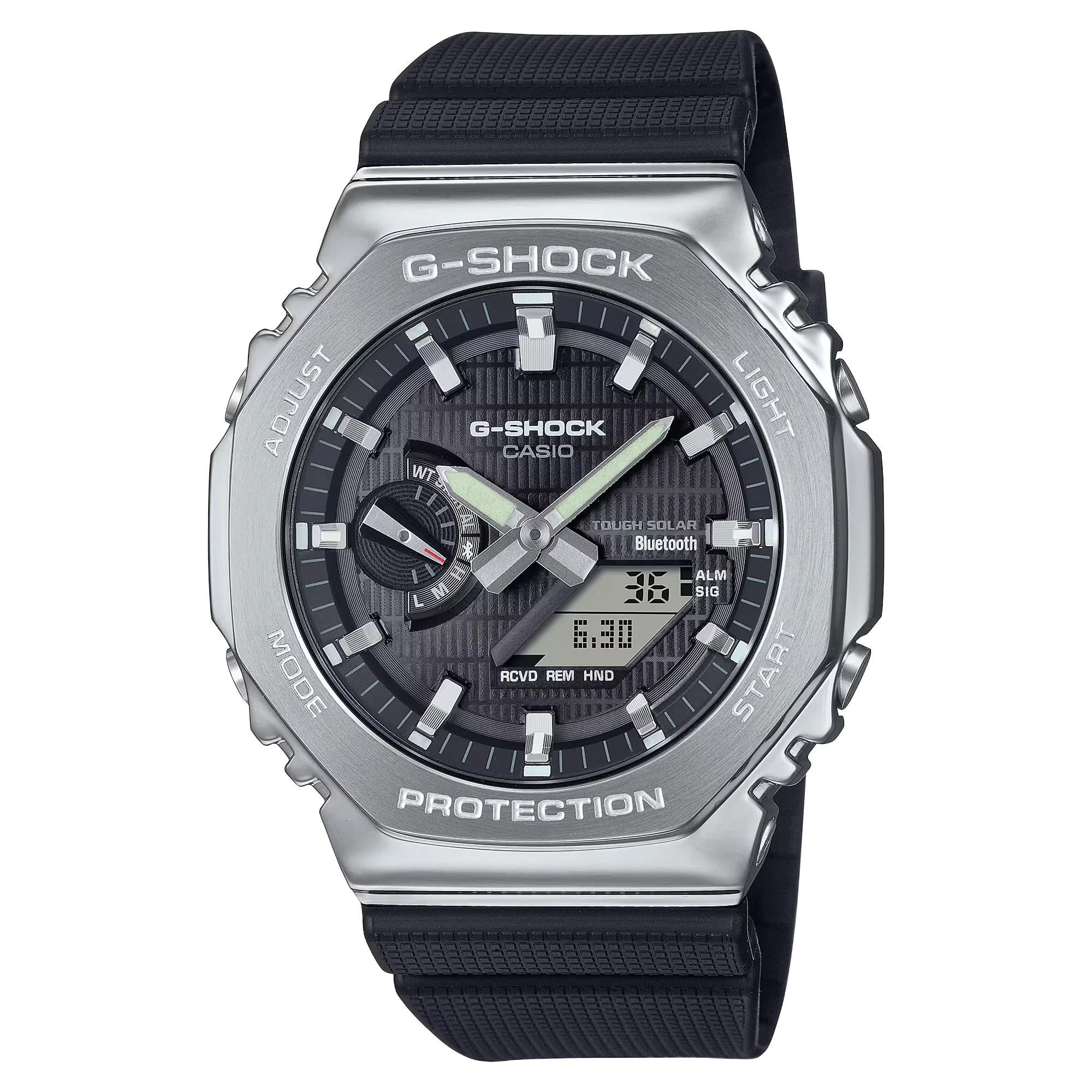
| Casio G-SHOCK GBM-2100 | Resin body, steel bezel | Tough Solar + Bluetooth | Steel-bezel look, connected |
| Casio G-SHOCK GM-2110D | Resin body, steel bezel + bracelet | Battery | Steel bracelet, no solar/Bluetooth |
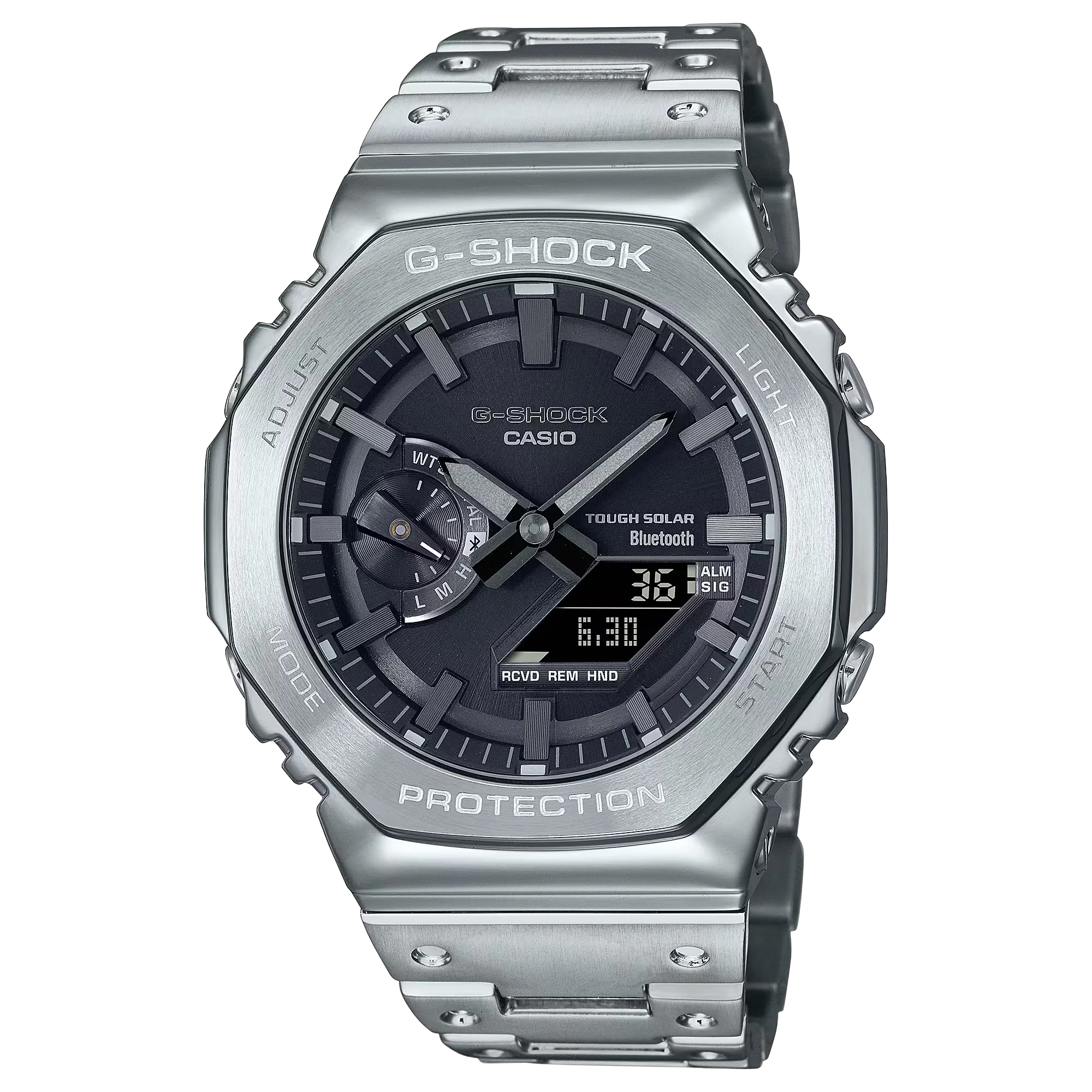
| Casio G-SHOCK GM-B2100D | Full steel case, bezel, bracelet | Tough Solar + Bluetooth | Full-metal CasiOak, connected |
| Casio G-SHOCK GMA-S2100 | Smaller carbon/resin case | Battery | Smaller case, keeps the day sub-dial |
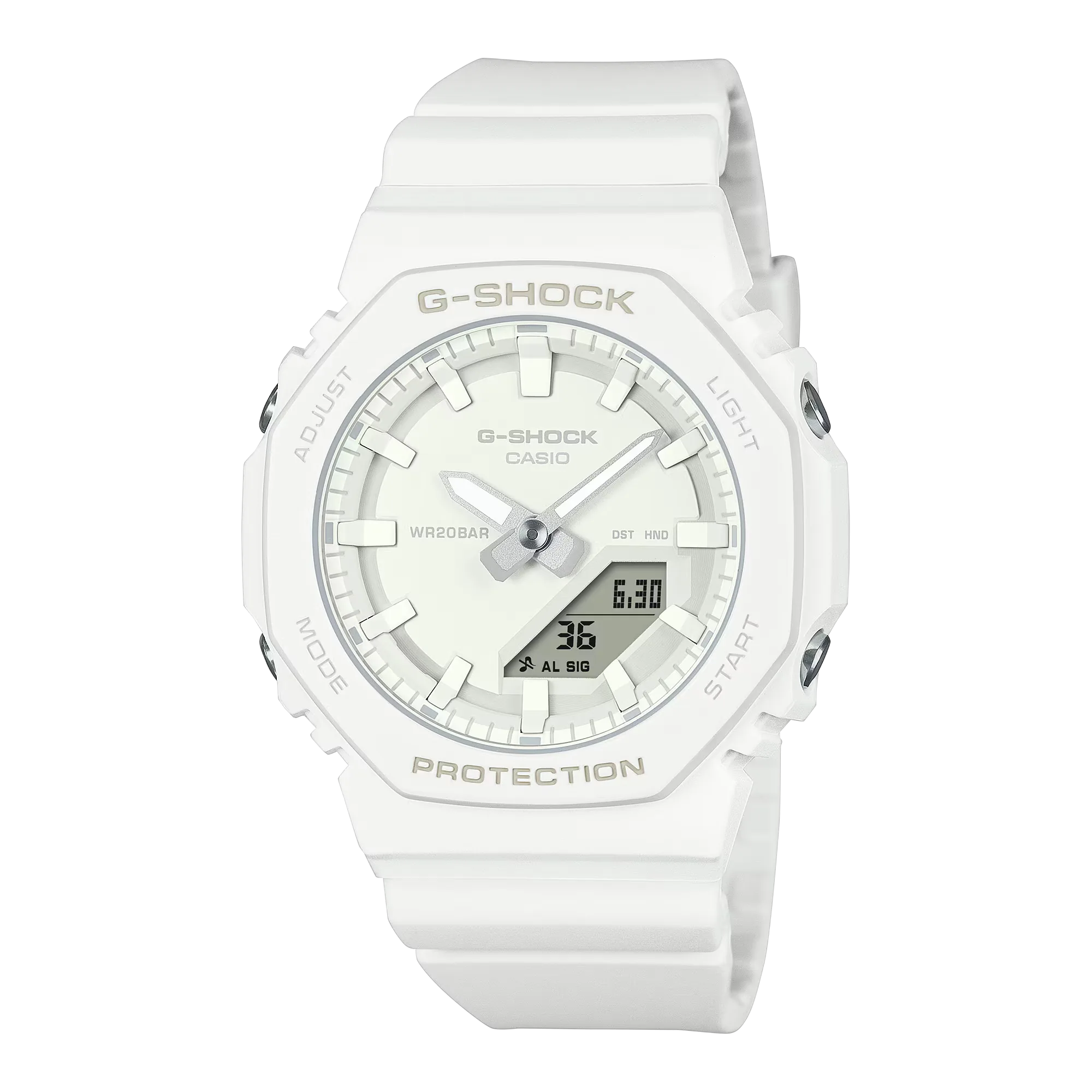
| Casio G-SHOCK GMA-P2100 | Compact resin/bio-based resin case | Battery | Narrowest standard-family case |
| Casio G-SHOCK GM-S2110 | Compact resin body, steel bezel | Battery | Compact steel-bezel alternative |
Start by distinguishing the closely named metal branches. GM-2100 is metal-covered, GBM-2100 is connected metal-covered, and GM-B2100 is full metal. Moving the letters is not a cosmetic change.
The table above uses exact representative configurations to make the branches concrete. Dimensions and detailed specifications discussed below come from Casio's own reference pages. US sellers may format references without hyphens, but the actual reference and supplied configuration still need to match.
These exact representative references all have mineral glass and a manufacturer-rated 200 metres of water resistance. A steel exterior does not automatically add sapphire or a higher water-resistance rating among these selections.
These two references share the same base silhouette and differ only in power source and connectivity.
Best for: Someone who wants the standard CasiOak format and does not need phone-assisted settings or solar charging.
Why it works: The GA-2100-1A measures 48.5 × 45.4 × 11.8 mm and weighs 51 g. Its Carbon Core Guard structure uses carbon-reinforced resin rather than a metal case. Casio estimates approximately three years of battery life from two SR726W cells.
The inset dial shows the day of the week. The separate digital display handles information such as date, seconds and timing modes, and a hand-shift function moves the hands away from that window when needed. Double LED illumination serves the face and digital display.
Watch-outs: Thin is not the same as narrow: this standard case is 45.4 mm wide. Also, a differently coloured GA-2100 can change how the hands, markers and digital window appear. Check the exact dial you plan to buy instead of treating colour as an inconsequential suffix.
Choose it when the conventional-battery approach meets your needs and the standard proportions suit you. You do not need to buy connected functions just to own the CasiOak design.
Best for: Someone who wants solar charging and phone-assisted time adjustment without substantially changing the standard case footprint.
Why it works: The selected GA-B2100 retains the GA-2100's 48.5 mm length and 45.4 mm width, while thickness rises to 11.9 mm and weight to 52 g. Tough Solar and Bluetooth through the CASIO WATCHES app add automatic time adjustment and easier settings.
This is not merely the original dial with two extra labels. Its inset dial indicates battery level and mode rather than being the GA-2100's dedicated day indicator; the digital display can still show the day.
Watch-outs: The countdown range is 60 minutes, versus 24 hours on the GA-2100-1A. If long countdowns matter to you, the connected version is not an upgrade in that particular function.
Choose it as the default standard-resin option when you will actually use solar charging and phone-linked settings. Choose the battery model instead when its functions, dial or price better match your use.
“Metal-covered” and “full metal” describe genuinely different constructions, not marketing tiers of the same thing.
Best for: Someone who wants the octagonal bezel in steel but does not want a steel bracelet.
Why the GM works: The GM-2100-1A has a glass-fibre-reinforced resin inner case and a stainless-steel bezel, with a resin band. Its published dimensions are 49.3 × 44.4 × 11.8 mm and its weight is 72 g. Casio estimates approximately three years on two SR726W batteries.
Why choose the GBM: The GBM-2100-1A adds Tough Solar and Bluetooth in a bio-based resin body/steel bezel configuration, with a bio-based resin band. It measures 49.3 × 44.4 × 11.9 mm, also weighs 72 g, and publishes a 145–215 mm band-compatible range for this exact reference.
Watch-outs: Neither is a stainless-steel case-and-bracelet watch. The GBM also has a 60-minute countdown, versus 24 hours on the selected GM. Do not assume every specification improves when you add solar and Bluetooth.
Choose GM-2100 when the steel bezel and conventional-battery functions are the attraction. Choose GBM-2100 when you want that exterior with connected convenience. The similar names should not decide for you.
Best for: Someone who wants a steel bracelet and needs to decide whether a steel case and solar/connected functions are also part of the purchase.
Why the GM-2110D works: It gives you a steel bezel and stainless-steel bracelet with a one-touch three-fold clasp, but the inner case is glass-fibre-reinforced resin. The exact GM-2110D-3A1 measures 49.3 × 44.4 × 11.8 mm and weighs 146 g. It remains battery-powered, with an approximately three-year estimate on two SR726W cells and a 24-hour countdown range.
Why choose the full-metal GM-B: The GM-B2100D-1A has a stainless-steel case and bezel, a solid steel bracelet, a one-touch three-fold clasp and a screw-lock case back. It adds Tough Solar and Bluetooth, measures 49.8 × 44.4 × 12.8 mm and weighs 165 g.
Watch-outs: The steel bracelet does not make the GM-2110D a full-metal case, and its reference should not be shortened to “GM-B2100.” Conversely, the GM-B2100 is 1.0 mm thicker and 19 g heavier than this GM-2110D, while using a 60-minute countdown rather than the battery model's 24-hour range. Both selected steel-bracelet configurations publish a 150–205 mm compatible band range — a compatibility figure, not a comfort guarantee, so try the exact reference after proper bracelet sizing.
Choose GM-2110D when you primarily want the bracelet and battery-powered feature set. Choose GM-B2100 when you also want the steel case, screw-back construction and connected/solar module. Do not spend for full metal solely because it sits at the top of a ladder.
If the standard footprint looks too large, do not automatically move to a heavier standard metal model. The smaller references change the actual case geometry.
GMA-S2100-1A is the smaller resin option that keeps the separate day-of-week dial: 46.2 × 42.9 × 11.2 mm, at 41 g. GMA-P2100-7A removes that inset dial and measures 46 × 40.2 × 11.2 mm, at 40 g. The P reference is narrower and slightly shorter, but not thinner than the S reference.
Best for: Choose the S route when the day inset dial or its supplied-band fit matters; start with the P route when reducing case width is the main goal.
Watch-outs: The P model's 145–190 mm band-compatible range does not reach a smaller minimum circumference than the S model's 140–205 mm range. Casio describes the P band as shorter, but that does not make its lower adjustment limit smaller. Neither range proves comfort.
For compact steel-bezel styling, GM-S2110-2A is a distinct option: 45.9 × 40.5 × 11 mm and 56 g, with a 145–190 mm band-compatible range. It has a resin body, steel bezel and bio-based resin band, and uses a CR1025 battery with an approximately three-year estimate. It is not a compact GBM with solar and Bluetooth — choose it when the smaller metal-covered format is what you want, and do not mistake its “2110” name for the standard-size, steel-bracelet GM-2110D.
The newer GMA-P2110B-1A is another compact reference worth distinguishing, not assuming equivalent: its closest documented sibling lists 46 × 40.5 × 11.3 mm and 37 g, with the same 145–190 mm band range as the P2100. Its basic case/bezel specification is resin/bio-based resin, despite a decorative metallic bezel ring — it is not the same steel-bezel construction as the GM-S2110. We flag it here rather than feature it as a full pick, since its catalogue record doesn't yet carry clean size data.
For more detailed wrist-fit routing across brands, see our small-wrists collection. Keep this family guide's case comparisons separate from a universal wrist-size verdict.
Related guideWatches for small wrists →
In the connected configurations discussed here, Bluetooth means phone-assisted time adjustment and settings through the CASIO WATCHES app. It is not the same as Multi Band 6 radio reception, which is not listed for these selected analog-digital references. Tough Solar concerns their light-charged power supply, not their case material.
If power source is the main attraction, our solar-watches collection offers a wider route. Within this shortlist, you can get solar and Bluetooth in resin, metal-covered or full-metal configurations without treating those exterior choices as equivalent.
The practical spending rules are clear. Paying for GA-B2100 over GA-2100 buys solar and connected settings without changing the listed length and width. Paying for GBM over GM adds those functions to a steel-bezel/resin-band format. Buying GM-2110D adds a bracelet without necessarily adding those functions. Buying GM-B2100 adds the full-steel case-and-bracelet construction alongside the connected module.
The 2100 name also extends beyond the analog-digital watches covered in the main map. GMC-B2100D-1A is a fully analog chronograph in a steel case; MRG-B2100B-1A is an analog MR-G reference with titanium and Cobarion construction, sapphire, and both radio and Bluetooth adjustment. Neither preserves the analog-digital interface of the mainstream CasiOak picks simply by costing more — they are different interface and materials decisions, not automatic replacements for a GA-B2100, and merit their own comparison rather than padding this guide's shortlist.
Related guideSolar watches buying guide →
Choose the size before the material. Then decide whether solar and phone-linked settings solve an ownership need. Finally, decide how much metal you actually want: bezel only, bezel plus bracelet over a resin body, or steel case and bracelet.
For the standard resin CasiOak, start with GA-B2100-1A if you value connected convenience; choose GA-2100-1A if its battery approach, day dial or longer countdown is preferable. For metal-covered models, compare GM-2100-1A with GBM-2100-1A. For a steel bracelet, compare GM-2110D-3A1 with full-metal GM-B2100D-1A rather than assuming they are the same construction.
If the standard footprint fails the fit check, reopen the compact branch before buying a more elaborate version of the wrong size. Fit can veto the purchase; a longer reference name and a higher price cannot fix it.
Take the seven-question quiz to narrow your watch shortlist by budget, wrist fit, style and the features you will actually use.
“In the 2100 range, a steel bracelet, a steel case and solar power are three different purchases.”
GBM-2100 is metal-covered: the selected GBM-2100-1A combines a bio-based resin body, a steel bezel and a bio-based resin band with solar power and Bluetooth. GM-B2100 is full metal: the selected GM-B2100D-1A has a steel case, bezel and solid bracelet, also with solar and Bluetooth. The letter order identifies materially different constructions.
It is not an equivalent feature-and-construction replacement. GM-2110D-3A1 has a steel bezel and bracelet but a resin inner case and conventional batteries. GM-B2100D-1A has a steel case, a screw-lock back, solar power and Bluetooth. Both can be sensible choices, but judge the cheaper offer against what it actually omits.
No. It adds Tough Solar and Bluetooth, but the selected GA-B2100-1A has a 60-minute countdown range versus 24 hours for the GA-2100-1A. The inset dial also changes from a day indicator to battery-level information. Pick the functions and layout you actually use rather than treating it as universally superior.
Start with GMA-P2100-7A when reducing width is the priority, GMA-S2100-1A when you prefer the separate day dial, or GM-S2110-2A when you want a compact steel bezel. These are all battery-powered; none is a smaller solar/Bluetooth substitute for the GA-B2100. Check the exact reference's band compatibility and try the watch before buying.
No. The mainstream metal-covered and full-steel analog-digital references discussed here use mineral glass, and the connected ones list Bluetooth rather than Multi Band 6. The MRG-B2100B-1A does have sapphire and radio reception, but it is a different, analog MR-G configuration, not a family-wide specification.
Explore Casio G-SHOCK through its squares, 2100 designs and metal models. Understand the features, wrist fit and trade-offs before choosing yours.
October 2, 2026Compare compact G-SHOCKs by case size and band-compatibility range, including the GMA-P2100 and GMA-S2100, with practical advice on strap fit.
October 2, 2026Are G-SHOCK watches worth buying? Compare their durability, fit and features with a basic Casio, and learn which upgrades justify the cost.
October 6, 2026