Junghans Max Bill: Who It Suits, and Who It Doesn't
The Junghans Max Bill offers real Bauhaus lineage and quiet design, but that restraint will not suit every wrist, wardrobe, or idea of a mechanical watch.
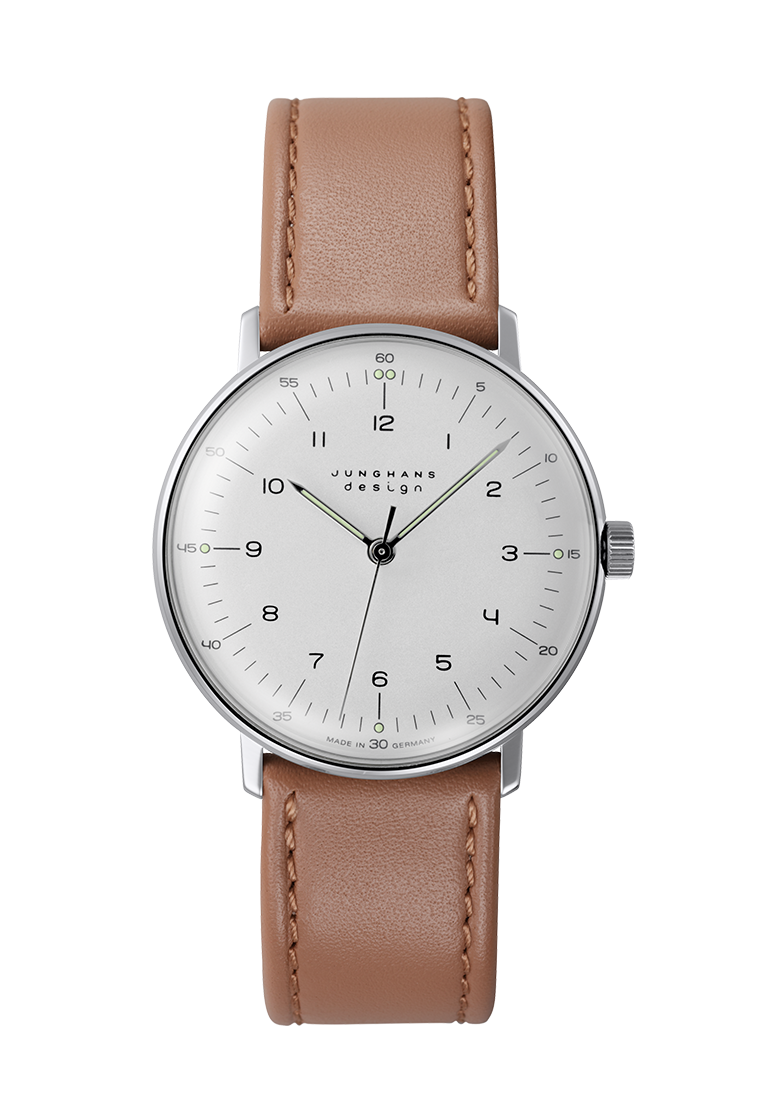
September 4, 2026Max Bill drew the Junghans wristwatch range in 1961, and Junghans still produces it practically unchanged. That continuity is the whole appeal — but it also hides a decision, because the same dial sits on three genuinely different watches. The hand-wound is 34 mm and the closest thing to Bill's original drawing. The automatic is 38 mm and the one most people end up wearing. The quartz is the thinnest and the cheapest to own. Choosing between them changes the case size, the thickness, whether there is a date on the dial, and what you pay.
Buy the 34 mm hand-wound if you want the closest thing to Bill's 1961 design, the 38 mm automatic if you want one watch for every day, and the quartz if you want the dial at the lowest cost of ownership.
| Watch | Case | Thickness | Movement (base) | Power reserve | Crystal | Date | Price (as of 2026) |
|---|---|---|---|---|---|---|---|
| Junghans max bill Handaufzug | 34 mm | 9.0 mm | Manual J805.1 (ETA 2801-2) | 42 h | Plexiglas or sapphire by reference | None | €1,175–1,275 |
| Junghans max bill Automatic | 38 mm | 10 mm | Automatic J800.1 (ETA 2824-2) | 38 h | Plexiglas or sapphire by reference | By reference | €1,445–1,645 |
| Junghans max bill Kleine Automatic | 34 mm | 10 mm | Automatic J800.1 (ETA 2824-2) | 38 h | Sapphire | Yes, at 3 | €1,165–1,475 |
| Junghans max bill Quarz | 38 mm | 7.9 mm | Quartz J645.33 (ETA 955.112) | Battery | Coated plexiglas, sapphire retrofit | Yes | €885–1,085 |
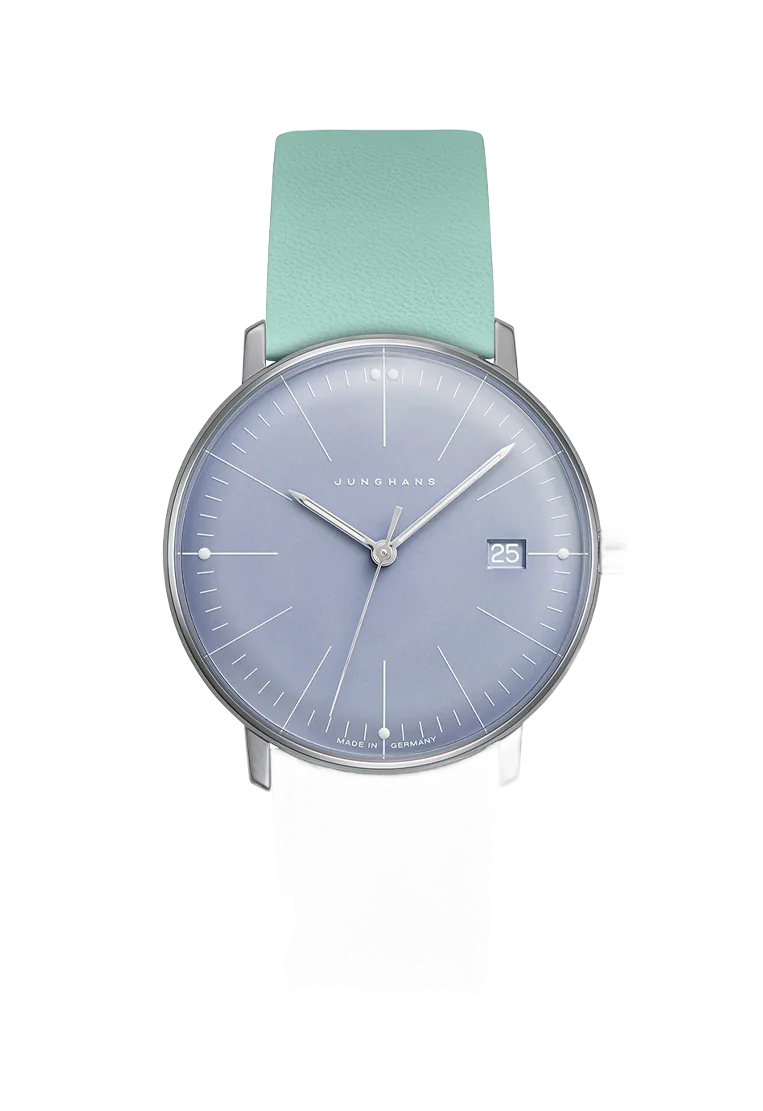
| Junghans max bill Damen | 32.7 mm | 6.9 mm | Quartz J643.29 (ETA 955.412) | Battery | Sapphire | Yes | €825–925 |
The table above reflects the most common configuration of each family, and that qualification matters more here than it does for most collections. Crystal and water resistance on the Max Bill vary by reference, not by movement type — this is where a lot of comparison coverage goes wrong. Entry hand-wound and automatic references use a convex hardened plexiglas with a Sicralan coating, with a sapphire retrofit available; separate sapphire references exist in both families, such as the Handaufzug 027/3702.02 and the automatic 027/4002.46 on a Milanaise bracelet. Water resistance figures differ between Junghans' own listings and dealer listings, so treat any single number as something to confirm against the exact reference before you buy.
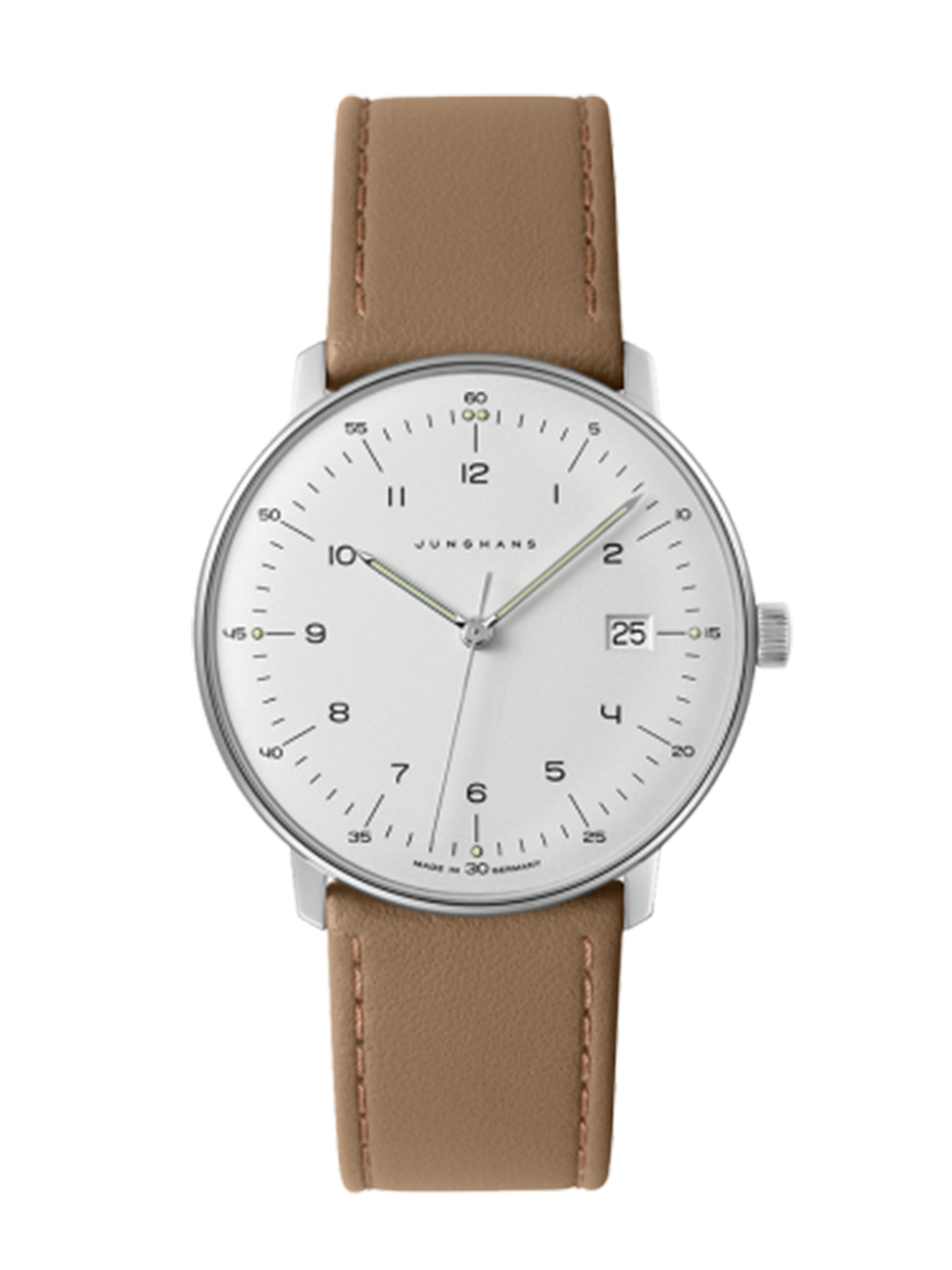
The date follows the same reference-level logic. Hand-wound models are all without a date, which keeps the dial closest to Bill's drawing. Automatics come both with and without a date at three o'clock. The quartz references carry a date, and so does the Kleine Automatic. Think of these as three watch families with real differences inside each one, rather than three versions of a single watch.
Related guideMechanical watches →
The Handaufzug runs the J805.1, built on an ETA 2801-2 with central seconds, 28,800 vibrations per hour, a 42-hour power reserve, Incabloc shock protection and anti-magnetic construction to DIN 8309. The case is 34 mm across and 9 mm thick, with an 18 mm lug width and roughly 37 mm from lug to lug. There is also a small-seconds variant using the J815.1, with the subdial at six and a slower 21,600 vibrations per hour, also with a 42-hour reserve — it is not currently in our catalogue, so check availability and specification with Junghans directly.
The case for it is straightforward. This is the thinnest mechanical Max Bill, the one whose proportions match the 1961 design most closely, and the one whose dial is never interrupted by a date window. Winding it each morning is a small ritual that some buyers want and others find tiresome — be honest with yourself about which you are. The limitation is size: 34 mm reads genuinely small on a wrist above roughly 17 cm, and there is no larger hand-wound option to move up to. If that is a problem, the Kleine Automatic gives you the same 34 mm footprint with automatic winding.
Related guideHand-wound watches →
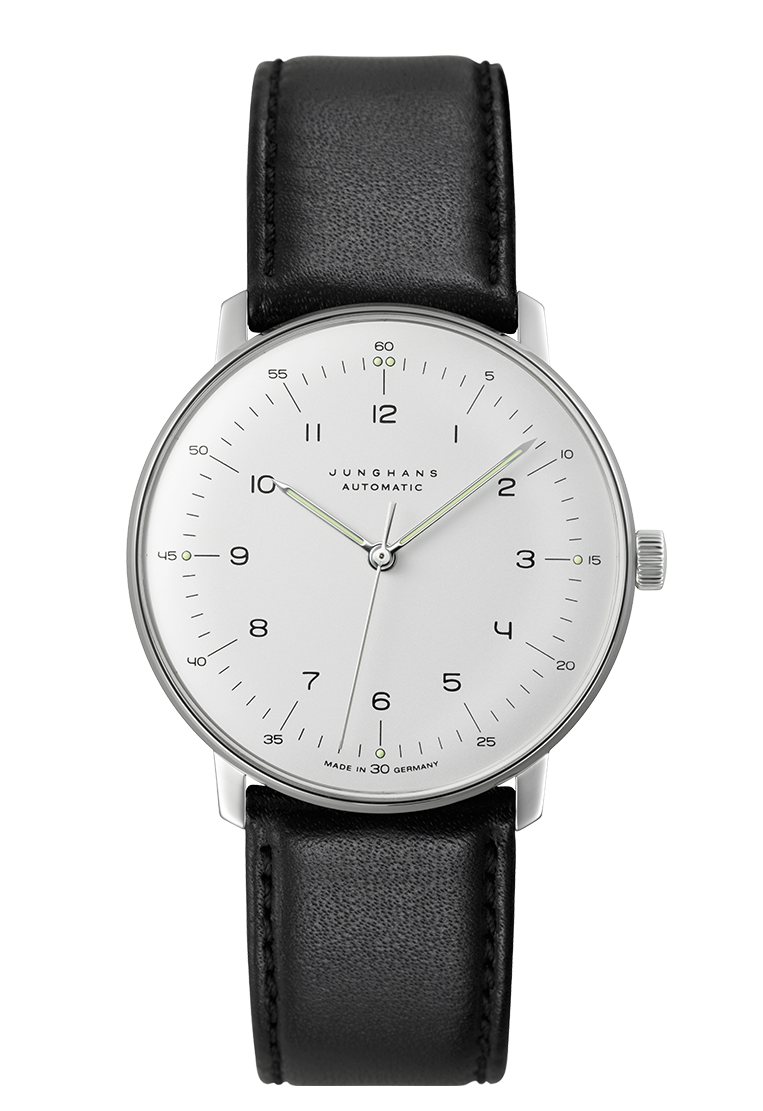
The 38 mm automatic uses the J800.1 — an ETA 2824-2 base with bi-directional winding, 28,800 vibrations per hour, a 38-hour power reserve, Incabloc and DIN 8309 anti-magnetic construction. The case is 10 mm thick with a 20 mm lug width, which gives it noticeably more presence than the hand-wound and makes strap changes easier and cheaper. This is the configuration most buyers choose, and for a single watch worn most days it is the sensible default.
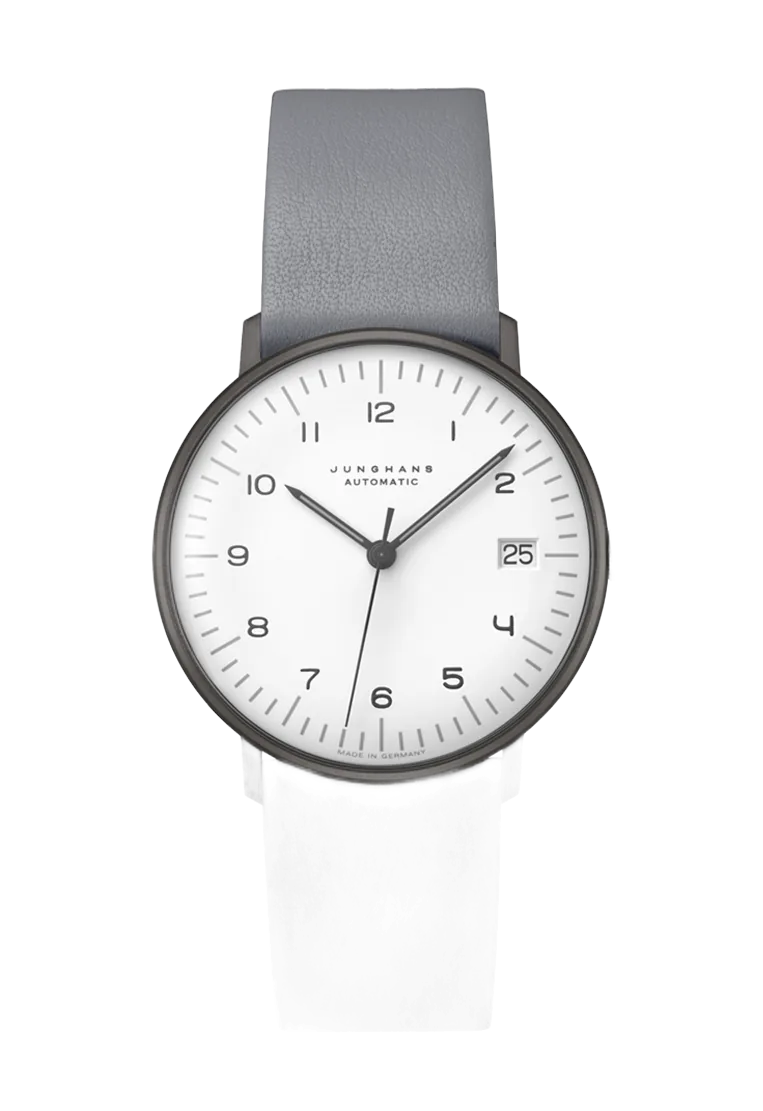
There is also the Kleine Automatic: the same J800.1 in a 34 mm case, with sapphire and a date at three. It exists for buyers who want the original's proportions without the winding commitment, and it is the quiet answer to a question a lot of people arrive with. The trade-off across the automatic family is that these are the thickest Max Bills at 10 mm, they have the shortest running time of the mechanical options at 38 hours, and on dated references the window at three is the least Bauhaus element anywhere on the dial. If the purity of the design is what drew you in, look at a no-date reference before you settle.
The 38 mm quartz runs the J645.33, based on the ETA 955.112, in a case just 7.9 mm thick and roughly 40 mm lug to lug. Most references use the convex coated plexiglas with a sapphire retrofit available. There is also a 32.7 mm Damen model with the J643.29, on an ETA 955.412 base, 6.9 mm thick and fitted with sapphire, offered across a wide spread of references including quick-release straps. On the wrist, these are the flattest Max Bills by some margin, and they slide under a cuff in a way the automatic never quite manages.
The fair criticism is that the Max Bill's appeal is bound up with mechanical-watch romanticism, and the quartz is the version most enthusiasts would not call the real one. That is a genuine position, not snobbery, and it is worth naming rather than talking around. But it is not the only way to buy a watch. If what you want is Bill's dial on your wrist, worn without thought, reset by nobody and accurate without attention, the quartz delivers exactly that for several hundred euros less than the mechanical versions. For a wearer who wants the design at the lowest cost of ownership, it is a legitimate choice — and the thinness is a real advantage, not a consolation.
Related guideWatches under $1,000 →
If you came to the Max Bill for its Bauhaus lineage and you lean vintage, buy the 34 mm hand-wound. It is the closest to what Bill drew, the dial is undisturbed by a date, and the winding is part of what you are buying rather than a chore attached to it. The only thing that should stop you is wrist size — and if it does, the Kleine Automatic wins over the 38 mm automatic, because it keeps the original proportions and removes the daily wind.
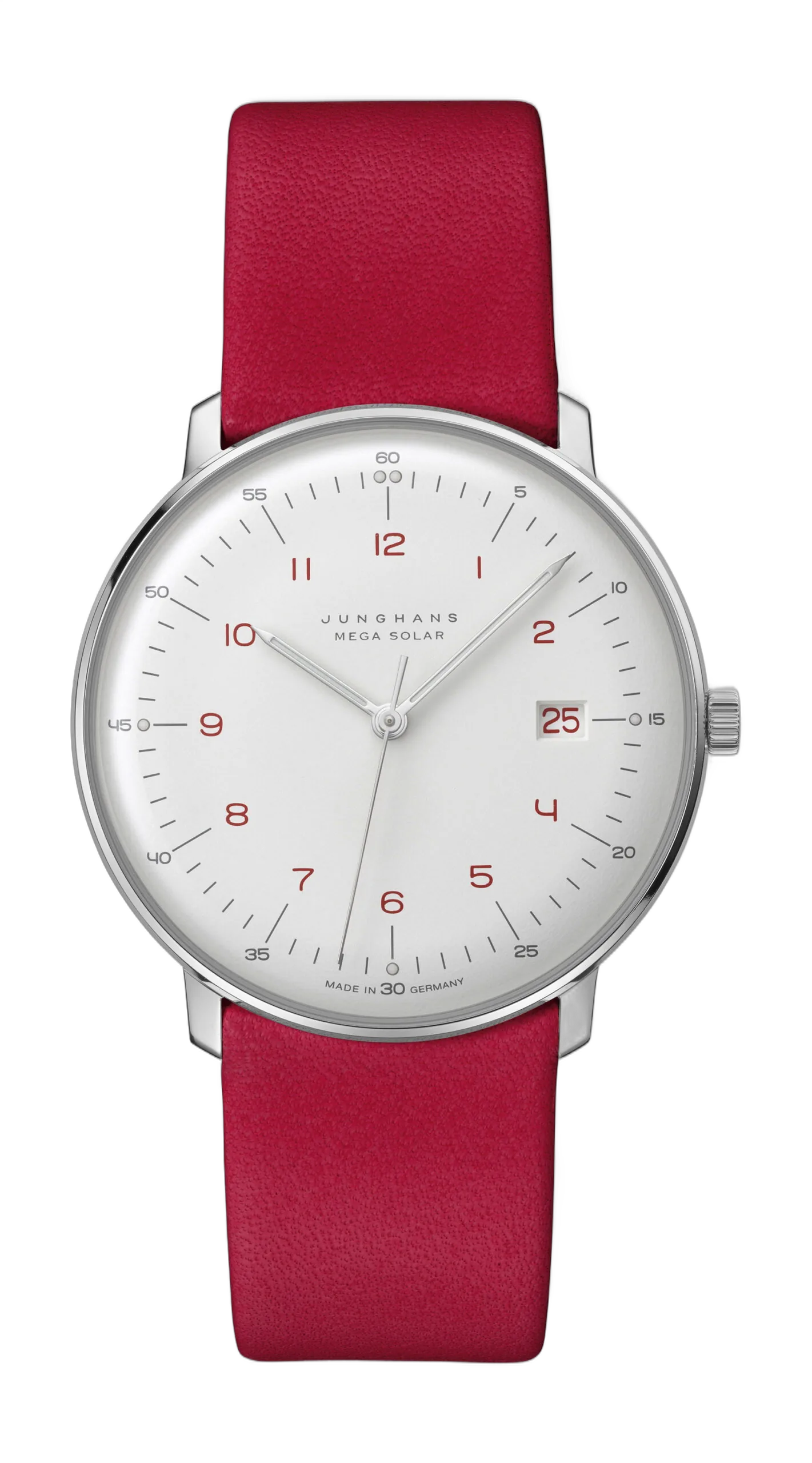
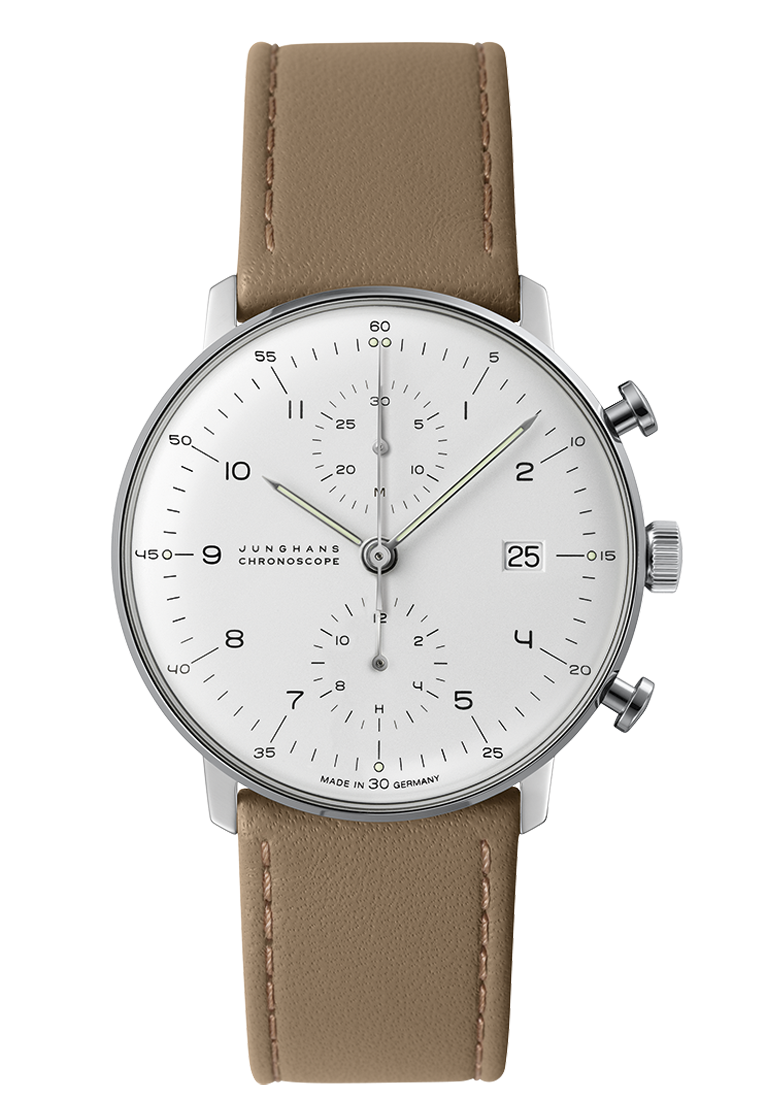
If this is going to be your one watch, worn most days across work and weekends, buy the 38 mm automatic — preferably a reference without the date if the dial's purity is part of the draw. And if you want the look with the least fuss and the smallest outlay, buy the quartz without apology. Two adjacent options are worth knowing about without derailing the three-way decision. The Max Bill MEGA Solar, in a 38 mm titanium case on the radio-controlled solar calibre J101.85, is the answer for anyone whose real priority is accuracy; note that the closely-named max bill MEGA on the J101.65 is a different, steel-cased watch. The Chronoscope, at 40 mm on the J880.2 with a Valjoux 7750 base and a 48-hour reserve, is the one to look at if you actually want a chronograph.
Over five years the three diverge less than people expect. The quartz needs batteries and, eventually, a movement replacement rather than a service — cheap each time, but it is a replacement rather than a repair. The mechanical versions need servicing at intervals, and the hand-wound is the simpler and less costly of the two to work on, having no automatic winding module. We will not quote service prices here, because they vary by market and workshop and any figure we invented would be worse than none — ask an authorised service centre for a current quote. On value, be realistic: all three depreciate, and the hand-wound and automatic hold their position in the second-hand market better than the quartz does.
Not sure which size and movement combination actually suits how you wear a watch? Take the seven-question quiz and see which Max Bill configuration comes back.
“The dial is the constant. Size, thickness, date and price are all variables.”
Yes, if you are buying the design rather than the mechanics. It is the thinnest Max Bill at 7.9 mm in the 38 mm case, the cheapest to buy and the cheapest to run, and the dial is the same one that makes the mechanical versions worth owning. What you give up is the connection to mechanical watchmaking that much of the collection's appeal rests on, and a slightly weaker second-hand position.
The J805.1 is the hand-wound movement, built on an ETA 2801-2, with central seconds, 28,800 vibrations per hour and a 42-hour power reserve. The J800.1 is the automatic, built on an ETA 2824-2 with bi-directional winding, the same 28,800 vibrations per hour but a shorter 38-hour reserve. Both use Incabloc shock protection and are built to DIN 8309 for anti-magnetism. The J805.1 appears only in the 34 mm case; the J800.1 appears in both the 38 mm automatic and the 34 mm Kleine Automatic.
Both, depending on the reference rather than the movement. Entry hand-wound and automatic references use a convex hardened plexiglas with a Sicralan coating, and Junghans offers a sapphire retrofit. Separate sapphire references exist in both families — the Handaufzug 027/3702.02 and the automatic 027/4002.46 among them — and the Damen quartz uses sapphire. Because this varies reference by reference, confirm the crystal on the exact reference you are buying rather than on the model family.
It depends on the wrist and on what you want the watch to say. At 34 mm across, 9 mm thick and roughly 37 mm lug to lug, the hand-wound Max Bill sits small and flat, which is period-correct for a 1961 design rather than a compromise. On a wrist above roughly 17 cm it will read as deliberately small — some buyers want exactly that, others will find the 38 mm automatic sits better. If you are unsure, the 38 mm is the safer first Max Bill.
Not in the standard range covered here. The J805.1, J800.1 and the quartz calibres are reliable ETA-based movements, but none of the references in this comparison carries COSC certification, and Junghans does not market them on chronometric performance. If accuracy is the thing you actually care about, the radio-controlled solar MEGA is the better answer within the collection than any of the mechanical options.
The Junghans Max Bill offers real Bauhaus lineage and quiet design, but that restraint will not suit every wrist, wardrobe, or idea of a mechanical watch.
September 4, 2026